
 Products
 Bars
Bars
 Beads & Spheres
 Bolts & Nuts
 Crucibles
 Discs
Discs
 Fibers & Fabrics
 Films
Films
 Flake
Flake
 Foams
Foams
 Foil
Foil
 Granules
 Honeycombs
 Ink
Ink
 Laminate
 Lumps
Lumps
 Meshes
 Metallised Film
 Plate
Plate
 Powders
 Rod
Rod
 Single Crystals
 Sputtering Target
 Tubes
Tubes
 Washer
 Wires
Wires
 Converters & Calculators
 Write for Us



ASTM E1269: Measuring Heat Capacity in Metals and Ceramics

Introduction
Heat capacity is among the fundamental thermophysical properties, which is measured in terms of the amount of heat a material will absorb for every unit rise in temperature. Heat capacity turns into an engineering, materials science, and industrial research requirement to design a component that must withstand temperature fluctuations, optimize energy efficiency, or be trustworthy under temperature stress.
ASTM E1269 is the ASTM International standard test method for the determination of the specific heat capacity of solid materials like ceramics and metals. The standard provides a reproducible, consistent method for measuring heat capacity by differential scanning calorimetry (DSC), which gives consistency across the laboratory and industry.
What Is Heat Capacity and Why Is It Significant
Heat capacity (C) is given as:
C = Q/Delta T
where (Q) is the heat added and (Delta T) is the temperature change generated. Specific heat capacity ((C_p)), heat capacity per unit mass, is utilized in engineering to compare materials. Heat capacity affects:
•Thermal Management: In electronics, metals like copper (C = 0.385 J/g·K) are utilized as heat sinks because they conduct and hold heat effectively.
• Energy Storage: Ceramic materials such as alumina (C = 0.9 J/g·K) are used in thermal barrier coatings and insulation at high temperatures due to their thermal stability and high heat capacity.
• Safety and Durability: Stable and predictable heat capacities of materials reduce the danger of thermal shock in engines, turbines, and industrial furnaces.
ASTM E1269 Test Method
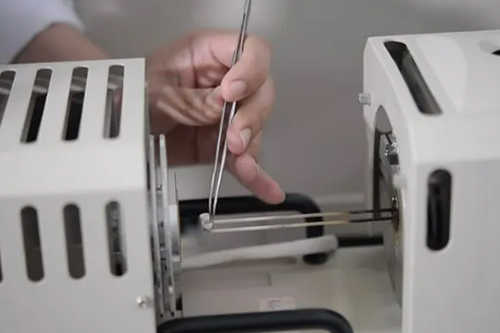
ASTM E1269 details the use of differential scanning calorimetry (DSC) for measuring composite, ceramic, and metal heat capacity. It entails comparison of a reference and sample heat flow while ramping temperature over a range. ASTM E1269 Testing procedures involved:
1. Sample Preparation: Homogeneous metal samples (titanium alloys, stainless steel, etc.) or ceramic samples (alumina, zirconia, etc.) are cut into a defined size. Sample weights vary between 5 mg and 50 mg for DSC analysis.
2. Reference Material: A reference material, typically sapphire in the case of metals, is used to calibrate the equipment and obtain accurate measurement.
3. Heating Protocol: The sample is heated at a controlled rate (generally 10 K/min) and the energy required to raise its temperature is recorded.
4. Data Analysis: Heat flow curves are used to calculate specific heat capacity after correcting for baselines, thermal lag, and heat loss.
Case Study: Titanium Alloy and Alumina
Consider a titanium alloy (Ti-6Al-4V) and an alumina ceramic (Al₂O₃). Using ASTM E1269:
• Titanium Alloy:
Temperature range: 25°C–600°C
Measured (C_p): 0.56–0.63 J/g·K (slightly increases with rising temperature)
Application Insight: Moderate specific heat coupled with high thermal conductivity renders Ti-6Al-4V particularly suitable for aerospace applications with high thermal cycling.
•Alumina Ceramic:
Temperature range: 25°C–1000°C
Measured (C_p): 0.88–0.95 J/g·K
Application Insight: Stability at very high as well as very low temperatures and high specific heat capacity render alumina very suitable for the thermal insulation of energy systems and furnace linings.
Such measurements enable engineers to anticipate temperature increases, develop thermal control systems, and rank materials based on objective assessment, aiding in material selection for aerospace, automotive, and power applications.
Factors Influencing Heat Capacity Measurements
Despite the availability of standard techniques, accuracy in measurements is affected by the following factors:
• Sample Homogeneity: Defects or non-homogeneous microstructure may distort measurements.
• Heating Rate: Too high a heating rate can lead to thermal lag; too low a rate can permit heat losses to influence measurements.
• Calibration accuracy: Reference materials must be well calibrated.
• Material Type: Thermally conductive metals equilibrate quickly, but ceramics may require slower ramp rates for quality data.
Applications of ASTM E1269
1. Aerospace: The selection of heat-resistant alloys for turbine blades, engine components, and spacecraft heat shields.
2.Electronics: Thermo-testing of metals and ceramics for thermal management in chips, heat sinks, and power modules.
3.Energy & Manufacturing: Thermal barrier coating and lining design for industrial furnaces.
4. Material Development: Comparative experimental testing of alloys or ceramic composites for optimizing thermal performance.
An example is a nickel superalloy with (C_p = approximately 0.45–0.50 J/g·K) that can be experimentally screened to absorb enough heat without expanding excessively, thereby minimizing stress on turbine blades. Similarly, zirconia ceramics filtered for (C_p =~ 0.82 J/g·K) direct the creation of high-temperature insulating coatings for solid oxide fuel cells.
Frequently Asked Questions
What is ASTM E1269 used for?
It standardizes the heat capacity measurement in metals, ceramics, and composites using DSC.
Why is heat capacity important in materials?
It determines the heat-holding capacity of a material that influences thermal management, energy efficiency, and durability.
Can ASTM E1269 handle high temperatures?
Yes. Metal measurement is typically up to 600–700°C, but ceramics can be measured over 1000°C, depending on instrument capability.
Does sample size have an impact?
Yes. Extremely small or uneven samples can lead to errors, and therefore ASTM E1269 recommends sample geometry and mass.
How does the standard serve the industry?
It provides reproducible, consistent data that facilitate material selection, thermal design, and quality control in a broad spectrum of industries.
Conclusion
ASTM E1269 is a materials science standard that has standardized test methods for the accurate measurement of heat capacity in metals and ceramics. It has broad application in aerospace, electronics, energy, and research and provides engineers and scientists with the data they need to predict thermal behavior, select materials, and design effective, safe systems.
Compliance with ASTM E1269 allows laboratories anywhere in the world to produce consistent, comparable heat capacity data that fuel both fundamental research and industrial progress.

 Chin Trento