Products
 Bars
Bars
 Beads & Spheres
 Bolts & Nuts
 Crucibles
 Discs
Discs
 Fibers & Fabrics
 Films
Films
 Flake
Flake
 Foams
Foams
 Foil
Foil
 Granules
 Honeycombs
 Ink
Ink
 Laminate
 Lumps
Lumps
 Meshes
 Metallised Film
 Plate
Plate
 Powders
 Rod
Rod
 Single Crystals
 Sputtering Target
 Tubes
Tubes
 Washer
 Wires
Wires
 Converters & Calculators
 Write for Us



The Substances With the Highest Melting Point

Back in 1930, a group of researchers proposed that a tantalum-hafnium-carbon alloy had the highest melting point ever recorded — about 4215°C. Later, another team verified that finding. But here's what still confuses me when I look at the literature today: many sources still claim that tantalum carbide holds the title, and the actual numbers for these compounds vary wildly from one paper to another.
Why Do Different Sources Disagree?
One group of researchers (Andrievskii's team) argued that the high melting point of the Ta-Hf-C alloy comes from a change in chemical composition during experiments. In their view, hafnium mainly encourages carbon to evaporate, which shifts the material's composition closer to that of tantalum carbide. They also pointed out that tantalum carbide's own high melting point comes from its unusually stable metallic sublattice structure.
Another team (Lavrentyev and colleagues) had a different take. They believed the high melting point comes from strengthened chemical bonding between hafnium carbide (HfC) and tantalum carbide (TaC) when they're combined. Other researchers — for example, Osama's group — later supported this explanation, adding that HfC and TaC form a uniform, single-phase cubic crystal structure, which improves overall structural stability.
So who's right? In my opinion, the real reason we still see conflicting numbers is probably much simpler: when you try to measure melting points at temperatures this extreme, the material's composition and structure inevitably change during the experiment. Add to that the general lack of direct, repeatable measurements, and it's no wonder the numbers don't line up.
What Actually Has The Highest Melting Point?
Let me give you a clear answer.
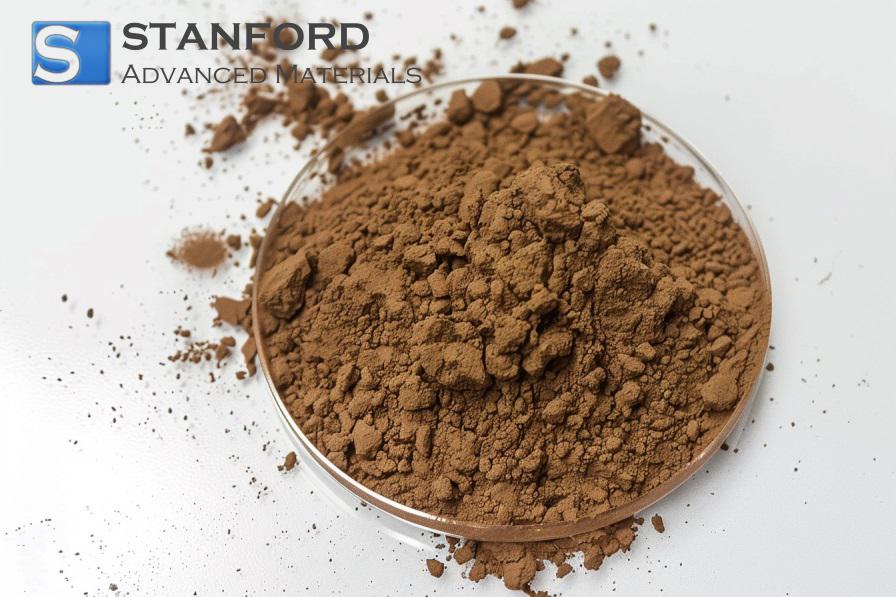
The compound with the highest experimentally confirmed melting point is Ta4HfC5 (pentatantalum hafnium pentacarbide) , at approximately 4215°C. A 2025 study described it as "one of the few materials with a melting point above 4000 K" — a threshold that very few substances cross.
Here's how the numbers compare:
| Material | Melting Point |
|---|---|
| Ta4HfC5 | ~4215°C (experimentally confirmed) |
| TaC (tantalum carbide) | ~3983°C |
| HfC (hafnium carbide) | ~3928–3958°C |
| WRO-3 (W42Re30Os28) | ~3244°C |
If we look only at simple two-element compounds, tantalum carbide takes the lead at 3983°C, followed closely by hafnium carbide. But overall, the Ta-Hf-C alloys remain the highest among all known compounds.
I also noticed something interesting: the Encyclopaedia Britannica once stated flatly that Ta-Hf-C alloys have the highest melting point. Later editions changed the wording to "one of the substances with the highest melting point" — a small but important shift that tells you how careful scientists have become on this question.
What's New in 2025–2026?
The field hasn't stood still. Here are two important developments that have emerged since my last update.
A Theoretical New Record: 4431 K
In 2025, a research team published a study using machine learning to simulate melting points in the Hf-Ta-C-N system. Their prediction? A carbonitride compound — Hf0。956Ta0.044C0.600N0.338 — with a melting point of 4431 K (about 4158°C).
A few important caveats: this is a computational prediction, not an experimental measurement. The team used advanced machine learning potentials and a novel "critical equilibrium method" to simulate phase diagrams. While their model successfully reproduced the known melting points of HfC and TaC, the 4431 K record still needs to be verified in the lab. If confirmed, it would edge out Ta4HfC5 as the new champion.
A Different Kind of Champion: W-Re-Os Alloys
Here's where things get really interesting. In 2026, a team reported a completely new class of ultra-high temperature alloys based on tungsten (W), rhenium (Re), and osmium (Os) — three metals that each melt above 3000°C.
Using a high-throughput "combinatorial additive manufacturing" approach, the researchers printed nearly 500 different compositions in a single run. The winner? W42Re30Os28 (also called WRO-3).
Why does this matter? Its melting point (~3244°C) is lower than Ta4HfC5, but its mechanical performance at extreme temperatures is unprecedented:
| Temperature | Yield Strength |
|---|---|
| Room temperature | 1.83 GPa (with ~9% plasticity) |
| 1400°C | 1.38 GPa (about 78% retention) |
To put this in perspective: most nickel-based superalloys soften rapidly above 1000°C. WRO-3 maintains nearly 80% of its room-temperature strength at 1400°C — and does so while remaining ductile, not brittle like most ceramics.
As one of the researchers put it: "This alloy achieves about 1.8 gigapascals at room temperature, while still sustaining roughly 1.4 gigapascals at 1400°C" — performance that puts it in a class beyond conventional superalloys.
What Does This Mean for Engineers?
This is where I get to the practical point I care about most.
If you're designing for the highest possible melting point alone, Ta4HfC5 remains the gold standard. That's why I'm seeing it actively used in laser additive manufacturing research — a 2025 study successfully fabricated Ta4HfC5 components with 98.3% density, reporting excellent oxidation resistance up to 787°C onset temperature.
But if you need a material that can actually be shaped, machined, and operated at ultra-high temperatures without shattering? That's where the new W-Re-Os alloys shine. Their dual-phase microstructure enables deformation mechanisms that ceramics simply cannot offer.
References
The following sources informed this article. Complete citations are available upon request.
-
Agte, Alterthum, et al. (1930) — Early proposal of Ta-Hf-C high melting point
-
Andrievskii et al. — Experimental verification and stoichiometry explanation
-
Lavrentyev et al. — Chemical bonding explanation for Ta-Hf-C solid solution
-
Osama et al. — Single-phase cubic crystal structure confirmation
-
Journal of Manufacturing Processes (2025) — Laser additive manufacturing of Ta₄HfC₅
-
Journal of the American Ceramic Society (2025) — Machine learning prediction of Hf-Ta-C-N carbonitride (4431 K)
-
Nature Communications (2026) — W-Re-Os multi-principal element alloys (WRO-3)
-
Encyclopaedia Britannica — Historical entries on highest melting point substances
 Chin Trento