
 Products
 Bars
Bars
 Beads & Spheres
 Bolts & Nuts
 Crucibles
 Discs
Discs
 Fibers & Fabrics
 Films
Films
 Flake
Flake
 Foams
Foams
 Foil
Foil
 Granules
 Honeycombs
 Ink
Ink
 Laminate
 Lumps
Lumps
 Meshes
 Metallised Film
 Plate
Plate
 Powders
 Rod
Rod
 Single Crystals
 Sputtering Target
 Tubes
Tubes
 Washer
 Wires
Wires
 Converters & Calculators
 Write for Us



Manganese: Element Properties and Uses

Manganese is an essential chemical element used widely across industries, from steel production and battery manufacturing to chemical processing. It also has a significant impact on human health. Its versatility makes it one of the most important elements in various industrial and biological processes.
Introduction to Manganese
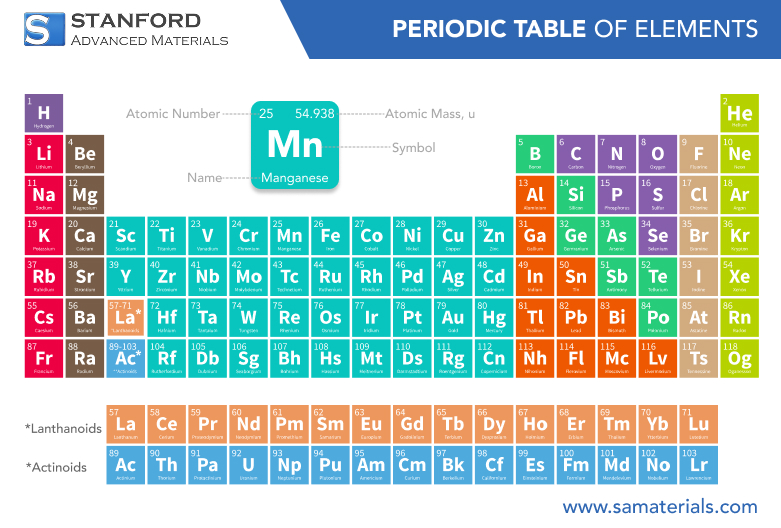
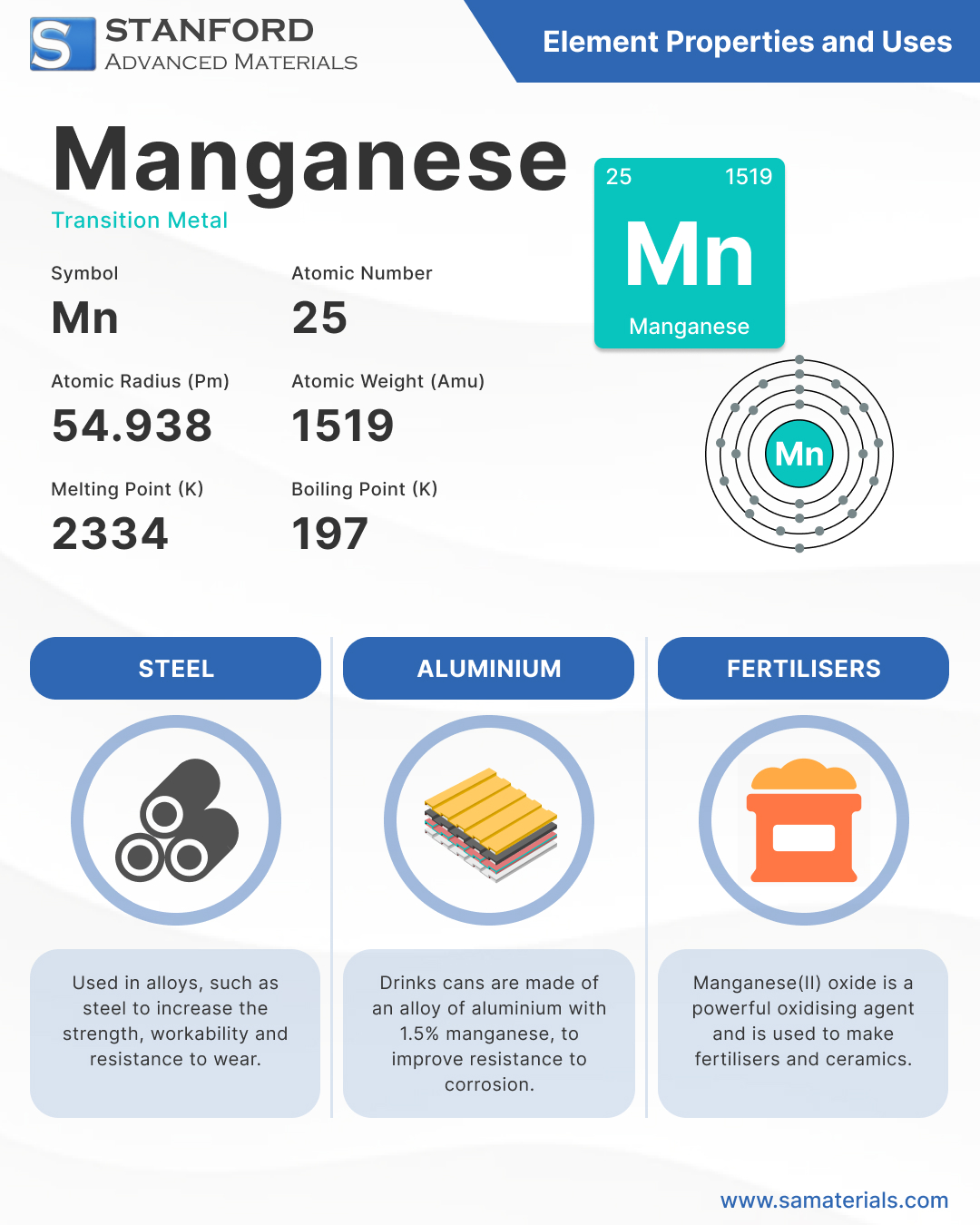
Manganese is an important transition metal of the periodic table, with the atomic number 25 and symbol Mn. It is one of the most common elements in nature, which may be found in a free state in pyrolusite and rhodochrosite ores. Despite the relative abundance of manganese, it is hardly ever found in its pure state and is usually combined with other minerals. This is actually where manganese finds the greatest employment-as an alloying agent to increase hardness, strength, and resistance of steel to corrosion. It's a trace element necessary for higher organisms, including humans, due to its role in many metabolic processes.
Manganese is widely utilized in different industries, but it plays a more vital role beyond the limits of industries and manufacturing processes—within the biological functions of the human body. From batteries to bone and brain health, manganese is just indispensable.
Chemical Properties
Manganese is a highly reactive metal, especially when it comes into contact with air and moisture. The reactivity of the metal is due to its unique property to have multiple oxidation states, ranging from +2 to +7, with the most common oxidation states being +2 and +4.
This property of having multiple oxidation states makes it an essential metal to use as a catalyst during various chemical reactions. For instance, it is regularly used as a catalyst in various industrial reactions because of its property to change its oxidation states.
Of the most prominent characteristics of manganese is that it is able to form manganese oxides, which are widely applied in pigment production and catalysis. By reacting manganese with chlorine, manganese chloride (MnCl₂) is formed; this is widely applied in various chemical reactions. Manganese is highly soluble in acids, and hydrochloric acid is most favored; thus, manganese salts such as manganese sulfate (MnSO₄), applied in agricultural and battery production, are formed.
Physical Properties
Manganese is a hard, brittle metal that has a silvery-gray appearance. Some of its key physical properties include:
- Density: 7.43 g/cm³
- Melting Point: 1,244°C (2,271°F)
- Boiling Point: 2,095°C (3,803°F)
- Electronegativity: 1.55 (Pauling scale)
- Hardness: 6 on the Mohs scale
- Crystal Structure: Cubic
These properties make manganese suitable for high-temperature applications, especially in steel production, where its high melting point is beneficial for maintaining strength under extreme heat.
Applications of Manganese
1. Steel Production
Manganese is used as a steel alloy. Manganese is used as an alloying agent that increases the hardness and strength of steel. Manganese is used to eliminate impurities like sulfur and oxygen from steel. Manganese is used as a crucial component of high strength steel. Special steels such as stainless steel and high carbon steel also use manganese as an alloying component that improves its strength and composition. Manganese is widely used as a micro-element that adds strength to special steels.
2. Battery Manufacturing
Manganese plays a significant role in the manufacture of dry cell batteries, like alkaline batteries, and lithium-ion batteries. Manganese dioxide (MnO₂) is applied in alkaline batteries as a cathode component; thus, it has a significant relationship with the ability to store energy. In a lithium-ion battery, manganese is utilized as a stabilization agent. Manganese cathode materials, for instance, lithium manganese oxide (LiMn₂O₄), have numerous applications in electrical vehicles and various gadgets.
3. Fertilizer
Manganese is a trace element that is vital for plants and takes part in the process of photosynthesis. It is often used to fortify fertilizers, especially those which are to be used for plants that need a higher dose of manganese. This includes rice, corn, and wheat. In this regard, manganese is significant because it enhances crop development.
4. Pigments and Catalysts
Manganese compounds are also used extensively as pigment materials in ceramics, glass, and paints. Manganese violet and cobalt-manganese pigments are some of the compounds that give colored appearances to glass and ceramics. Manganese is also known to be a catalyst and is used extensively as such in certain chemical reactions, such as fuel synthesis and wastewater treatment. Potassium permanganate (KMnO4), a chemical composed of manganese, is used as an oxidizing agent.
5. Water Treatment
Manganese, particularly in its form as potassium permanganate, has uses as a water treatment agent. This is due to its ability to oxidize certain water contaminants like iron, hydrogen sulfide, and manganese. Therefore, manganese can be considered a very significant element for water purification.
Manganese and Human Health
Manganese represents an important trace element for human health. It is implicated in the activity of various enzymes involved in the process of bone formation, amino acid metabolism, and cholesterol synthesis. In addition to these functions, manganese exerts antioxidant activity and thus contributes to cell protection from the action of free radicals.
However, while manganese is essential for health, exposure to excessively high levels, especially through inhalation in dust and fumes resulting from industrial processes, could be highly toxic. Long-term exposure to high concentrations of manganese has been related to neurological disorders such as manganism, which resembles Parkinson's disease. Symptoms of manganism include tremors, difficulty walking, and cognitive impairment. Proper handling and workplace safety are thus important in various industries that depend greatly on manganese.
Current Extraction and Production
Manganese is generally processed from its compounds using two major processes:
- Hydrometallurgical Process: This process entails the use of a series of reactions to dissolve the ores using an acid solution. The resulting solution is then treated to produce pure manganese.
- Pyrometallurgical Process: Manganese ores are melted at a very high temperature along with carbon to remove manganese oxide and get pure manganese.
Similar Industrial Products
Manganese is involved in the production of essential industrial materials:
- Steel Alloys: Stainless steels and high-strength steels, which are utilized in the construction, automotive, and heavy machine industries, have an immense demand for manganese as alloying elements to enhance performance.
- Batteries: Manganese dioxide is a major component in dry batteries and is a critical material for lithium-ion batteries needed for electric cars and consumer electronics.
- Fertilizers: Manganese is a trace element in fertilizers, which act as nutrients to facilitate effective nutrient uptake in plants.
FAQs
- What is the primary use of manganese?
Manganese is primarily used in steel production as an alloying agent to enhance the strength, hardness, and resistance to corrosion of steel. - Is manganese toxic to humans?
While manganese is essential in small amounts for human health, excessive exposure to manganese, particularly as dust or fumes, can be toxic and lead to neurological disorders. - How is manganese extracted from its ores?
Manganese is extracted through hydrometallurgical processes (using acid to dissolve ores) or pyrometallurgical processes (smelting ores at high temperatures). - What are the most common manganese compounds?
The most common manganese compounds include manganese sulfate (MnSO₄), manganese dioxide (MnO₂), and potassium permanganate (KMnO₄). - What industries use manganese?
Manganese is essential in steel production, battery manufacturing, agriculture (fertilizers), and water treatment.


 Chin Trento