Products
 Bars
Bars
 Beads & Spheres
 Bolts & Nuts
 Crucibles
 Discs
Discs
 Fibers & Fabrics
 Films
Films
 Flake
Flake
 Foams
Foams
 Foil
Foil
 Granules
 Honeycombs
 Ink
Ink
 Laminate
 Lumps
Lumps
 Meshes
 Metallised Film
 Plate
Plate
 Powders
 Rod
Rod
 Single Crystals
 Sputtering Target
 Tubes
Tubes
 Washer
 Wires
Wires
 Converters & Calculators
 Write for Us



Scandium: Element Properties and Uses

Scandium, a rare transition metal, is valued for its exceptional properties, which make it indispensable in industries like aerospace, lighting, electronics, and sports equipment, despite its scarcity and high cost.
Introduction to Scandium
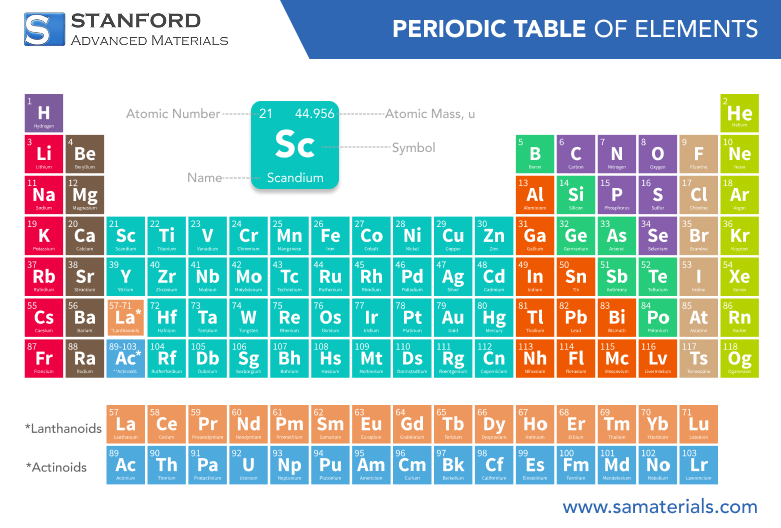
Scandium (chemical symbol: Sc) is an uncommon and light metal that falls into the group of transition elements of the periodic table, which contains 21 elements by atomic number. Scandium, though less popular as aluminum or copper, is widely used in various applications that call for high performance. Scandium was detected by Swedish chemist Lars Fredrik Nilson in 1879, and this metal was named after Scandinavia, which is where this metal was initially detected. Scandium does not form in large amounts in nature; thereby, it is an uncommon and costly material, though its physical and chemical properties have found applications in many fields of science and technology.
Chemical & Physical Properties of Scandium
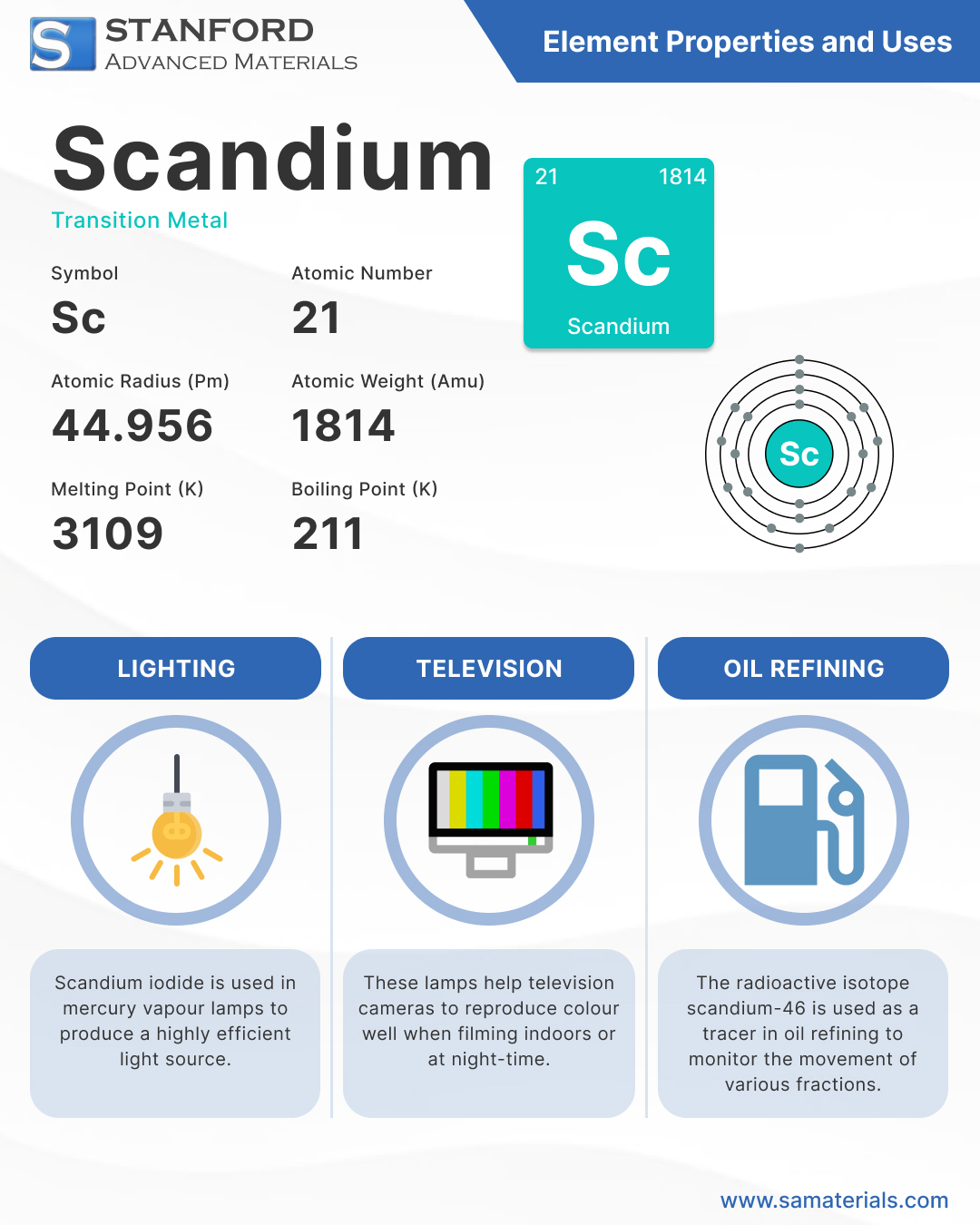
Scandium has properties that make it a vital element in different industries. Below is a table detailing some key physical properties of the element:
|
Property |
Value |
|
Atomic Number |
21 |
|
Atomic Mass |
44.955 g/mol |
|
Density |
2.985 g/cm³ |
|
Melting Point |
1,540°C (2,804°F) |
|
Boiling Point |
2,840°C (5,144°F) |
|
Electrical Conductivity |
Good |
|
Appearance |
Silvery-white, metallic |
|
Crystal Structure |
Hexagonal close-packed (hcp) |
Some of these properties include the high melting point, good electrical conductivity, and hexagonal crystal structure, which make scandium reliable in such strenuous applications. It is also relatively lightweight, with a density of 2.985 g/cm³, which for a large part stands out from most other metals in the transition group and adds to its utility in aerospace and other industries where weight is a critical factor. For more information, please check Stanford Advanced Materials (SAM).
Common Uses of Scandium
Despite its rarity, scandium is used in several high-tech applications, particularly in those fields requiring strength, light weight, or efficient lighting. Below are some of the key industries and products that benefit from the unique properties of scandium.
Aerospace Industry
Of all the uses, the most important is in the field of aerospace, where the addition of scandium to aluminum improves aircraft and spacecraft use, extending to sports equipment. Scandium alloyed with aluminum possesses superior strength-to-weight ratios, hence the reason why it is in great demand in the aerospace industry, where any reduction in weight is very crucial without reducing the strength. Even a very small addition of scandium to aluminum can yield an alloy that is far stronger than standard aluminum while retaining light weight. This is what has made its application expand in aerospace structure, including aircraft fuselage, fuel tanks, and other vital parts.
Lighting Applications
Because of this fact, scandium iodide is used in various forms of metal halide lamps. These lamps boast bright and highly efficient lights, and because of this quality, they find tremendous application in places like stadium lighting, streetlights, and theater lighting. The development of high-quality, bright light with accurate color rendition through scandium has made it a preferred choice in systems that require visibility and color precision in lighting.
Electronics
Some of the Scandium properties extend to the electronics industry for specialized components like fuel cells and superconductors. Scandium alloyed materials in fuel cells enhance their efficiency and, therefore, are suitable for high-performance environmental-friendly energy systems.
Besides that, scandium is being investigated for application in solid-state batteries, where its compounds offer stability and improvements in the performance of energy storage systems that will help solve the emergent demand for long-lasting and efficient batteries in everything from mobile devices to electric vehicles.
Sporting Goods
Another interesting application of scandium involves sports equipment manufacturing: bicycles, baseball bats, and even golf clubs. Lightweight yet resilient frames are constructed for bicycles by using scandium-alloyed aluminum, which reduces the overall weight of the equipment without sacrificing strength. In baseball bats, scandium provides the perfect balance of lightness and resilience, helping players achieve faster swing speeds and better performance.
The scandium alloys are especially in demand for high-performance sports because the reduction in weight, without loss of strength, can significantly enhance efficiency and increase durability.
Preparation Methods of Scandium
Scandium can be extracted from minerals like thortveitite, or it can be extracted as a by-product of the mining of uranium or rare earth elements. The extraction of pure scandium metal involves several steps:
1. Solvent Extraction: The other element scandium is extracted from other elements with the use of solvent extraction, where certain substances dissolve scandium selectively.
2. Purification: The extracted scandium is further subjected to various purification processes, which may include further chemical reactions.
3. Isolation: Scandium is extracted in its pure state after being purified, although because of its scarcity, scandium is usually extracted in limited quantities and at a high price.
Owing to its rarity and complicated extraction method, the price of scandium is relatively high, and its production is limited, usually restricted to the applications that leverage its distinct properties in the technology sector.
Similar Industrial Products
A number of products derive their high-performance properties from scandium:
• Aluminum-Scandium Alloys: These alloys, employed for aircraft as well as automotive parts, require high strength-to-weight ratios, thereby supporting a wide range of manufacturing activities for lighter, tougher structures.
• Scandium metal halide lamps: Scandium metal halide lamps are bright, energy-efficient lamps used for applications such as street lighting and film and theater performances.
• Solid-State Batteries: Scandium compounds are also utilized to increase the stability and efficiency of batteries, which play an essential role in the field of renewable energy and electric automobiles.
Frequently Asked Questions
Can scandium be found in nature?
Yes, scandium occurs naturally in small quantities in minerals such as thortveitite and in trace amounts in other rare-earth and uranium ores.
What are the main physical properties of scandium?
Scandium is a silvery-white metal with good electrical conductivity, a high melting point, and a relatively light density. It is often used in high-temperature and high-performance applications.
How is scandium extracted?
Scandium is extracted through solvent extraction methods and then purified to isolate the metal. The extraction process is complex due to the metal's rarity and limited natural deposits.
 Chin Trento