
 Products
 Bars
Bars
 Beads & Spheres
 Bolts & Nuts
 Crucibles
 Discs
Discs
 Fibers & Fabrics
 Films
Films
 Flake
Flake
 Foams
Foams
 Foil
Foil
 Granules
 Honeycombs
 Ink
Ink
 Laminate
 Lumps
Lumps
 Meshes
 Metallised Film
 Plate
Plate
 Powders
 Rod
Rod
 Single Crystals
 Sputtering Target
 Tubes
Tubes
 Washer
 Wires
Wires
 Converters & Calculators
 Write for Us



Calcium: Element Properties and Uses

Calcium is a highly abundant alkaline earth metal that plays a fundamental role in biological systems while also serving as a critical raw material in construction, metallurgy, agriculture, and chemical manufacturing.

Introduction to the Element
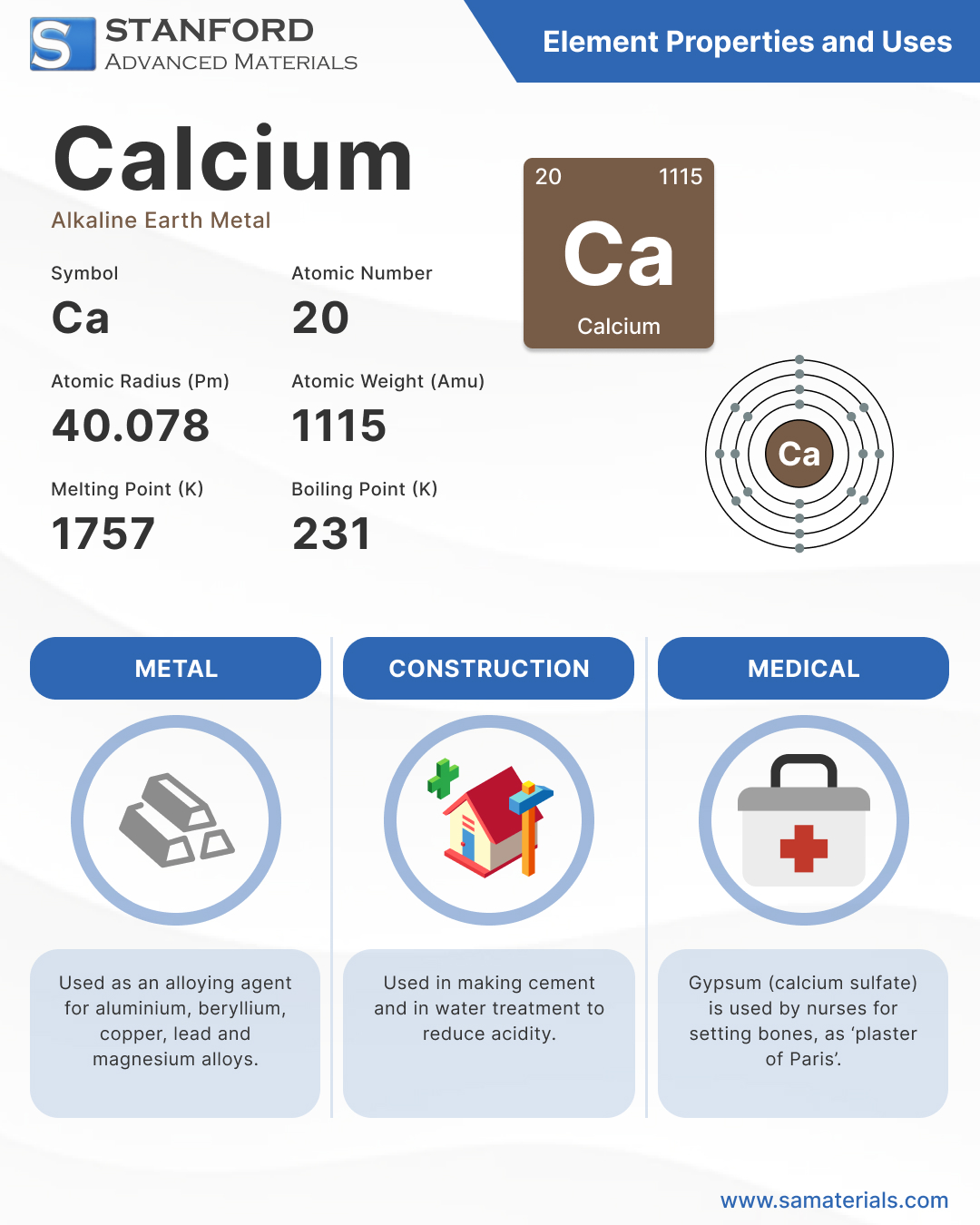
Calcium, with the chemical symbol Ca and atomic number 20, belongs to Group 2 of the periodic table, known as the alkaline earth metals. It is one of the most essential elements for life and one of the most widely used elements in modern industry. In nature, calcium rarely exists in its pure metallic form due to its high reactivity. Instead, it is commonly found as compounds such as calcium carbonate (CaCO₃), calcium phosphate, and calcium sulfate.
From a geological perspective, calcium is the fifth most abundant element in the Earth's crust, forming the backbone of limestone, marble, and chalk. Biologically, calcium is indispensable for bone and teeth formation, muscle contraction, nerve signaling, and blood clotting. Industrially, calcium compounds are indispensable to cement production, steelmaking, plastics, water treatment, and agriculture.
Chemical Properties Description
Calcium is highly reactive and readily forms compounds with oxygen and other non-metals. It reacts with water to form calcium hydroxide and hydrogen gas. In its pure form, calcium is quite soft and can be easily shaped. It burns with a bright red flame when ignited in air, forming calcium oxide. Calcium compounds, especially calcium carbonate, are widely used in construction materials and as industrial agents.
When exposed to oxygen, calcium forms a thin, protective oxide layer. It does not react with nitrogen, but it does react with acids, forming calcium salts. Its reactivity decreases as it moves down the periodic table, making it less reactive than other elements like magnesium.
Physical Properties
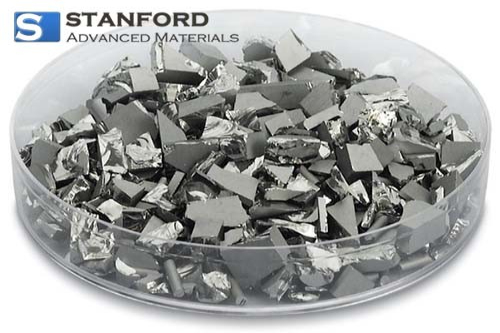
Calcium is a soft, silvery-white metal that is less dense than many other metals. The following table outlines some key physical properties of calcium:
|
Property |
Value |
|
Atomic Number |
20 |
|
Atomic Mass |
40.08 g/mol |
|
Density |
1.54 g/cm³ |
|
Melting Point |
842°C |
|
1484°C |
|
|
Electrical Conductivity |
High |
|
Appearance |
Silvery-white, shiny metal |
|
Hardness |
Soft (can be cut with a knife) |
For more information, please check Stanford Advanced Materials (SAM).
Common Uses
Calcium has a variety of uses, both in biological systems and in industrial applications:
- Biological Uses: It is a vital element for bone and teeth health, muscle function, and nerve transmission.
- Industrial Uses: Calcium carbonate is used as a building material and in the production of lime. Calcium salts are used in fertilizers, food additives, and in the treatment of water.
- Other Uses: Calcium is also used in the production of alloys, particularly in steelmaking, to improve hardness and durability.
Preparation Methods
Calcium can be prepared through several methods:
- Electrolysis of Calcium Chloride (CaCl2): This method involves passing an electric current through molten calcium chloride, which decomposes to release calcium metal and chlorine gas.
- Reduction of Calcium Oxide (CaO) with Aluminum: Calcium can also be extracted from calcium oxide by reduction with aluminum at high temperatures.
Related Industrial Products
Calcium is a core component in a range of industrial products:
- Cement and Lime: Calcium compounds like calcium carbonate and calcium oxide are key in the manufacturing of cement and lime.
- Steelmaking: Calcium is used in the production of steel to remove impurities and enhance the strength of the final product.
- Plastics and Rubber: Calcium salts, like calcium carbonate, are used as fillers in the production of plastics and rubber.
|
Product |
Calcium Compound |
Primary Function |
|
Cement |
CaO, CaCO₃ |
Structural binding |
|
Lime |
CaO, Ca(OH)₂ |
Chemical processing, water treatment |
|
Fertilizers |
Calcium phosphates |
Soil nutrition |
|
Plastics & Rubber |
CaCO₃ |
Filler, cost reduction |
|
Steel Additives |
Calcium alloys |
Impurity control |
Frequently Asked Questions
What are the primary biological roles of calcium?
Calcium is crucial for bone and teeth formation, muscle contraction, and nerve transmission. It also plays a role in blood clotting.
How is calcium obtained from natural sources?
Calcium is primarily obtained from limestone and other calcium-containing minerals, which are processed in industrial operations.
Is calcium dangerous in its pure form?
Calcium metal is reactive and can be hazardous when exposed to air or water. However, in its compound forms, it is generally safe and widely used in various industries.
Can calcium be found in water?
Yes, calcium is commonly found in natural water sources, mainly in the form of dissolved calcium salts like calcium carbonate.
What industries use calcium the most?
The construction, steel, and agricultural industries are among the largest consumers of calcium in various forms such as calcium carbonate, calcium oxide, and calcium salts.



 Chin Trento