Products
 Bars
Bars
 Beads & Spheres
 Bolts & Nuts
 Crucibles
 Discs
Discs
 Fibers & Fabrics
 Films
Films
 Flake
Flake
 Foams
Foams
 Foil
Foil
 Granules
 Honeycombs
 Ink
Ink
 Laminate
 Lumps
Lumps
 Meshes
 Metallised Film
 Plate
Plate
 Powders
 Rod
Rod
 Single Crystals
 Sputtering Target
 Tubes
Tubes
 Washer
 Wires
Wires
 Converters & Calculators
 Write for Us



Sulfur: Element Properties and Uses

Description
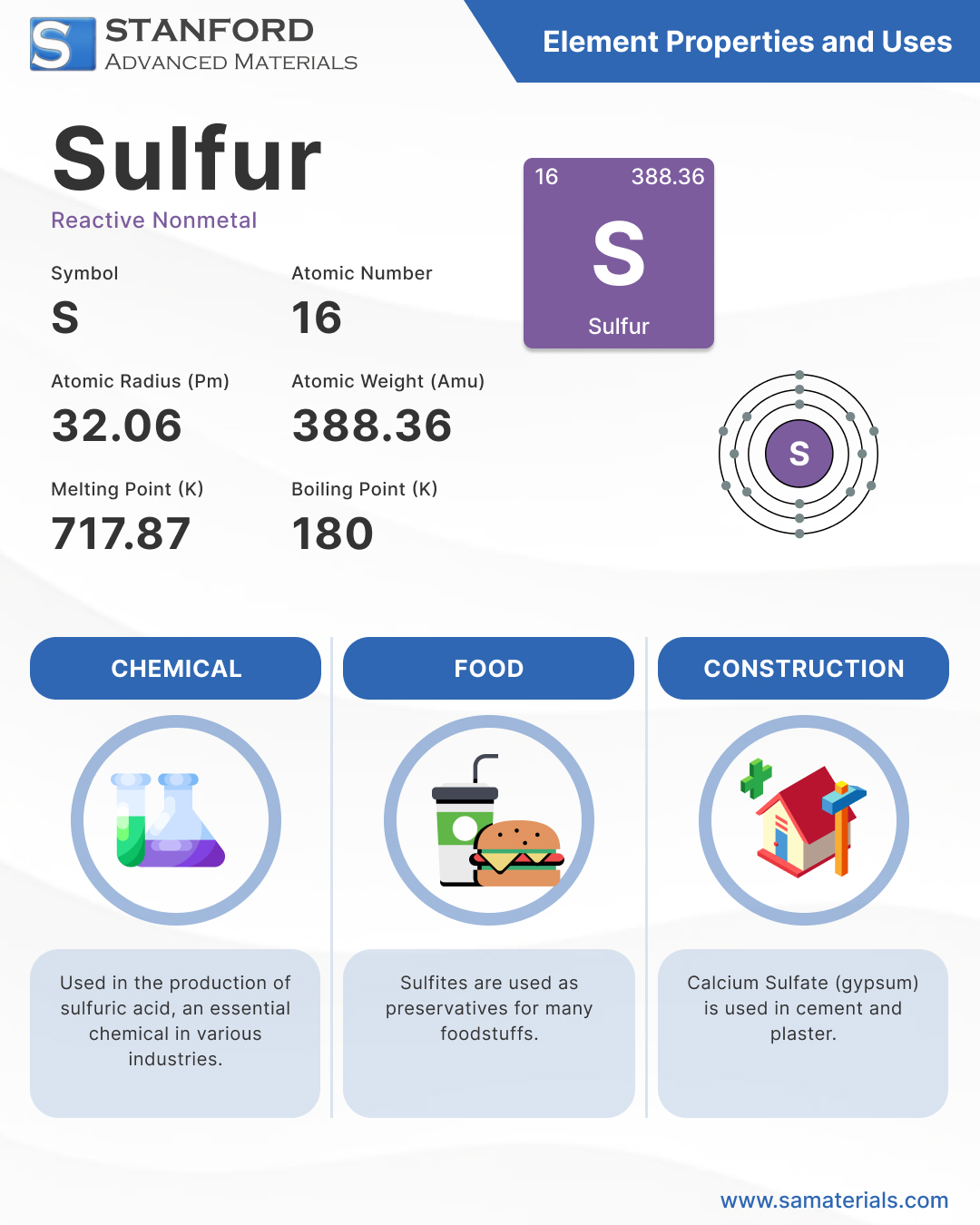
Sulfur is a very versatile non-metal element that finds wide applications in the production of sulfuric acid, rubber vulcanization, agriculture, and pharmaceutical industries. Its versatility ranges from chemical manufacturing to healthcare.
Introduction to the Element
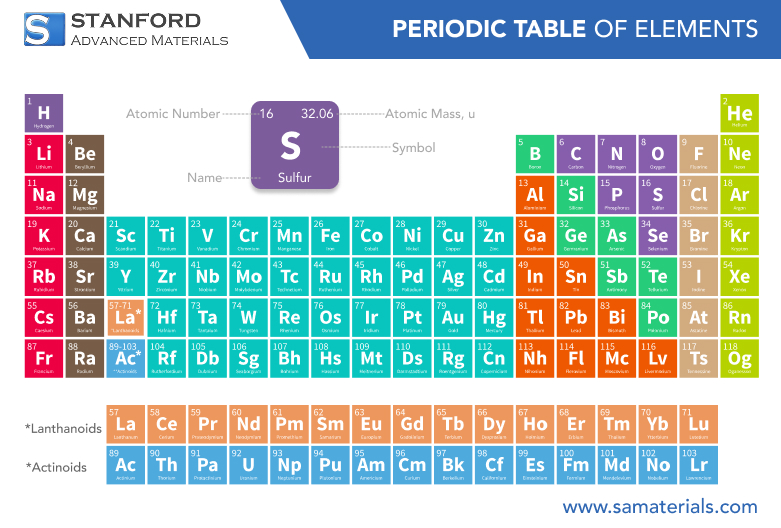
Sulfur is a non-metal in nature, existing abundantly and playing a major role in biological systems and at the industrial level. It is an important constituent in amino acids, vitamins, and other biological molecules. Naturally, this element is usually found around volcanic eruptions and hot springs. It also occurs in various minerals like gypsum (CaSO₄) and pyrite (FeS₂). The element primarily exists as yellow, crystalline sulfur; however, rhombic and monoclinic sulfur are other allotropic forms. These have different crystal structures, yet they have similar properties chemically.
Chemical Properties
Sulfur is very reactive and combines with a wide range of elements to make many compounds. When combined with oxygen it takes the form of sulfur dioxide (SO₂), which can be further oxidized yielding sulfur trioxide (SO₃), the basis for sulfuric acid production (H₂SO₄) - one of the most critical industrial chemicals. The manufacture of fertilizers, chemicals, and petroleum products all depend on sulfuric acid.
Sulfur also exhibits allotropy with its most common allotropes: rhombic sulfur, which is stable at room temperature, and monoclinic sulfur, stable at higher temperatures. Sulfur generally forms covalent bonds in such compounds as sulfur dioxide (SO₂), sulfur hexafluoride (SF₆), and hydrogen sulfide (H₂S). These compounds are used in such industrial processes as semiconductor production and refrigerants.
Physical Properties
Sulfur has a number of interesting physical properties that affect its uses. It has a relatively low melting point at 115.21°C and a boiling point at 444.6°C; thus, it is a rather soft, low-melting metal among other non-metals. The density of sulfur is 2.07 g/cm³, and its appearance is generally yellow and crystalline in form. Sulfur is also poor in electrical conductivity and insoluble in water compared to other non-metals. Such properties are significant in its role within the chemical industry and in environmental processes.For more information, please check Stanford Advanced Materials (SAM).
Common Uses
Sulfur finds wide applications in industries related to the manufacture of sulfuric acid, vulcanization of rubber, and agricultural products. The most outstanding use involves making sulfuric acid, widely used in producing fertilizers, detergents, and other chemicals. Usually, the manufacture of sulfuric acid includes the contact process, whereby sulfur is oxidized into sulfur trioxide (SO₃), later converted into sulfuric acid.
Sulfur also plays an important role in the vulcanization of rubber, wherein sulfur is added to the raw rubber to make it more elastic and durable. Vulcanized rubber is used in products such as tires and industrial seals. In agriculture, the element is utilized as a fungicide and pesticide wherein its compounds effectively help in controlling fungi and pests that may affect crops, especially in organic farming. Moreover, sulfur-based compounds such as sulfur dioxide are applied in food preservation, particularly in dried fruits and beverages like wine.
Sulfur in pharmaceuticals is used in treating skin diseases, such as acne and seborrheic dermatitis, as well as in a variety of topical ointments and creams. It plays an essential role in maintaining digestive system health, with its natural sources being garlic, onions, and eggs.
Methods of Preparation
Sulfur is extracted both naturally and industrially by several different methods. The most important method of extracting sulfur is the Frasch process, which involves the injection of superheated water and air into the sulfur-containing ore, enabling the sulfur to be pumped to the surface in a liquid state. Sulfur is mined directly from natural deposits, many of which are found in volcanic regions. Much sulfur is also recovered as a by-product of petroleum and natural gas refining, which reduces the emissions of sulfur compounds such as sulfur dioxide into the atmosphere.
Frequently Asked Questions
What is the use of sulfur in everyday life?
Sulfur is used in the manufacture of fertilizers, pharmaceuticals, rubber, fungicides, and food preservatives. It forms a very important part in the production of sulfuric acid essential for various industries.
Is sulphur harmful to mankind?
Sulfur in the form of SO₂ can be quite injurious when present in large quantity, especially to the human respiratory system. However, small quantities of sulfur are essential for health, and sulfur-based treatments do exist for skin conditions and are generally safe when applied topically.
How is sulfur extracted from nature?
Sulfur is extracted by various methods including the Frasch process, mining from volcanic deposits, and recovering it as a by-product in petroleum refining.
Can sulfur be found in food?
Yes, sulfur naturally occurs in foods such as garlic, onions, and eggs, where it plays an integral role in health maintenance and detoxification.
What are the industrial uses for sulfur compounds?
The sulfur compounds are used in the manufacture of sulfuric acid, which is an important raw material for the manufacturing of fertilizers, rubber, and different industrial chemicals. They are also used in the manufacture of pesticides, fungicides, and food preservatives.
 Chin Trento