Products
 Bars
Bars
 Beads & Spheres
 Bolts & Nuts
 Crucibles
 Discs
Discs
 Fibers & Fabrics
 Films
Films
 Flake
Flake
 Foams
Foams
 Foil
Foil
 Granules
 Honeycombs
 Ink
Ink
 Laminate
 Lumps
Lumps
 Meshes
 Metallised Film
 Plate
Plate
 Powders
 Rod
Rod
 Single Crystals
 Sputtering Target
 Tubes
Tubes
 Washer
 Wires
Wires
 Converters & Calculators
 Write for Us



Chlorine: Element Properties and Uses

Description
Chlorine is an industrially very useful chemical element used in several applications starting from water purification to the manufacture of household items.
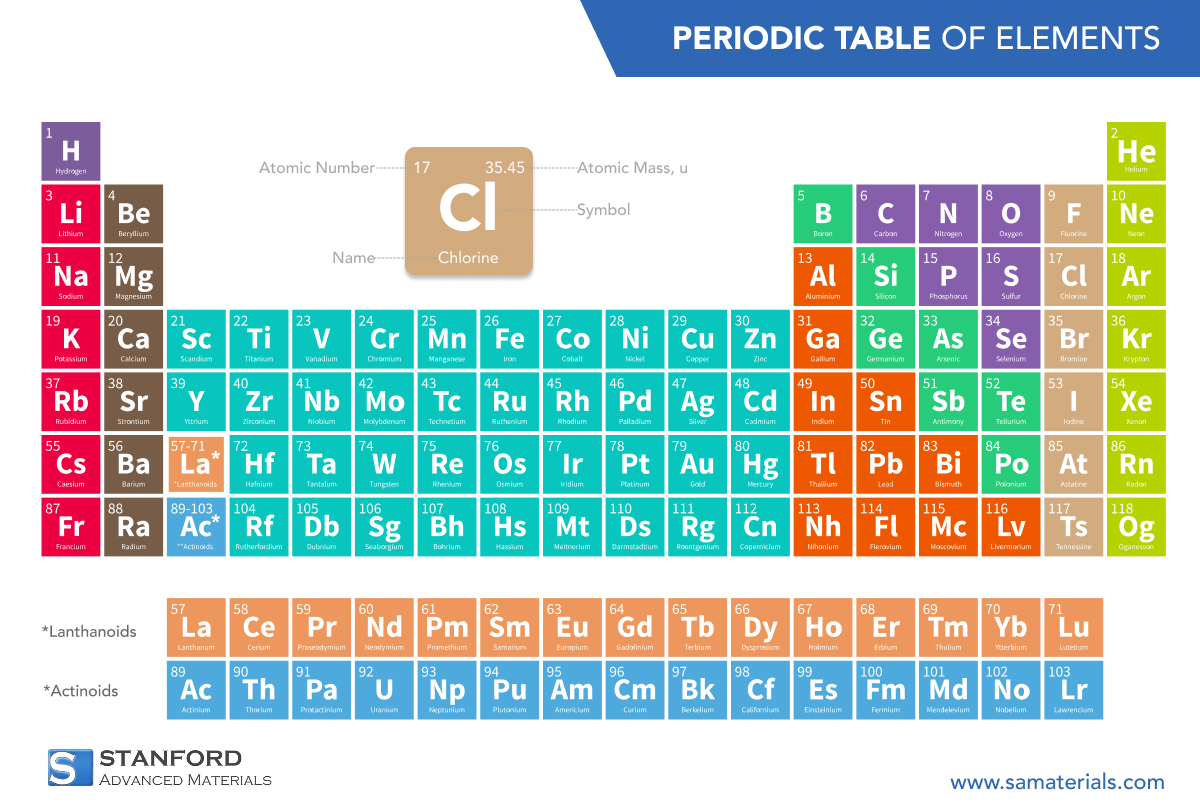
Chlorine the Element
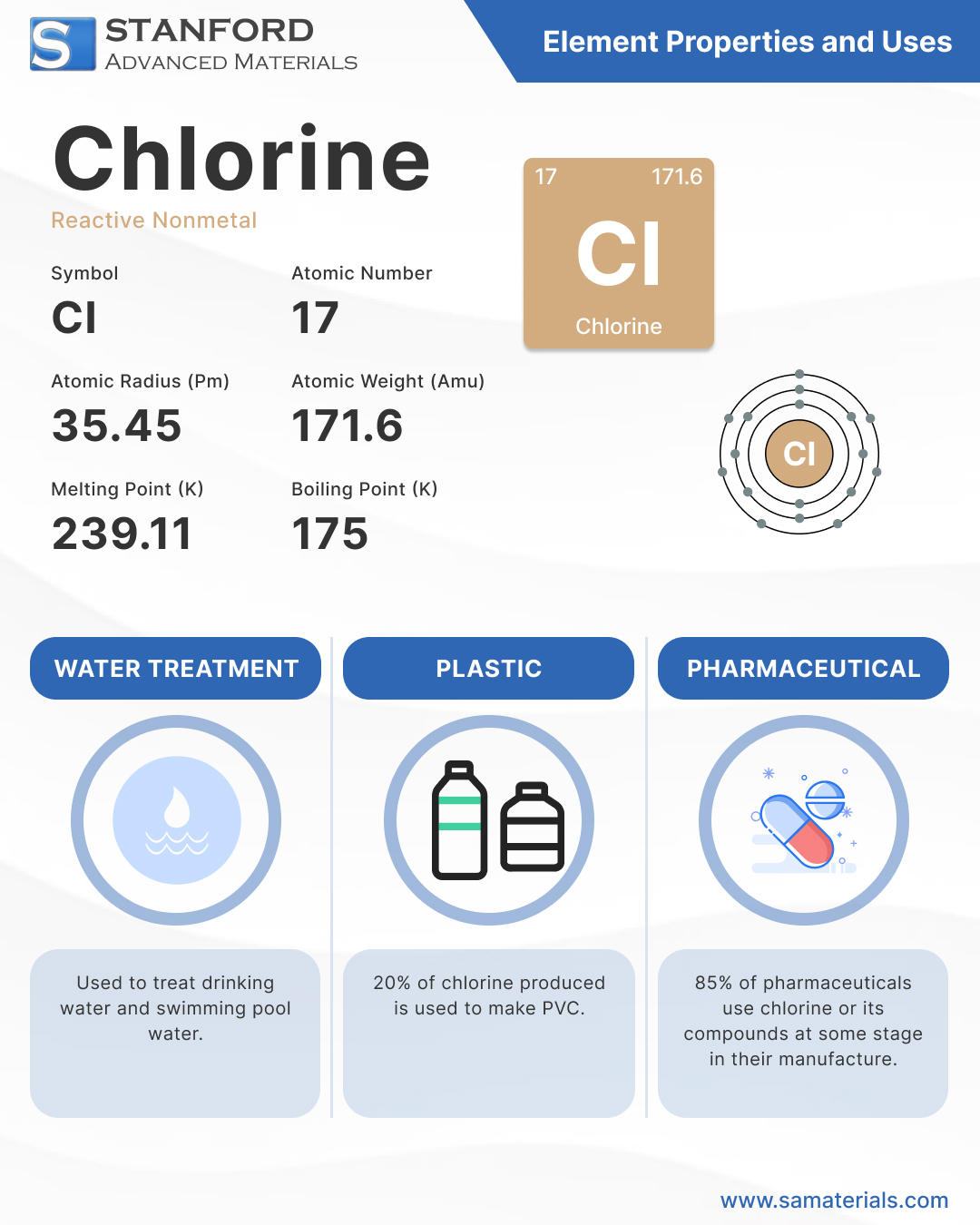
Chlorine is a chemical element and falls under the category of the halogen group in the periodic table, with the atomic number 17 and symbol Cl. It is alongside fluorine, bromine, iodine, and astatine. It is an extremely reactive chemical element. Most commonly, chlorine is used for disinfection or sanitation purposes, even in treating drinking water and swimming pools.
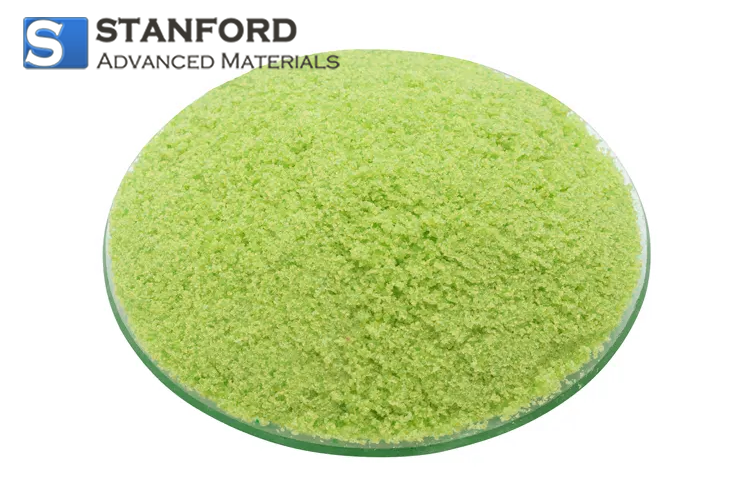
In its elemental form, chlorine exists as a yellow-green gas at room temperature but is very easily combined with other elements to form various types of compounds. These compounds have broad applications in many industries, ranging from plastics production to pharmaceuticals to cleaning products.
Chemical Properties Description
Chlorine is a very reactive and electronegative element. It belongs to the halogen family and forms salts by easily combining with metals. Some key chemical properties of chlorine include:
- Reactivity: Chlorine combines excitedly with the majority of elements and compounds; hence, when combined with hydrogen, it mostly forms acids, such as hydrochloric acid, HCl.
- Oxidizing Agent: Chlorine is a strong oxidizing agent, which means it readily accepts electrons from other substances during chemical reactions.
- In general, chlorine is usually combined with other nonmetals by covalent linkage in the preparation of compounds containing chlorine.
- Acidity: Chlorine combines with water to form hydrochloric acid and hypochlorous acid, which are highly acidic.
These chemical properties make chlorine vital in such industrial processes as water treatment, manufacturing of bleach, and synthesis of organic compounds.
Physical Properties Data Table
|
Property |
Value |
|
Atomic number |
17 |
|
Symbol |
Cl |
|
Atomic weight |
35.45 u |
|
State at room temperature |
Gas |
|
Color |
Yellow-green |
|
Density (gas) |
3.2 g/L |
|
Melting point |
-101.5°C |
|
-34.04°C |
|
|
Solubility in water |
Soluble |
These physical properties underline chlorine's behavior and the problems that come along with its manipulation in different industrial and laboratory practices.
Common Uses
Chlorine is used in a variety of industries, including:
- Water Treatment: Chlorine is one of the most commonly used disinfectants in water treatment plants. It kills bacteria and other pathogens, making water safe for consumption.
- Bleach Production: Chlorine is used mainly in the manufacture of sodium hypochlorite, commonly referred to as household bleach.
- Plastic Manufacturing: Chlorine is used in the manufacturing of a certain plastic known as polyvinyl chloride, or PVC, which is used in many items ranging from piping to flooring to window framing.
- Pharmaceuticals: Chlorine compounds are being used for the manufacture of pharmaceuticals, disinfectants, and sanitizers.
- Pesticides: Chlorine is further employed in various productions of pesticides and herbicides.
Preparation Methods
In general, chlorine is the product of the electrolysis process of sodium chloride (NaCl), better known as the chlor-alkali process. In such a process, an electric current is passed through an aqueous solution of sodium chloride, where chlorine gas, hydrogen gas, and sodium hydroxide (NaOH) are separated.
Chlor-alkali process:
Electrolysis reaction:
2NaCl (aq) + 2H2O (l) → Cl2 (g) + H2 (g) + 2NaOH (aq)
This method is widely used for mass production in industries because it is efficient and economical.
Related Industrial Products
In addition to its use in bleach and PVC production, chlorine plays a role in the creation of several other industrial products:
- Solvents: Chlorine is utilized in the manufacture of chlorinated solvents such as chloroform and carbon tetrachloride.
- Hydrochloric Acid: Chlorine is a key component in the industrial production of hydrochloric acid, a substance used in cleaning, metal refining, and other chemical processes.
- Herbicides and Insecticides: Chlorine compounds form part of the formulations of herbicides and insecticides used in agriculture.
These industrial products make chlorine a very valuable and versatile chemical both in manufacture and agriculture.
Frequently Asked Questions
What is chlorine used for in everyday life?
Chlorine is used in everyday life for water purification, bleach production, and in disinfectants found in cleaning products.
Is chlorine harmful to humans?
Yes, chlorine is toxic in high concentrations. It can cause respiratory issues and skin irritation. However, it is safe when used in controlled amounts, such as in drinking water treatment.
How is chlorine produced?
Chlorine is mainly produced by the electrolysis of sodium chloride (salt) in the chlor-alkali process, which separates chlorine gas, hydrogen gas, and sodium hydroxide.
Why is chlorine important in water treatment?
Chlorine is crucial in water treatment because it effectively kills bacteria, viruses, and other pathogens, making water safe for drinking and recreational use.
Does chlorine have any medicinal uses?
Yes, chlorine compounds have wide applications in the pharmaceutical industry in producing different types of drugs, disinfectants, and sanitizers.
 Chin Trento