Products
 Bars
Bars
 Beads & Spheres
 Bolts & Nuts
 Crucibles
 Discs
Discs
 Fibers & Fabrics
 Films
Films
 Flake
Flake
 Foams
Foams
 Foil
Foil
 Granules
 Honeycombs
 Ink
Ink
 Laminate
 Lumps
Lumps
 Meshes
 Metallised Film
 Plate
Plate
 Powders
 Rod
Rod
 Single Crystals
 Sputtering Target
 Tubes
Tubes
 Washer
 Wires
Wires
 Converters & Calculators
 Write for Us



Barium: Element Properties and Uses

Description
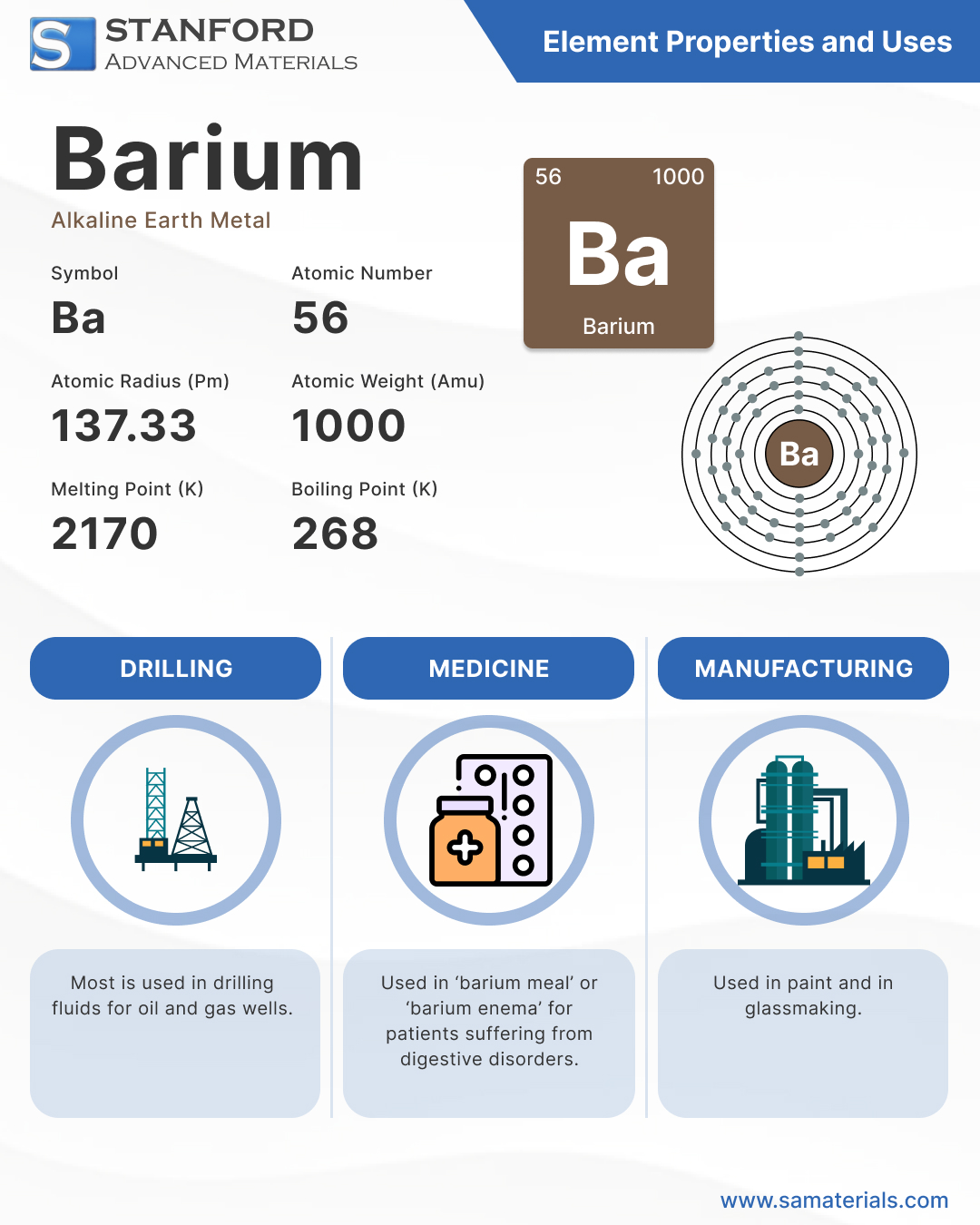
Barium is a versatile alkaline earth metal primarily used in medical imaging, pyrotechnics, and oil drilling, with important applications in glass production and industrial processes.
Introduction to the Element
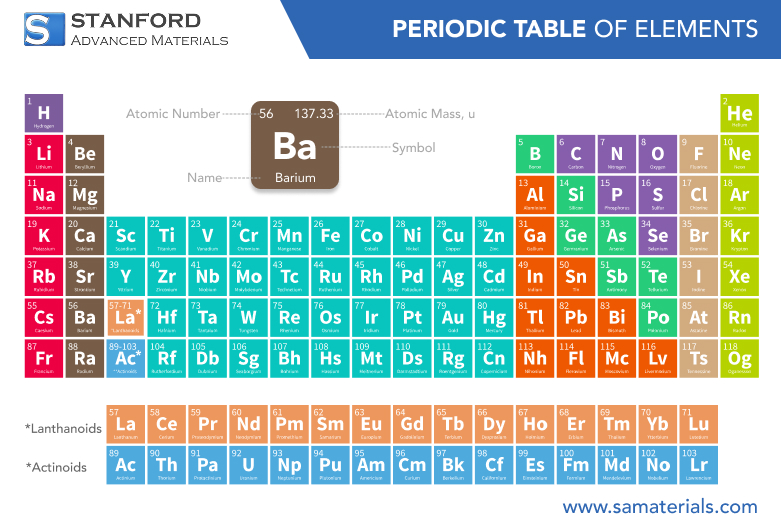
Barium is a soft, silvery alkaline earth metal with an atomic number of 56 and an atomic weight of approximately 137.33 g/mol. Known for centuries through its naturally occurring compounds, barium has been isolated in pure form only relatively recently. The most notable natural sources of barium include the minerals barite (BaSO₄) and witherite (BaCO₃). These compounds have been used for various purposes for centuries, but modern science has enabled the extraction of pure barium for a wide range of industrial and medical applications.
Barium is a very reactive metal; it's especially reactive with oxygen when exposed to air, creating a protective oxide layer. These properties, coupled with the softness and low melting points of this element, make it an interestingly challenging element to work with. The +2 oxidation state of barium is stable, which enables the formation of compounds with oxygen, sulfur, and halogens; these are useful in a variety of industrial applications.
History and Naming
The discovery of barium dates back to the late 18th century. Carl Wilhelm Scheele, a Swedish chemist, first isolated barium in the form of barium carbonate from the mineral witherite in 1772. The element was later named "barium" by Humphry Davy in 1808, who was able to isolate the pure metal through electrolysis of barium hydroxide.
The origin of the name "barium" comes from the Greek name "barys," which means "heavy," since the compounds of this element have a high density, as seen with barium sulfate. The more general use of barium was encouraged during the 19th and 20th centuries by the industrial revolution, as its demand in glass production and medial imaging grew.
Chemical Properties
Barium is highly reactive and most commonly occurs in the +2 oxidation state, forming stable compounds with oxygen, sulfur, and halogens. When exposed to air, barium forms a protective oxide layer (BaO), which prevents further oxidation. This reactivity makes barium and its compounds important in various chemical reactions and industrial processes.
- Flame Test: Barium compounds are renowned for their distinctive green colored flame when burnt. This property is then widely used in pyrotechnics to impart a green color to fireworks and flares.
- Solubility: BaSO₄ is highly insoluble in water, making it an ideal candidate for application as a contrast agent in medical imaging, such as in X-ray and computed tomography.
Physical Properties
Barium possesses some very important physical properties determining its usefulness in many fields:
- Density: 3.62 g/cm³
- Melting point: 727°C, relatively low for a metal
- Boiling Point: 1640°C
- Crystal Structure: Orthorhombic
Softness and a relatively low melting point combine to make barium a malleable metal for industrial applications; however, its high chemical reactivity requires great care in handling to avoid unwanted oxidation. Please check Stanford Advanced Materials (SAM).
Applications of Barium
The unique properties of barium enable its use in the most diverse industries, giving it great versatility and value.
1. Medical Imaging:
Barium sulfate or BaSO₄ is a widely used contrast agent in X-ray imaging and CT scans for visualizing the gastrointestinal tract. Because of its high density and chemical inertness, barium sulfate can be used to obtain clear images with high contrast without harm to the patients. For instance, during a barium swallow test, barium sulfate is swallowed, which shows abnormalities of the esophagus.
Barium sulfate is one of the most commonly used barium meal procedures when viewing the stomach and intestine. It blocks X-rays, which is very helpful for doctors in outlining issues like ulcers, tumors, and blockages.
2. Pyrotechnics:
Barium compounds, especially barium nitrate (Ba(NO₃)₂), are involved in the manufacturing process to make fireworks produce bright green flames. Burning barium salts produces a bright, green color that has become synonymous with celebratory firework displays.
The green color common in fireworks on New Year's and Independence Day belongs to barium nitrate.
3. Oil and Gas Industry:
Barium is an important constituent of drilling fluids in the extraction of oil and gas resources. The high-density barium compounds, especially barium sulfate, provide the required weight that will stabilize the operation of drilling to avoid blowouts by regulating the pressure.
Barite (BaSO₄) is used in drilling fluids to balance well pressure during deep-sea drilling.
4. Glass and Ceramics:
Barium compounds are used in the manufacture of high-quality glass and ceramics, particularly those requiring high refractive indices. Addition of barium improves the optical properties of glass, making it good for use in specialized applications like optical lenses, cameras, and microscope lenses.
Barium is used in the production of television tubes and CRTs due to its optical qualities.
5. Other industrial uses:
The applications of barium salts involve the production of paints and plastics, being used mostly as fillers or stabilizers. Barium oxide (BaO) is useful in electronics and catalysis, improving the performance of assorted devices and processes.
Preparation Procedures
The industrial preparation of barium involves several key steps, the most common being the extraction of barium sulfate from barite, BaSO₄:
1. Extraction of Barite: Barite is mined from natural deposits, often in countries like China, India, and the USA.
2._conversion into BaCl₂: it is converted into barium chloride by treating the barite with carbon and chlorine.
3. Purification to Pure Barium: The resultant barium chloride is then reduced by electrolysis or carbon reduction to pure barium metal.
Frequently Asked Questions
What is barium?
Barium is an alkaline earth metal of atomic number 56, best known for its chemical versatility, high reactivity, and industrial uses in medicine, pyrotechnics, and drilling.
How is barium used for medical imaging?
Barium sulfate is used as a contrast agent in X-ray and CT scans to enhance the clarity of images, particularly in visualizing the gastrointestinal tract.
What are the typical preparation methods for barium?
Recovering barium from barite minerals involves a lot of processing that includes transformation to barium chloride and, by electrolysis or carbon reduction, into pure barium metal.
Why do barium compounds produce green colored flames in fire works?
Barium produces a green color in firework burning, and barium nitrate is one of the most widespread green color producers. In the process of burning, the barium ion gets excited.
What industrial products does barium yield?
Products derived from barium include barium sulfate, barium nitrate, barium oxide, and barium carbonate, used in applications ranging from medical imaging and pyrotechnics to glass manufacturing and oil drilling.
 Chin Trento