Products
 Bars
Bars
 Beads & Spheres
 Bolts & Nuts
 Crucibles
 Discs
Discs
 Fibers & Fabrics
 Films
Films
 Flake
Flake
 Foams
Foams
 Foil
Foil
 Granules
 Honeycombs
 Ink
Ink
 Laminate
 Lumps
Lumps
 Meshes
 Metallised Film
 Plate
Plate
 Powders
 Rod
Rod
 Single Crystals
 Sputtering Target
 Tubes
Tubes
 Washer
 Wires
Wires
 Converters & Calculators
 Write for Us



Lanthanum: Element Properties and Uses

Lanthanum is a soft, silvery-white rare earth metal known for its high reactivity. It is used in hybrid vehicle batteries, optical lenses, catalysts, and advanced ceramics due to its excellent electrical and optical properties.
Chemical Properties
It is a soft, ductile, and silvery white metal, preferring to be reactive, though it is anything but aggressively reactive. It will react with air to form a thin oxide layer, which acts to retard any further corrosion reaction. But it becomes highly reactive when it gets finely divided because of its large number of possible encounters with oxygen.
Its reactivity with water is moderately low; water causes a slow chemical reaction, resulting in lanthanum hydroxide. Lanthanum is, therefore, normally stored in oil or an inert atmosphere. This is due to its reactivity with water.
The metal has a preference for +3 oxidation states, which is not unusual within the rare earth family of elements. The metal's stability at this oxidation state is one reason it is preferred in many chemical applications, particularly in catalytic reactions where the stability of the resultant compound with other elements is crucial.
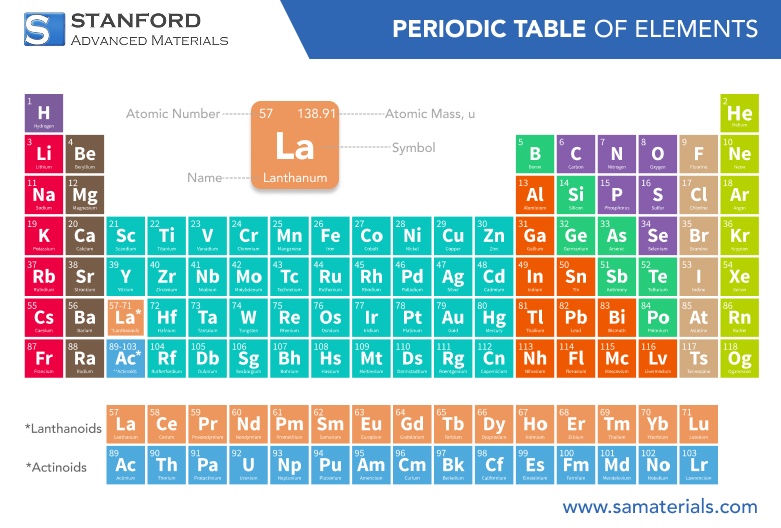
Physical Properties Data Table
|
Property |
Value |
Unit |
|
Atomic Number |
57 |
- |
|
Atomic Weight |
138.91 |
u |
|
Density |
6.15 |
g/cm³ |
|
Melting Point |
920 |
°C |
|
Boiling Point |
3464 |
°C |
For more information, please check Stanford Advanced Materials (SAM).
Lanthanum Compounds and Products
Being such a versatile element, lanthanum is involved in many compounds, both organic and inorganic. Some of its compounds include lanthanum oxide (La₂O₃), lanthanum chloride (LaCl₃), and lanthanum carbonate (La₂(CO₃)₃). Some of lanthanum's applications can be attributed to the many uses of these compounds.
- Lanthanum Oxide (La₂O₃): La₂O₃ is one of the important compounds of lanthanum, and it is used to manufacture high-quality optical glasses like the lenses of cameras and telescopes. The refractive index and clarity of the resulting glass are enhanced by the addition of this compound, and it acts as a catalyst in petroleum and hydrogen gas formation.
- Lanthanum Chloride (LaCl₃): This compound is used in some specialized glasses made for laboratory equipment and acts as a catalyst in chemical reactions. It is also used in separating the rare earth elements in industrial as well as laboratory settings.
- Lanthanum Carbonate (La₂(CO₃)₃): Primarily employed in the pharmaceutical industry, lanthanum carbonate is applied in the treatment of hyperphosphatemia in patients suffering from Chronic Kidney Disease. It works by binding Lanthanum compounds are also used as components of some alloys, such as those used at high temperatures or as rechargeable batteries. Lanthanum nickel alloys, for instance, are used in the production of nickel-metal hydride batteries, NiMH batteries that are used to power hybrid cars as well as electronics.
Preparation Methods
Lanthanum is extracted from rare earth-bearing minerals such as monazite sands and bastnasite. This begins by separating the mineral by hand from other materials in the rock to which it is attached. There then follow chemical processes, such as acid leaching to extract the rare earth elements. This is followed by further chemical processes to isolate the lanthanum as an oxide.
Contemporary methods also apply the processes of solvent extraction and ion exchange to increase the degree of purity of lanthanum compounds. The purified compounds are of great importance in both industrial processes and high-tech applications.
Everyday Applications
The range of applications of Lanthanum lies in the special characteristics it possesses. The major applications of Lanthanum are
- Carbon Arc Lamps:Lanthanum has an important application in carbon arc lamp lighting in projectors and studios. The element is crucial in producing a strong white light which is utilized in high-illumination tasks.
- Catalysts: Compounds of Lanthanum, specifically Lanthanum oxide, are used as catalysts in many different industrial reactions. In Petroleum refining reactions, Lanthanum-based catalysts enhance fuel quality by decomposing high molecular weight alkanes.
- Optical Glass: Lanthanum oxide is used in high-quality optical glass for making camera, microscope, and other scientific instruments' lenses. Lanthanum oxide increases the clarity and refractive index, resulting in clearer images.
- Batteries and Fuel Cells: The alloys of Lanthanum are very important in the development of nickel-metal hydride batteries used in electric vehicles and other electronics. It also helps to improve fuel cell efficiency and life.

Frequently Asked Questions
What is lanthanum?
Lanthanum is a rare earth element with unique chemical and physical properties. It is primarily used in applications such as carbon arc lamps, catalysts, optical glass, and batteries.
How is lanthanum prepared?
Lanthanum is extracted from minerals like monazite and bastnasite through chemical processes such as acid leaching, solvent extraction, and ion-exchange techniques to obtain high-purity compounds.
What are lanthanum compounds?
Lanthanum compounds, such as lanthanum oxide (La₂O₃), lanthanum chloride (LaCl₃), and lanthanum carbonate (La₂(CO₃)₃), are used in a wide variety of industries, including optics, catalysis, and medicine.
What are the common uses of lanthanum?
Lanthanum is used in a range of industries, including lighting, petroleum refining, optics, and energy storage technologies.
What industries rely on lanthanum and its compounds?
Lanthanum is essential in industries such as electronics, automotive, renewable energy, and healthcare, where it is used in batteries, fuel cells, glass manufacturing, and medical treatments.


 Chin Trento