Products
 Bars
Bars
 Beads & Spheres
 Bolts & Nuts
 Crucibles
 Discs
Discs
 Fibers & Fabrics
 Films
Films
 Flake
Flake
 Foams
Foams
 Foil
Foil
 Granules
 Honeycombs
 Ink
Ink
 Laminate
 Lumps
Lumps
 Meshes
 Metallised Film
 Plate
Plate
 Powders
 Rod
Rod
 Single Crystals
 Sputtering Target
 Tubes
Tubes
 Washer
 Wires
Wires
 Converters & Calculators
 Write for Us



Flerovium: Element Properties and Uses

Flerovium: Physical Properties and Uses
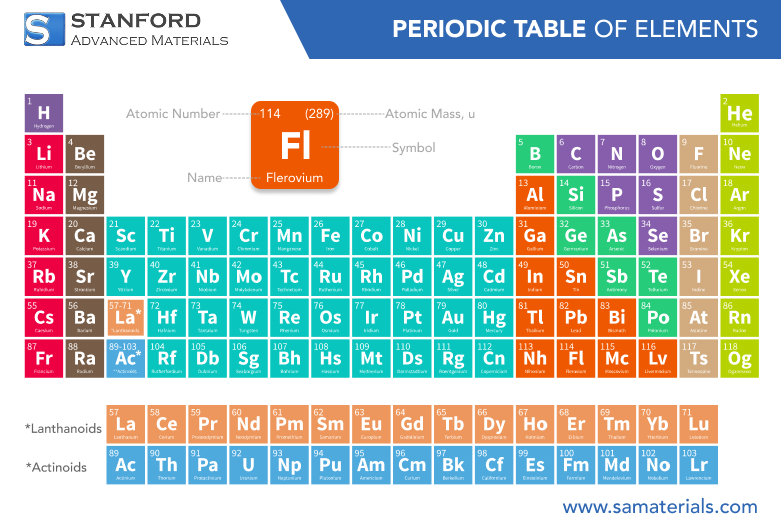
Flerovium (chemical symbol Fl, atomic number 114) is a synthetic superheavy element belonging to group 14 of the periodic table, a member of the carbon family of silicon, germanium, tin, and lead. It was initially synthesized in 1998 at the Joint Institute for Nuclear Research (JINR) in Dubna, Russia, and occurs in minute traces in laboratories alone and is very unstable with isotopes lasting milliseconds to a few seconds. Despite this fleeting existence, research on flerovium provides us with valuable insights into nuclear physics, relativistic chemistry, and the limitations of the periodic table.
Atomic and Physical Properties
Flerovium is a post-transition p-block element whose properties have largely been theoretically calculated since very few atoms have ever been synthesized.
Some remarkable properties are:
• Atomic number: 114
• Symbol: Fl
• Electron configuration (estimated): [Rn] 5f¹⁴ 6d¹⁰ 7s² 7p²
• Atomic mass (most stable isotope, Fl-289): 289 u
• Melting point and boiling point: Estimated ~200–300°C and ~400–500°C, respectively
• Density: Estimated at 14–16 g/cm³
The relativistic contraction of the 7p electrons makes flerovium behave differently than lighter group 14 elements. These effects would be responsible for claimed low reactivity and volatility, and it is unlike lead, which is a stable, similarly reactive post-transition metal.
Chemical Properties Description
Little experimental data exist, but chemical studies on isolated atoms show that flerovium has:
• Oxidation states: +2 stable relative to +4, as opposed to more usual +2 and +4 of lead.
• Inertness: Gold surface interaction studies show weak adsorption, as expected with noble-metal-like character, not usual for a group 14 element.
• Predicted compounds: FlCl₂, FlF₂, and possibly FlO, very similar to some of lead's chemistry but less so due to relativistic stabilization of electrons.
Comparison:
• Lead (Pb): +2 and +4 oxidation states; forms PbO, PbCl₂, PbSO₄.
• Tin (Sn): +2 and +4 oxidation states; forms SnO, SnO₂, SnCl₄.
• Flerovium: Presumably prefers +2, looser metallic bonding, and volatilility, exhibiting deviation from normal group 14 behavior.
Isotopes
All flerovium isotopes are radioactive. Principal isotopes are:
|
Isotope |
Half-life |
Decay mode |
Notes |
|
Fl-285 |
~0.13 s |
α-decay |
Shortest-lived; synthesized for decay chain studies |
|
Fl-287 |
~0.80 s |
α-decay |
Produced via Pu-244 + Ca-48 reaction |
|
Fl-288 |
~0.80 s |
α-decay |
Enables study of nuclear shell effects |
|
Fl-289 |
~2.6 s |
α-decay |
Most stable isotope; used in chemical experiments |
Fl-289 has also been used in pioneering single-atom chemistry research in which 5–10 atoms at the same time were made to examine adsorption phenomena and chemical bonding trends.
Synthesis
Flerovium is prepared exclusively in particle accelerators through nuclear fusion reactions. For example:
Reaction Example:
Pu-244 + Ca-48 → Fl-292* → Fl-289 + 3n
In this, plutonium targets are bombarded with high-energy calcium ions. The formed superheavy nuclei emit alpha particles and are confirmed to yield flerovium by detection of decay chains to recognized isotopes like copernicium (Cn, element 112).
Comparison with Lead and Other Group 14 Elements
Theoretical properties of flerovium highlight relativistic stabilization effects in superheavy elements:
1. Metallicity: Though lead is a soft, highly conducting metal, flerovium will be volatile and poorly metallic due to relativistic contraction of the 7p orbitals.
2. Reactivity: Lead combines with oxygen, acids, and halogens to form PbO, PbCl₂, and PbF₂. +2 compounds of flerovium will be less reactive; e.g., FlCl₂ will be more volatile and poorly bound than PbCl₂.
3. Oxidation State Preference: Lead has a preference for +2 and +4 oxidation states, while flerovium is supposed to have a preference for +2 due to relativistic effects, which is not in agreement with periodic trends.
Case Study: Flerovium atoms on a single-atom experiment deposited onto a gold-plated detector surface failed to adsorb. Unlike lead with its metallic bonding to surfaces, flerovium atoms acted virtually like noble gases, as theory would predict for reduced metallic character.
Uses and Applications
Due to the extreme instability, flerovium is of no commercial interest. Its worth is purely scientific:
• Nuclear Physics: Uncovering the "island of stability" and confirmation of nuclear shell models. Flerovium isotopes are intermediate compounds involved in the synthesis of heavier elements like Livermorium (Lv, atomic number 116).
• Relativistic Chemistry: Research into relativistic electron effects on group 14 trend anomalies.
• Superheavy Materials Research: Single-atom investigations supply data for adsorption, volatility, and bonding in superheavies.
Safety Considerations
Flerovium is radioactive, but useful hazards are insignificant: experiments yield only a handful of atoms at once, and decay in seconds. Routine laboratory precautions against radiation are followed in particle accelerator labs.
Conclusion
Flerovium occupies a unique position in the periodic table, being positioned between normal chemistry and the boundaries of nuclear physics. Although it inherited group 14 tendencies from tin and lead, its predicted volatile, weakly metallic, and inert properties make it stand apart.
While there is no industrial use, the dedication of flerovium to the growth of the periodic table, in defiance of relativistic chemical theory, and pioneer synthesis of the heavy elements is invaluable. It remains a edge in science, demonstrating the subtle interplay of nuclear forces, electron motion, and chemical periodicity.


 Chin Trento