
 Products
 Bars
Bars
 Beads & Spheres
 Bolts & Nuts
 Crucibles
 Discs
Discs
 Fibers & Fabrics
 Films
Films
 Flake
Flake
 Foams
Foams
 Foil
Foil
 Granules
 Honeycombs
 Ink
Ink
 Laminate
 Lumps
Lumps
 Meshes
 Metallised Film
 Plate
Plate
 Powders
 Rod
Rod
 Single Crystals
 Sputtering Target
 Tubes
Tubes
 Washer
 Wires
Wires
 Converters & Calculators
 Write for Us



Moscovium: Element Properties and Uses

Moscovium is a synthetic, highly radioactive element that represents one of the most significant achievements in modern nuclear science. Although it has no practical industrial applications, Moscovium plays a crucial role in expanding our understanding of atomic structure, nuclear stability, and the limits of the periodic table.
Introduction to the Element
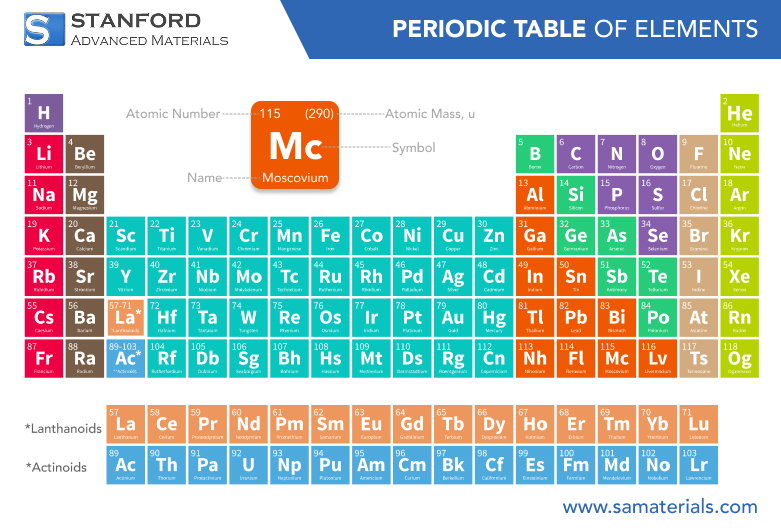
Moscovium is an artificially produced element that has an atomic number of 115 and is denoted by the symbol Mc. Moscovium is one of the heavy elements that are only found in the far-off regions of the Periodic Table, where the atoms are so large that their positively charged nuclei are no longer stable.
Moscovium does not naturally occur in nature but is produced in advanced scientific labs. Since its half-life is measured in milliseconds, Moscovium is short-lived and decreases in mass to form other elements. In fact, despite its extremely short lifespan, its existence is sufficient to serve as an indispensable verification in scientific theory of its "island of stability."
Discovery, History, and Naming
The first reported synthesis of the element Moscovium took place in 2003 by a team of Russian and American scientists from the Joint Institute for Nuclear Research (JINR) located in Dubna, Russia, together with the Lawrence Livermore National Laboratory located in the United States. Scientists synthesized a few atoms of the element 115 by fusing an americium-243 atom with calcium-48 ions using a particle accelerator.
When it was first discovered, it was given a temporary name based on its systematic name, "ununpentium" or "Uup," which comes from the Latin numbering system. Over the following years, further experiments showed the existence and properties of the element's decay, thus providing evidence for validation.
In 2015, element 115 was formally acknowledged in its name, "Moscovium," by the International Union of Pure and Applied Chemistry (IUPAC) in recognition of its geographical connection to the region of Moscow, in which JINR resides. The name reflects the continued contributions made in the research of super-heavy elements in the Russian nuclear research communities. It is one of a set of new elements that emphasize global scientific collaboration, rather than the individual researchers' contributions.
Atomic & Nuclear Properties
Moscovium is a p-block element and a member of group 15 of the periodic table, below bismuth. However, because of its very high atomic number, relativity influences the electronic structure of Moscovium greatly, making it very different from the other elements in the same group.
The most stable isotopes of Moscovium have an atomic mass between 286 and 290. Even its longest-lived form has a half-life measured in less than one second. These elements decay mostly through alpha decay, forming nihonium and then progressing to form lighter and stable elements.
Researching the decay chain of Moscovium can be very enlightening for scientists to better understand the stability of elements and develop predictive models for elements further down the periodic table of elements.
Chemical Properties Description
Due to the fact that Moscovium atoms have a very short lifetime and exist in tiny quantities, sometimes in terms of merely a few atoms, their chemical properties have not yet been directly observed in conventional lab tests. This is due to the fact that scientists have no other choice but rely heavily on calculations and predictions.
Theoretical calculations predict that Moscovium might differ in characteristics from other Group 15 elements like nitrogen, phosphorus, and bismuth. Because of the effects of relativity, the outermost electrons in Moscovium might be bound more strongly, and lower oxidation states, for example, +1 or +3, could be favored over higher states. Oxidation states up to +5 might be possible, but their stability is a question.
Some theories also advance the possibility of Moscovium having metallic or semi-metallic properties rather than behaving in a typical pnictogenic manner. The peculiar prediction associated with Moscovium's properties has made it an extremely interesting element in the development of theoretical chemistry despite the difficulties in verifying these theoretical properties through experimentation.
Preparation and Synthesis Methods
The isolation process for Moscovium involves sophisticated processes involving nuclear fusion. This takes place in a particle accelerator facility. One method used to make it entails bombarding a target isotope, which in this case is americium-243, using calcium-48 ions.
When a calcium nucleus merges successfully with an americium nucleus, a very excited element, known as the compound nucleus, is formed. If the excited element lives long enough to emit a few neutrons rather than disintegrating, a Moscovium atom is formed. The chances of its formation are very low, and at times, no more than a few atoms are obtained after weeks and months of non-stop experimentation.
Detection involves tracking decay patterns, rather than direct observation. Advanced detection devices are capable of tracking alpha particle emissions and spontaneous fission occurrences, providing a means for scientists to verify the existence of element 116, Moscovium, indirectly.
Scientific Significance and Value of Research
There are also no known uses of Moscovium yet. This is attributed to the fact that it is not stable. Moscovium is purely used in scientific research. One area where the study of Moscovium is valuable is in testing the nuclear shell models or verifying predictions regarding the limits of the periodic chart.
The production of Moscovium is further related to the general search for the "island of stability," where superheavy elements could have relatively long half-lives. Although Moscovium itself is not located in this region, it serves as one of the tools in the search for heavier, perhaps stable, elements.
Frequently Asked Questions
What is Moscovium?
Moscovium is a synthetic radioactive element with atomic number 115, created artificially in nuclear research laboratories.
How was Moscovium discovered?
It was first synthesized in 2003 through nuclear fusion experiments involving americium and calcium ions at JINR in Russia.
Why is Moscovium named Moscovium?
The name honors the Moscow region, recognizing the contributions of Russian research institutions to superheavy element discovery.
Does Moscovium have any practical uses?
No. Due to its extremely short half-life, Moscovium is used only for fundamental scientific research.
Why is Moscovium important to science?
It helps scientists understand nuclear stability, relativistic effects, and the theoretical limits of the periodic table.


 Chin Trento