
 Products
 Bars
Bars
 Beads & Spheres
 Bolts & Nuts
 Crucibles
 Discs
Discs
 Fibers & Fabrics
 Films
Films
 Flake
Flake
 Foams
Foams
 Foil
Foil
 Granules
 Honeycombs
 Ink
Ink
 Laminate
 Lumps
Lumps
 Meshes
 Metallised Film
 Plate
Plate
 Powders
 Rod
Rod
 Single Crystals
 Sputtering Target
 Tubes
Tubes
 Washer
 Wires
Wires
 Converters & Calculators
 Write for Us



Nihonium: Element Properties and Uses

Description
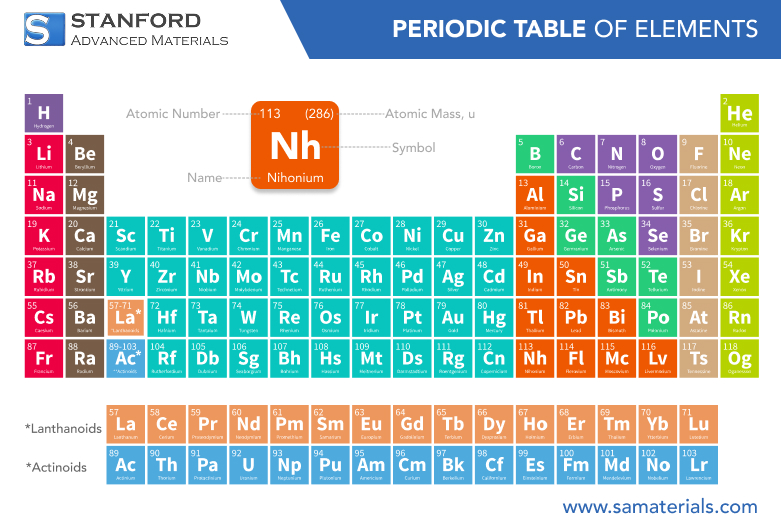
Nihonium (Nh) is a very radioactive artificially produced element with atomic number 113. It is very unstable, with isotopes that possess half-lives of a few milliseconds to about 20 seconds. Because of its rapid decay, most of its chemical and physical properties are theoretically predicted and not really established. According to periodic trends, Nihonium is a post-transition metal in group 13 with similar properties to light homologues such as thallium.
Discovery of Nihonium
Nihonium was first synthesized in 2003 by researchers from Japan in the RIKEN lab. The scientists bombarded targets of bismuth-209 with zinc-70 ions, which created Nihonium-278 atoms through a process of fusion. Alpha-particle spectroscopy was employed to identify as the formed atoms decayed nearly immediately and emitted characteristic alpha particles.
The formal naming of Nihonium as an element was approved by IUPAC in 2015 and was formally named in 2016, with the name "Nihonium" being taken from the Japanese term for Japan, "Nihon," in honor of where it was discovered.
Isotopes and Stability
So far, a series of isotopes of Nihonium have been made, with masses ranging from 278 to 286.
|
Isotope |
Production Method |
Half-Life |
Decay Mode |
|
Nihonium-278 |
⁷⁰Zn + ²⁰⁹Bi |
~0.7 ms |
Alpha decay |
|
Nihonium-284 |
⁴⁸Ca + ²⁴³Am |
~0.5 s |
Alpha decay |
|
Nihonium-286 |
Secondary decay chain |
~20 s |
Alpha decay, spontaneous fission |
Nihonium-286 is the longest-lived currently known isotope, lasting long enough for chemical prediction and theoretical modeling. Scientists believe that elements near Nihonium might approach the "island of stability," a postulated region where superheavy nuclei would possess greatly extended half-lives.
Chemical Properties Description
Even with limited experimental data due to Nihonium's short half-life, theoretical predictions paint an unambiguous picture:
|
Property |
Predicted Value / Notes |
|
Atomic Number |
113 |
|
Most Stable Isotope |
Nihonium-286 |
|
Half-life |
20 seconds (Nihonium-286), <1 second for lighter isotopes |
|
Electron Configuration |
[Rn] 5f¹⁴6d¹⁰7s²7p¹ |
|
Density |
~16–17 g/cm³ (predicted) |
|
Melting Point |
Unknown; estimated >700°C |
|
Boiling Point |
Unknown; expected >1400°C |
|
Oxidation States |
+1 and +3 likely; +3 analogous to thallium |
|
Chemical Reactivity |
Predicted to form halides and oxides; relativistic effects may reduce metallic character |
For more information, please check Stanford Advanced Materials (SAM).
Notable Properties:
• Because of its high atomic number, relativistic effects are very important in its electron orbitals, reducing reactivity compared to thallium most likely.
• Expected to have Nihonium(I) such as TlCl and Nihonium(III) such as TlCl₃.
Methods of Preparation
Nihonium is synthesized in high-energy particle accelerators through heavy-ion nuclear fusion. The process involves:
1.Accelerating zinc-70 ions at high velocity.
2.Bombardment of bismuth-209 targets to induce fusion, creating individual Nihonium nuclei.
3.Monitoring decays by alpha spectroscopy or automated nuclear detection arrays.
The preparation is conducted in ultra-high vacuum conditions with precise beam alignment and very sensitive detectors as a result of the rapid decay of the element.
Applications of nihonium
Applications of nihonium in technology are extremely restricted because of its short half-life. However, its production has resulted in:
•Scientific Research: Nihonium provides details about nuclear structure, superheavy element stability, and relativistic effects on chemistry.
•Technological Advances: Technology and methodology developed for its creation have advanced the field in particle accelerator technology, nuclear detection techniques, and material analysis equipment.
•Isotope Production Methods: Techniques refined through Nihonium work lead to the production of artificial isotopes for industrial and medical purposes.
There are no industrial applications of the element itself, but the discovery helps in basic materials and nuclear science research.
Frequently Asked Questions
What is Nihonium?
An artificially produced, short-lived, very radioactive element (atomic number 113) with very short-lived isotopes.
How is Nihonium produced?
Through nuclear fusion within particle accelerators, typically by bombarding targets of bismuth with zinc ions.
What are its chemical properties?
Projected to be a post-transition metal with +1 and +3 oxidation states, possessing halides and oxides, with relativistic effects suppressing reactivity.
Why is Nihonium not very useful?
Its rapid decay and extreme instability exiles practical applications; its value is found in nuclear experimental science.
Are there industrial uses associated with Nihonium?
Although Nihonium itself is not used industrially, methods of synthesis and detection technology benefit nuclear science, isotope production, and advanced instrumentation technologies.


 Chin Trento