Products
 Bars
Bars
 Beads & Spheres
 Bolts & Nuts
 Crucibles
 Discs
Discs
 Fibers & Fabrics
 Films
Films
 Flake
Flake
 Foams
Foams
 Foil
Foil
 Granules
 Honeycombs
 Ink
Ink
 Laminate
 Lumps
Lumps
 Meshes
 Metallised Film
 Plate
Plate
 Powders
 Rod
Rod
 Single Crystals
 Sputtering Target
 Tubes
Tubes
 Washer
 Wires
Wires
 Converters & Calculators
 Write for Us



Copernicium: Element Properties and Uses

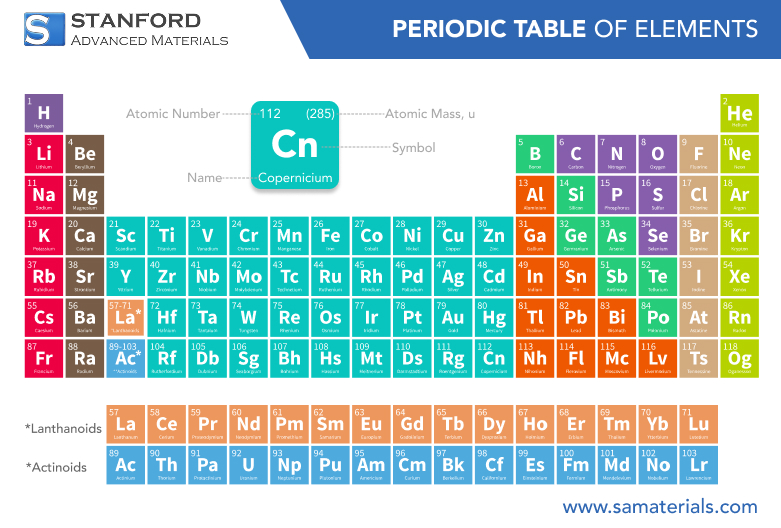
Copernicium (Cn), with the atomic number 112, is a synthetic superheavy element that was first discovered in 1996. It is named in honor of the astronomer Nicolaus Copernicus and has intrigued scientists for its potential applications in research and the study of superheavy elements.
Discovery and Naming
Copernicium was first synthesized at the GSI Helmholtz Centre for Heavy Ion Research in Darmstadt, Germany, by a team of scientists led by Sigurd Hofmann in 1996. The discovery was the result of a fusion reaction between zinc-70 and lead-208 nuclei. This reaction produced a single atom of copernicium, which decayed after only a few milliseconds. Copernicium was officially recognized by the International Union of Pure and Applied Chemistry (IUPAC) in 2009, and its name was chosen to honor Nicolaus Copernicus, the Polish astronomer who proposed the heliocentric model of the solar system.
Production
As a synthetic element, copernicium cannot be found naturally and is produced in a laboratory setting. It is typically created in particle accelerators by fusing lighter nuclei. In the case of copernicium, the most common method involves bombarding zinc-70 ions with lead-208 target nuclei. This process creates a compound nucleus, which then decays rapidly into different elements, including copernicium. The production of copernicium is highly challenging because it involves the creation of superheavy elements that are extremely unstable and decay quickly. The small amounts produced and their short half-lives make studying the element difficult, requiring advanced detection and research techniques.
Properties
Copernicium belongs to Group 12 of the periodic table and is expected to share some chemical properties with other group 12 elements like zinc, cadmium, and mercury. However, because of its position as a superheavy element, its physical and chemical properties are not fully understood due to its instability and the difficulty in synthesizing large quantities. Here are some predicted properties:
- Atomic Number: 112
- Appearance: Copernicium is presumed to be a metallic element, though its exact appearance is not well-documented due to the short lifespan of the atoms.
- Density: It is predicted to have a density around 15 g/cm³, making it relatively heavy compared to many other metals.
- Chemical Behavior: Copernicium is thought to exhibit properties similar to mercury, including being a soft, liquid metal at room temperature. However, due to relativistic effects, its properties could differ significantly from those of mercury, particularly in its chemical bonding and reactivity.
Isotopes
Copernicium has several isotopes, the most stable of which is copernicium-285, which has a half-life of about 29 seconds. Other isotopes include copernicium-283 and copernicium-284, but they have much shorter half-lives, making their study more challenging. The isotopes of copernicium undergo rapid alpha decay, which means they emit helium-4 nuclei in the form of alpha particles, leading to the formation of lighter elements. The study of these isotopes contributes to the broader understanding of nuclear physics and the behavior of superheavy elements.
Superheavy Elements
Copernicium is a member of the superheavy elements, a group of elements beyond uranium, which have atomic numbers greater than 92. These elements are typically created in particle accelerators and have highly unstable isotopes that decay rapidly. The quest to synthesize and study these elements is driven by the desire to understand the limits of the periodic table, nuclear stability, and the theory of nuclear reactions at extreme conditions. Superheavy elements like copernicium are also central to research on the island of stability, a theoretical region of the periodic table where certain superheavy elements may have relatively longer half-lives due to favorable nuclear configurations.
Research and Uses
Research into copernicium is primarily focused on understanding its chemical behavior and nuclear properties. Because copernicium exists only in trace amounts and decays rapidly, its practical applications remain limited. However, its study has important implications for nuclear chemistry, materials science, and the synthesis of superheavy elements.
- Scientific Research: Copernicium plays a role in the ongoing investigation of theoretical chemistry and nuclear physics. By studying its properties, scientists hope to learn more about how superheavy elements behave, the stability of their nuclei, and the potential for creating elements with longer lifespans.
- Medical and Industrial Applications: While no immediate practical applications have been discovered, the research on copernicium could lead to advancements in radiation therapy, nuclear medicine, and the creation of new materials with unique properties. However, due to its instability and the minute quantities in which it is produced, copernicium is not yet used commercially.
Conclusion
Copernicium is a fascinating and enigmatic element, primarily valued for its contribution to scientific research rather than any immediate practical applications. Its synthesis has expanded our understanding of superheavy elements and their behavior at the edges of the periodic table. As experimental techniques improve and more stable isotopes are potentially synthesized, copernicium may one day play a more significant role in the world of nuclear physics and materials science.
Frequently Asked Questions
- What is Copernicium used for?
Currently, copernicium is used primarily for scientific research in the fields of nuclear chemistry, physics, and theoretical studies of superheavy elements. It has no practical applications yet due to its extreme instability.
- How was Copernicium discovered?
Copernicium was discovered in 1996 by a team of scientists at the GSI Helmholtz Centre for Heavy Ion Research in Darmstadt, Germany, by bombarding zinc-70 ions with lead-208 nuclei.
- What is the most stable isotope of Copernicium?
The most stable isotope of copernicium is copernicium-285, which has a half-life of about 29 seconds.
- Why is Copernicium important in science?
Copernicium helps scientists study the behavior of superheavy elements, nuclear stability, and theoretical chemistry, contributing to our understanding of the limits of the periodic table.
- Can Copernicium be used in medicine?
While there are no immediate applications of copernicium in medicine, the research into superheavy elements may eventually lead to advancements in nuclear medicine and radiation therapy.


 Chin Trento