
 Products
 Bars
Bars
 Beads & Spheres
 Bolts & Nuts
 Crucibles
 Discs
Discs
 Fibers & Fabrics
 Films
Films
 Flake
Flake
 Foams
Foams
 Foil
Foil
 Granules
 Honeycombs
 Ink
Ink
 Laminate
 Lumps
Lumps
 Meshes
 Metallised Film
 Plate
Plate
 Powders
 Rod
Rod
 Single Crystals
 Sputtering Target
 Tubes
Tubes
 Washer
 Wires
Wires
 Converters & Calculators
 Write for Us



Roentgenium: Element Properties and Uses

Description
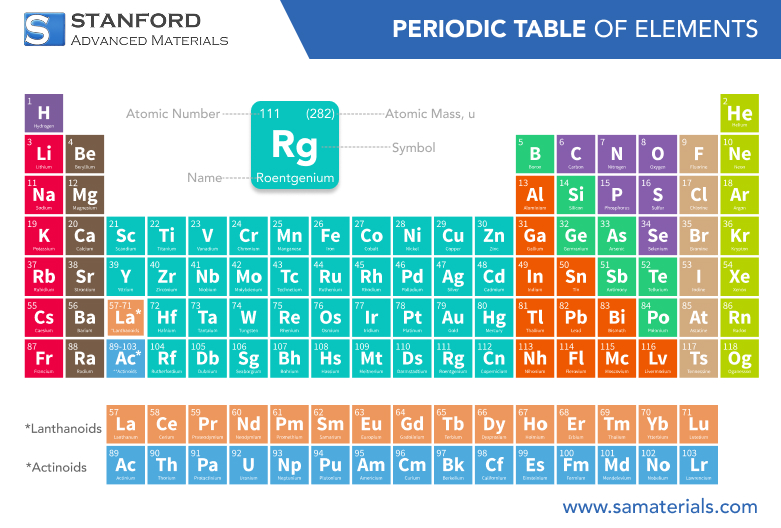
Roentgenium (symbol Rg, atomic number 111) is a synthetic, radioactive metal that has a lifespan of little more than a fraction of a second before it disintegrates. Though its short life span means there can be no direct industrial application, it remains a source of fascination to scientists studying the limits of the periodic table and the behavior of superheavy elements.
Introduction to Roentgenium
Discovered in 1994 by scientists at Germany's Gesellschaft für Schwerionenforschung (GSI) in Darmstadt, Germany, roentgenium was given the name of Wilhelm Conrad Röntgen, the physicist who originally discovered X-rays. As a superheavy element, roentgenium does not occur naturally; it must be produced through high-energy particle collisions.
Because few atoms have ever been made, the physical properties of roentgenium—color, density, and melting point—exist largely on paper. However, scientists expect that it will have some characteristics similar to gold (Au) and silver (Ag) due to its location in Group 11 of the periodic table.
For additional information, please visit Stanford Advanced Materials (SAM).
Atomic and Physical Properties
|
Property |
Value (Predicted or Observed) |
|
Atomic Number |
111 |
|
Symbol |
Rg |
|
Element Category |
Transition Metal (Superheavy) |
|
Group / Period |
11 / 7 |
|
Density (Predicted) |
~28.7 g/cm³ |
|
Melting Point (Estimated) |
~700–800°C |
|
Half-Life |
Ranges from milliseconds to seconds, depending on isotope |
|
Most Stable Isotope |
Rg-282 |
Chemical Properties Description
The chemistry of roentgenium has been studied primarily by relativistic quantum chemistry calculations and model theory. Because single atoms in isolation are not available before they break down, experimental work depends largely on calculations and simulations.
• Group Similarity: Roentgenium is expected to exhibit gold-like (Au) and copper-like (Cu) properties by the formation of compounds such as RgCl or RgF₃ under specific conditions.
• Oxidation States: The anticipated normal oxidation states are +1 and possibly +3, based on patterns with other Group 11 elements.
• Relativistic Effects: Due to its highly relativistic atomic number, roentgenium's electrons experience very strong relativistic effects, which may give it unique bonding character unlike lighter isotopes.
How Roentgenium Is Made
Roentgenium is prepared through nuclear fusion reactions with the assistance of particle accelerators. The reaction entails the bombardment of a target of bismuth-209 (²⁰⁹Bi) using nickel-64 (⁶⁴Ni) ions at extremely high speeds:
209Bi+64Ni→272Rg+1n
Roentgenium-272 produced in the reaction decays immediately by alpha emission to lighter elements. The experiment requires precise energy tuning and advanced detection instrumentation, as typically only a few atoms are formed during an entire experimental run.
Applications and Scientific Significance
Due to its extremely short half-life (in seconds to milliseconds), roentgenium is not utilized in any commercial or industrial application. Its scientific importance, however, is significant:
• It helps scientists to be aware of nuclear stability and the theoretical "island of stability"—a theoretical region of longer-lived superheavy nuclei.
• Application techniques utilized in generating roentgenium, such as ion acceleration, target production, and detection methods, are used towards the development of nuclear physics instrumentation and particle beam technology.
• Findings from roentgenium experiments also enhance theoretical models of relativistic quantum mechanics and heavy-element periodic trends.
Interesting Facts
• December 8, 1994, was the first time roentgenium was observed at the GSI Helmholtz Centre for Heavy Ion Research.
• The discovery was confirmed by decay chain analysis, correlating it with known isotopes of meitnerium and iridium.
• Less than ten atoms have ever been synthesized, existing for mere milliseconds.
• The element's behavior is so transient that no direct measurement of color, density, or chemical reactivity has yet been taken.
Frequently Asked Questions
What is Roentgenium?
Roentgenium (Rg) is a synthetic, radioactive chemical element with atomic number 111, produced in particle accelerators by nuclear fusion reactions.
Why is it named Roentgenium?
It was named after German physicist Wilhelm Conrad Röntgen, who discovered X-rays in 1895.
How is Roentgenium made?
By colliding bismuth-209 with nickel-64 ions in a particle accelerator to produce Roentgenium-272 or other isotopes similar to it.
Why is Roentgenium unstable?
Its superheavy nucleus is so proton-rich that it radiologically decays quickly, with no room for stable existence.
Is Roentgenium useful?
There are no applications yet. Its production and study are useful to nuclear science and the understanding of atomic behavior at extreme proton numbers, however.
What elements are chemical analogues for Roentgenium?
It ought to be similar in chemistry to gold, silver, and copper, all Group 11 elements.


 Chin Trento