Products
 Bars
Bars
 Beads & Spheres
 Bolts & Nuts
 Crucibles
 Discs
Discs
 Fibers & Fabrics
 Films
Films
 Flake
Flake
 Foams
Foams
 Foil
Foil
 Granules
 Honeycombs
 Ink
Ink
 Laminate
 Lumps
Lumps
 Meshes
 Metallised Film
 Plate
Plate
 Powders
 Rod
Rod
 Single Crystals
 Sputtering Target
 Tubes
Tubes
 Washer
 Wires
Wires
 Converters & Calculators
 Write for Us



Hassium: Element Properties and Uses

Description
Hassium is a synthetic, radioactive element with intriguing chemical and physical properties, used in advanced research and industrial applications worldwide.
Introduction to the Element
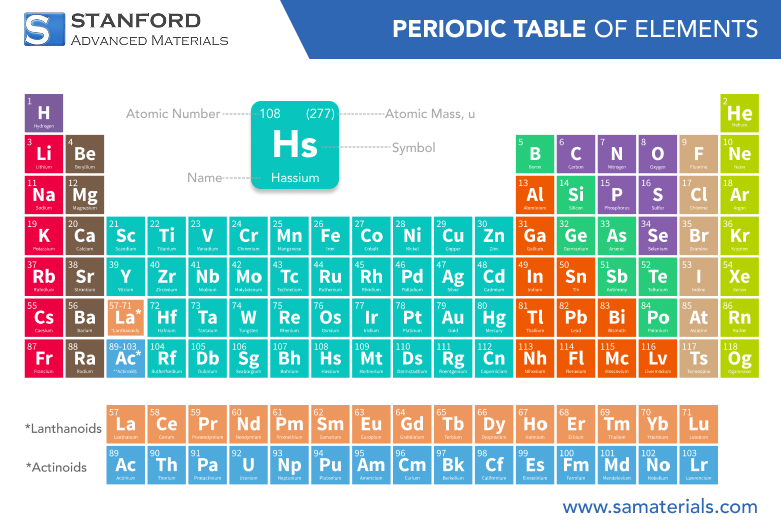
Hassium, with atomic number 108, is one of the most elusive elements on the periodic table. Classified as a transactinide metal, it was first synthesized in the 1980s under controlled laboratory conditions. As a member of the heavy elements group, hassium has captured scientific attention because its creation challenges modern experimental techniques and deepens our understanding of nuclear stability.
Chemical Properties Description
Hassium is among group 8 elements, which also includes metals like osmium. Due to its extremely short half-life, direct measurements of its chemical reactions remain limited. However, theoretical studies indicate that hassium is likely to exhibit oxidation states similar to its lighter counterparts, particularly the +8 state. Computational models suggest that the electron configuration of hassium may result in unusual bonding patterns influenced by relativistic effects.
Physical Properties Data Table
|
Property |
Value/Description |
|
Atomic Number |
108 |
|
Atomic Weight |
Estimated 265-277 u |
|
Density |
Estimated > 40 g/cm³ |
|
Melting Point |
Theoretical high melting point |
|
Boiling Point |
Not established |
|
Radioactivity |
Highly radioactive, short half-life |
For more information, please check Stanford Advanced Materials (SAM).
Preparation Methods
The preparation methods for hassium require advanced nuclear synthesis techniques that are performed in particle accelerators. In these experiments, a target material, such as lead or bismuth, is bombarded with a beam of ions, for instance, iron. The collision between these nuclei may result in the formation of hassium atoms. Because the production yield is extremely low—often only a handful of atoms are created—the experimental setup must be highly sensitive and precise.
Specialized detection equipment is used to confirm the presence of hassium, even if only for a fraction of a second before it decays. These preparation methods, while primarily serving academic and research purposes, have contributed to improvements in nuclear reaction technology and instrumentation used in high-energy physics laboratories.
Frequently Asked Questions
What is hassium?
Hassium is a synthetic, radioactive element with atomic number 108, produced in
high-energy particle collisions.
How is hassium produced?
It is produced using heavy-ion collisions in particle accelerators where target
materials are bombarded with ion beams.
What are the chemical properties of hassium?
Its chemical properties are largely theoretical, based on its group placement
and predicted oxidation states similar to osmium.
Why is hassium mainly used in research?
Due to its extreme instability and short half-life, hassium is used primarily
for testing nuclear theories and refining experimental techniques.
Are there any practical applications of hassium in industry?
Hassium itself is not used industrially, but research techniques developed
through its study have improved related industrial products.


 Chin Trento