
 Products
 Bars
Bars
 Beads & Spheres
 Bolts & Nuts
 Crucibles
 Discs
Discs
 Fibers & Fabrics
 Films
Films
 Flake
Flake
 Foams
Foams
 Foil
Foil
 Granules
 Honeycombs
 Ink
Ink
 Laminate
 Lumps
Lumps
 Meshes
 Metallised Film
 Plate
Plate
 Powders
 Rod
Rod
 Single Crystals
 Sputtering Target
 Tubes
Tubes
 Washer
 Wires
Wires
 Converters & Calculators
 Write for Us



Meitnerium: Element Properties and Uses

Description
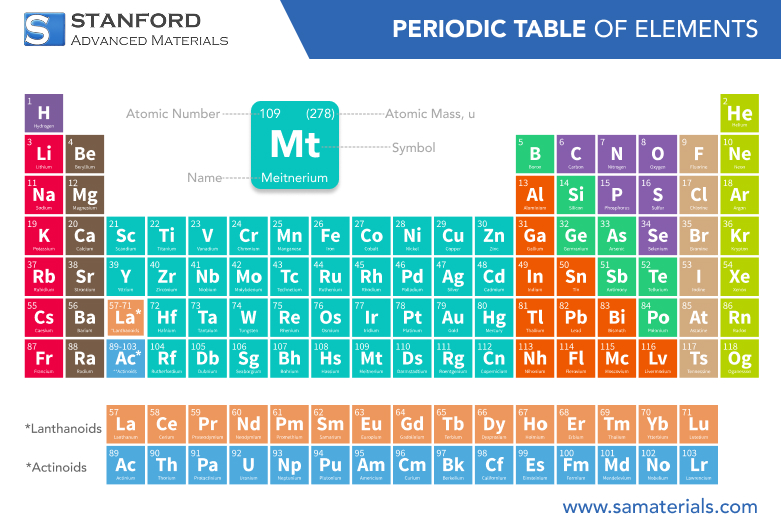
Meitnerium (element 109) is a synthetic superheavy metal with distinct chemical and physical traits, a short half-life, and—unlike commercially available transition metals—no industrial applications.
Introduction to the Element
Meitnerium is one of the rare synthetic elements that have been created in a laboratory setting. Discovered through advanced nuclear experiments, it is named in honor of the renowned nuclear physicist Lise Meitner. As element 109 on the periodic table, its creation required specialized conditions, and only a few atoms have ever been produced. Because of its extremely short half-life, most of what is known about meitnerium is based on theoretical predictions and limited experimental evidence.
Stanford Advanced Materials (SAM) supplies a wide range of transition metals and rare earth elements for research and industry—view our product categories.
Chemical Properties Description
As a member of the transition metals, meitnerium is expected to exhibit properties similar to its lighter congeners in Group 9, such as cobalt and rhodium. The element is believed to adopt oxidation states that range from +1 to +3, although experiments have been severely limited by its short half-life. Its reactivity, bonding characteristics, and potential to form compounds are topics of ongoing research.
Common Uses
Unlike commercially available transition metals such as cobalt or rhodium, meitnerium is produced only in microscopic quantities for fundamental research and has no industrial applications. The few atoms produced are utilized in experiments aimed at understanding the fundamental aspects of atomic nuclei and the forces that hold them together.
Preparation Methods
The preparation methods for meitnerium involve sophisticated nuclear fusion reactions in particle accelerators. In controlled laboratory conditions, a target composed of a heavy element is bombarded with accelerated ions of a lighter element. This process creates a fusion reaction that forms meitnerium atoms, albeit in extremely small amounts. Such methods require precise control over energy and reaction conditions, as well as highly sensitive detection equipment.
Frequently Asked Questions
What is meitnerium?
Meitnerium is a synthetic superheavy element with atomic number 109, created in laboratory conditions and named after Lise Meitner.
How is meitnerium produced?
It is produced by nuclear fusion reactions in particle accelerators, where a heavy target is bombarded by ions, resulting in the formation of meitnerium atoms.
Why is meitnerium so unstable?
Its instability stems from its superheavy nucleus, which has a very short half-life due to rapid radioactive decay, making experimental studies challenging.
Are there any practical applications for meitnerium?
No. Unlike materials we supply such as cobalt, rhodium, or other transition metals, meitnerium has no industrial or commercial applications. It exists only in research settings.
How does meitnerium contribute to scientific research?
Despite its instability, studying meitnerium helps scientists understand nuclear forces and the behavior of superheavy elements, influencing the design of advanced detection instruments and safety protocols.
Stanford Advanced Materials (SAM) offers high-purity transition metals, rare earth elements, and advanced materials for research and industry. Browse our catalog or contact us for specific requirements.

 Chin Trento