Products
 Bars
Bars
 Beads & Spheres
 Bolts & Nuts
 Crucibles
 Discs
Discs
 Fibers & Fabrics
 Films
Films
 Flake
Flake
 Foams
Foams
 Foil
Foil
 Granules
 Honeycombs
 Ink
Ink
 Laminate
 Lumps
Lumps
 Meshes
 Metallised Film
 Plate
Plate
 Powders
 Rod
Rod
 Single Crystals
 Sputtering Target
 Tubes
Tubes
 Washer
 Wires
Wires
 Converters & Calculators
 Write for Us



Bohrium: The Ghost Superheavy Element

Introduction
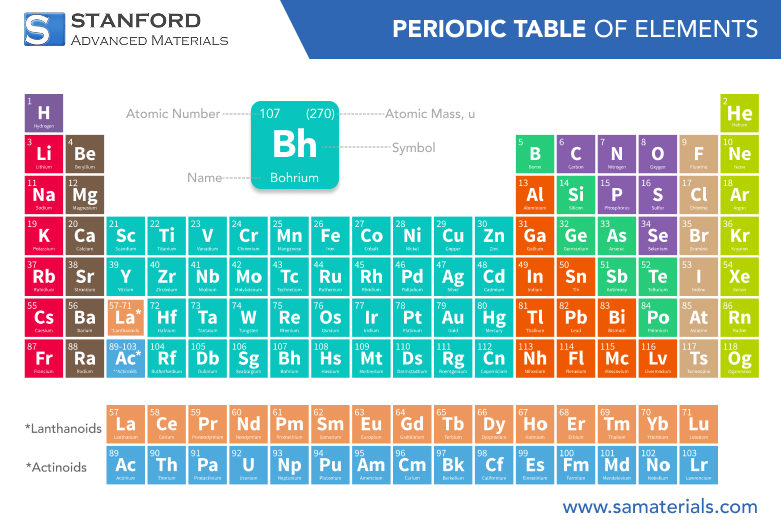
Bohrium (Bh), atomic number 107, is perhaps the most transitory and least common element on Earth. In contrast to familiar metals such as copper or iron, Bohrium never occurs naturally on our planet. Bohrium is an artificial, radioactive element created exclusively in high-energy nuclear laboratories with the assistance of particle accelerators. Its production is the outcome of high-energy collisions involving heavy ions and target nuclei, and researchers only ever observe a few atoms at a time, lasting milliseconds to seconds before they break down. Despite its brief lifetime, Bohrium has been useful in expanding our information regarding superheavy elements and the reach of the periodic table.
A Brief History
The journey to Bohrium began in the 1980s, when nuclear scientists were testing the boundaries of atomic research. The Darmstadt team in Germany, in 1981, synthesized the first Bohrium isotopes. They synthesized Bohrium-262 by bombarding chromium-54 ions on targets of bismuth-209, and they established that superheavy elements beyond Meitnerium could indeed be synthesized.
The element was given its formal name Bohrium in 1997, in honor of Niels Bohr, whose work on atomic structure and quantum theory provided the foundation for the knowledge of heavy elements. The discovery of Bohrium was not only a laboratory success; it validated nuclear stability models, decay chains, and relativistic influences in superheavy elements.
Chemical Properties Description
Bohrium belongs to group 7 of the periodic table and is hence the heavier homolog of rhenium. Because of its extremely short half-life, few direct experiments exist and most of the properties are theoretical calculations:
• Oxidation state: Theoretically expected to be +7, similar to rhenium.
• Density: Based on estimates to be around 29 g/cm³.
• Melting and boiling points: Not yet experimentally fixed but speculated to be very high because of metallic bonding.
• Atomic weight: Approximately 270, as confirmed by the most stable isotope (Bh-270).
Predicted chemical behavior would cause Bohrium to produce volatile oxides and behave like a transition metal, but experimental verification is nearly impossible because very few atoms can be made at one time.
How Bohrium Is Made
Synthesizing Bohrium is an art of precision and exercising very precise control. In an experiment, ions such as chromium-54 are made to go at high speed and are bombarded on bismuth-209 targets. Nuclear fusion reactions between them from time to time form a Bohrium nucleus, which is trapped using the assistance of alpha spectroscopy and other rapid analytical techniques before it decays. Isotopes of Bohrium have extremely short half-lives—anywhere from milliseconds to a few seconds—and detection and identification must be nearly instant.
This meticulous process has broader scientific connotations. The process developed for the synthesis of Bohrium has guided the manufacturing of other synthetic isotopes, particularly in medicine.
Applications and Impacts
Though Bohrium itself has no industrial application due to its unstable nature, the research that is done on it has immense impacts:
1.Scientific Discovery: Bohrium experiments allow scientists to probe superheavy elements and island of stability predicted, where heavier nuclei might live longer. This research provides insight into nuclear structure and relativistic effects in heavy atoms.
2.Nuclear Technology: Methods used to create Bohrium advance particle accelerator technology and detection methods for nuclear particles, which can be applied to creating isotopes for medicine and research.
3. Medical Isotopes: While Bohrium itself has no medical applications, methods developed to analyze and synthesize Bohrium have been employed to produce technetium-99m, the most widely utilized diagnostic isotope used in medical imaging, illustrating the way research at high nuclear levels can have practical implications.
4. Materials Science: The procedures developed for processing and analyzing superheavy elements have entered precision materials processing, particularly in high-temperature or high-radiation conditions.
Conclusion
Briefly, although Bohrium will never be seen in everyday technology, it is a pinnacle of human scientific achievements. The existence and investigation of this fleeting element not only increase our understanding of the periodic table but also prompt advances in nuclear science, medicine isotopes, and material sciences, proving that even the most evasive atoms can leave a lasting impact. For more information, please check Stanford Advanced Materials (SAM).
Frequently Asked Questions
What is Bohrium?
Bohrium is a very radioactive man-made element (atomic number 107) produced in particle accelerators.
How is it produced?
By smashing heavy nuclei like bismuth with high-energy ions like chromium in highly controlled laboratory conditions.
Does it behave like other metals?
Theoretical models predict Bohrium will behave like rhenium, particularly in oxidation states and chemical reactions, although experimental confirmation is very limited.
Can it be used in industry?
No. Its half-life is too long for any practical uses.
Why is it significant?
Bohrium provides a glimpse into the behavior of superheavy elements, improves nuclear chemistry techniques, and indirectly contributes to the study of synthetic isotopes and advanced materials.
 Chin Trento