
 Products
 Bars
Bars
 Beads & Spheres
 Bolts & Nuts
 Crucibles
 Discs
Discs
 Fibers & Fabrics
 Films
Films
 Flake
Flake
 Foams
Foams
 Foil
Foil
 Granules
 Honeycombs
 Ink
Ink
 Laminate
 Lumps
Lumps
 Meshes
 Metallised Film
 Plate
Plate
 Powders
 Rod
Rod
 Single Crystals
 Sputtering Target
 Tubes
Tubes
 Washer
 Wires
Wires
 Converters & Calculators
 Write for Us



Seaborgium: Element Properties and Uses

Seaborgium is a synthetic, radioactive element with unique chemical and physical properties, providing insight into advanced nuclear research and theoretical element behavior.
Introduction to Seaborgium
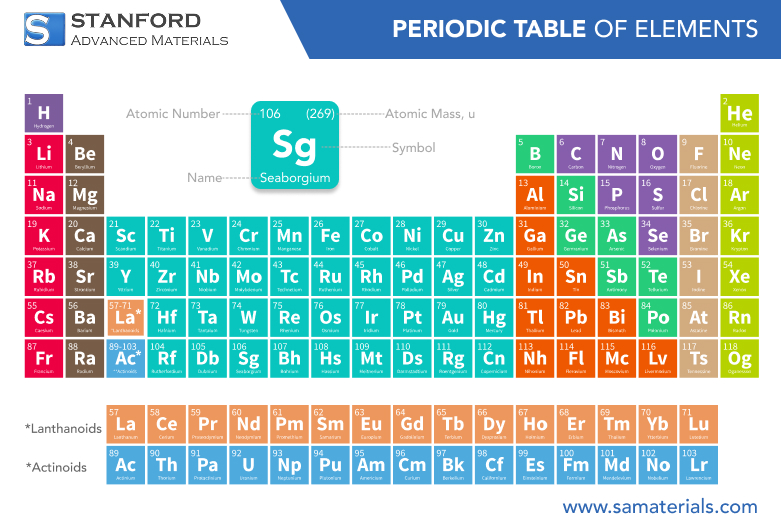
Seaborgium is an artificially produced element with an atomic number of 106 and the chemical symbol Sg. Seaborgium is included in the group 6 elements of the periodic table, which makes it the element following tungsten and molybdenum in the periodic table. Seaborgium is not found in nature because it is extremely unstable. Every atom of seaborgium that has been studied so far was artificially produced with the help of sophisticated accelerators. Most of these artificially produced atoms of seaborgium decay within seconds.
Seaborgium is of immense scientific importance, even with the limitations that it faces. Seaborgium assists scientists in testing whether periodic trends continue to persist in the case of super-heavy elements, in addition to the relativistic effects that occur due to the very high nuclear charge.
Discovery and Naming
The discovery of Seaborgium marked a scientific and historical milestone in the annals of chemical and nuclear history. In the early 1970s, scientists in the United States and the Soviet Union simultaneously pursued the synthesis of the 106th chemical element. In 1974, a team of scientists at the Lawrence Berkeley National Laboratory (LBNL) in California successfully synthesized Seaborgium by bombarding a californium-249 target with oxygen-18 ions. Simultaneously, a team of scientists at the Joint Institute for Nuclear Research (JINR) in Dubna, Russia, achieved a similar result through different nuclear reactions.
The naming of Seaborgium was a point of controversy among scientists and chemists. The American scientists suggested the name Seaborgium in recognition of the pioneering nuclear chemist Glenn T. Seaborg, who discovered several transuranic elements and changed the periodic table of elements. The suggestion was challenged on the grounds that Seaborg was alive when the element was discovered—an unprecedented occurrence in the history of chemical elements. After much debate and discussion over several years, the International Union of Pure and Applied Chemistry (IUPAC) officially approved the name Seaborgium in 1997—the first time an element was named after a living scientist.
The decision underscored Seaborg's immense influence on nuclear science and cemented element 106 as a symbol of modern, laboratory-driven chemistry.
Chemical Properties
Due to the small amount of seaborgium that can be synthesized at any given time, the chemical properties of seaborgium can only be predicted computationally. Seaborgium is predicted to display similar properties to the elements tungsten (W) and molybdenum (Mo) since it is in the same group.
The most stable oxidation state of seaborgium that is significant in terms of chemistry is +6, similar to the other elements in the group. Seaborgium is predicted to display the properties of the group 6 transition metals since it can form volatile hexachlorides, which were verified by the use of rapid chemical separation techniques. Seaborgium can form SgCl₆.
Relativistic effects in seaborgium chemistry
Seaborgium is different from the elements in the same group in that relativistic effects play a significant role in the chemistry of seaborgium compared to the elements in the group. Due to the highly positive charge of the nucleus of seaborgium, the innermost electrons move at almost the speed of light.
Physical Properties
The physical properties of seaborgium remain largely theoretical due to its extremely short half-life and the impossibility of producing macroscopic samples. Computational simulations and periodic trends provide the best estimates for its characteristics.
|
Property |
Predicted Value |
|
Atomic Number |
106 |
|
Atomic Mass |
Not well established |
|
Density |
~35 g/cm³ |
|
Melting Point |
~2200 K |
|
Boiling Point |
~4000 K |
These predictions suggest that seaborgium would be a very dense, high-melting-point metal, similar in appearance and structure to tungsten if it could exist in bulk form. For more information, please check Stanford Advanced Materials (SAM).
Isotopes of Seaborgium
All known isotopes of seaborgium are radioactive and have a very short half-life. To date, several isotopes of seaborgium have been discovered, with mass numbers ranging from about Sg-258 to Sg-271.
Of these, seaborgium-269 and seaborgium-271 have relatively longer half-lives, measured in seconds. Although this appears to be a very short half-life, it is long enough to conduct a few chemical experiments with automated and ultrafast detection systems.
The study of seaborgium isotopes also aids in understanding nuclear shell effects and decay modes, as well as the theoretical "island of stability" that is hypothesized to exist for superheavy elements. Every new isotope of seaborgium that is created further refines the models of nuclear structure and stability at the top of the periodic table.
Preparation Methods
The production of seaborgium demands sophisticated and precise equipment. Seaborgium is synthesized via nuclear fusion reactions using particle accelerators. In this process, heavy target nuclei are bombarded with lighter ions at extremely high energies. The target materials used are lead, bismuth, or californium, and oxygen, neon, or chromium are used as projectiles.
The probability of synthesizing seaborgium is extremely low. Only a few atoms are synthesized in days or weeks of continuous experimentation. As soon as seaborgium is synthesized, it must be analyzed almost immediately before it disintegrates. Sophisticated equipment is mandatory for obtaining significant information.
Scientific Significance and Research Value
Although seaborgium has no industrial or commercial value, its scientific value is significant. Some of the areas where research on seaborgium plays an important role are as follows:
• Periodic trends for superheavy elements
• Relativistic effects in atomic and molecular chemistry
• Nuclear stability and decay
• The limits of element formation
Conclusion
Seaborgium represents the edge of modern chemistry and nuclear physics. Seaborgium is a synthetic and short-lived superheavy element that extends our understanding of chemical and atomic structures. Seaborgium's discovery, naming, isotopes, and properties have played an important role as tools for exploring the fundamental laws governing matter that are beyond the edge of the periodic table. Seaborgium's impact on science and discovery is significant, even though it remains confined to the laboratory.


 Chin Trento