Products
 Bars
Bars
 Beads & Spheres
 Bolts & Nuts
 Crucibles
 Discs
Discs
 Fibers & Fabrics
 Films
Films
 Flake
Flake
 Foams
Foams
 Foil
Foil
 Granules
 Honeycombs
 Ink
Ink
 Laminate
 Lumps
Lumps
 Meshes
 Metallised Film
 Plate
Plate
 Powders
 Rod
Rod
 Single Crystals
 Sputtering Target
 Tubes
Tubes
 Washer
 Wires
Wires
 Converters & Calculators
 Write for Us



Dubnium: Element Properties and Uses

Description
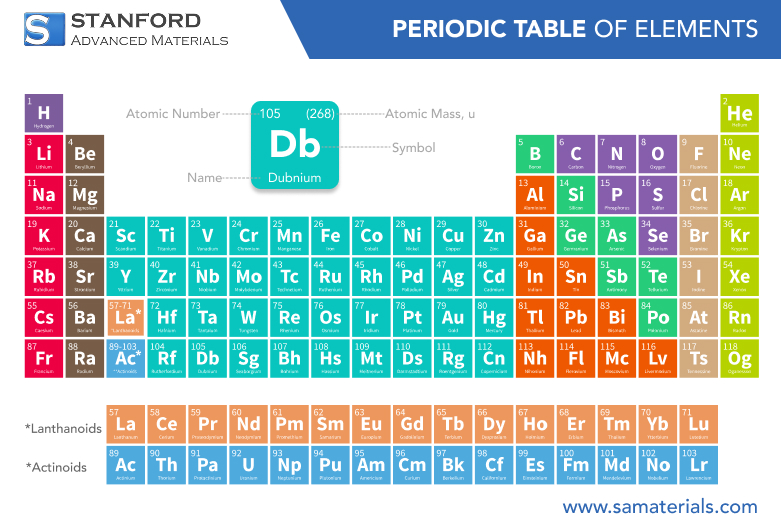
Dubnium is a synthetic radioactive element (atomic number 105) with unique chemical properties and predicted physical traits that intrigue scientific study.
Introduction to the Element
Dubnium is one of the superheavy elements synthesized in modern nuclear laboratories. As an introduction to the element, dubnium occupies a special place in the periodic table due to its position in group 5.
Although only a few atoms have ever been produced, its discovery has contributed significantly to our understanding of nuclear reactions and the limits of atomic structure. Named after the town of Dubna in Russia, where extensive research in nuclear physics is conducted, this element is characterized by its short half-life and the challenges it presents to scientists attempting to study it in detail.
Chemical Properties Description
The chemical properties description of dubnium is largely based on its position in the periodic table and the behavior of similar transition metals. Dubnium is predicted to exhibit a +5 oxidation state, a common trait among group 5 elements. In chemical reactions, it is expected to behave similarly to its lighter counterparts by forming compounds that could be analogues to those of vanadium, niobium, and tantalum.
However, due to its high radioactivity and extremely short half-life, practical experiments are limited, and most conclusions are derived from theoretical models and indirect chemical observations.
Physical Properties Data Table
|
Property |
Value |
|
Atomic Number |
105 |
|
Atomic Weight |
[262] (varies by isotope) |
|
Electron Configuration |
[Rn] 5f14 6d3 7s2 (predicted) |
This table represents the best current predictions of dubnium's physical properties based on periodic trends and theoretical models.
Preparation Methods
Due to its instability, dubnium cannot be isolated in bulk and is produced through nuclear reactions in particle accelerators. Typically, heavy ion bombardment is employed, where lighter nuclei are accelerated and directed to collide with heavier target atoms. In many cases, targets composed of elements such as americium or californium are used. When these targets are bombarded by ions, nuclear fusion may occur, resulting in the synthesis of dubnium atoms.
Common Uses
Given its short half-life and the minuscule quantities in which it is produced, dubnium has no practical common uses in everyday applications. Instead, its value lies in academic research and the theoretical insights it offers. Research on dubnium helps scientists refine models of nuclear structure and understand the behavior of matter under extreme conditions.
Related Materials from Stanford Advanced Materials
While dubnium itself is not commercially available, Stanford Advanced Materials supplies stable group 5 metals for research and industrial applications:
- Vanadium: Sheet, rod, powder
- Niobium: Sheet, rod, wire, sputtering targets
- Tantalum: Sheet, rod, wire, sputtering targets
All materials supplied with certifications. [Browse our products] or [contact us] for specifications.
Frequently Asked Questions
What is dubnium?
Dubnium is a synthetic radioactive element with atomic number 105, primarily produced in nuclear laboratories for research purposes.
How is dubnium produced?
Dubnium is synthesized using heavy ion bombardment in particle accelerators, where lighter nuclei are fused with heavier target atoms under extreme conditions.
What are the chemical properties of dubnium?
Its chemical properties, as described in its Chemical Properties Description, are inferred from its position in group 5, suggesting it may exhibit a +5 oxidation state like other transition metals.
Why does dubnium have no significant industrial use?
Due to its extremely short half-life and the challenges in producing it in substantial quantities, dubnium is used only in scientific research rather than in commercial applications.
What challenges are associated with studying dubnium?
Studying dubnium is difficult because of its high radioactivity, fleeting existence, and the need for specialized equipment to produce and detect even a few atoms.
 Chin Trento