
 Products
 Bars
Bars
 Beads & Spheres
 Bolts & Nuts
 Crucibles
 Discs
Discs
 Fibers & Fabrics
 Films
Films
 Flake
Flake
 Foams
Foams
 Foil
Foil
 Granules
 Honeycombs
 Ink
Ink
 Laminate
 Lumps
Lumps
 Meshes
 Metallised Film
 Plate
Plate
 Powders
 Rod
Rod
 Single Crystals
 Sputtering Target
 Tubes
Tubes
 Washer
 Wires
Wires
 Converters & Calculators
 Write for Us



Nobelium: Element Properties and Uses

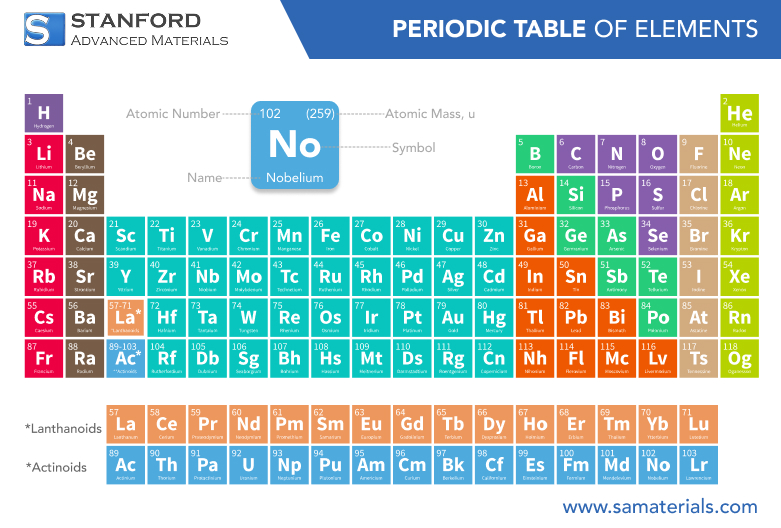
Nobelium is a synthetic radioactive element from the actinide series of the periodic table. Its atomic number is 102, and it is among the heavier transuranium elements—elements heavier than uranium on the periodic table. Since it is synthetic, has a short half-life, and is manufactured in small amounts, nobelium exists only in controlled laboratory environments. Though it finds no practical application in daily industry, this element is highly valuable in nuclear research and theoretical modeling of the heavy elements and offers valuable insight into the boundaries of atomic structure and chemical stability.
Introduction to the Element
Nobelium (symbol No) is a man-made element that is not naturally found on Earth. It is an actinide and follows mendelevium (Md) and precedes lawrencium (Lr). Nobelium was first discovered in 1957–1958 in nuclear bombardment experiments with high energy, although the discovery was controversial over a span of many years due to conflicting reports coming from Swedish, American, and Soviet labs.
The element was finally confirmed in 1966 by scientists at Dubna's Joint Institute for Nuclear Research (JINR) in Russia, who produced isotopes of nobelium by bombarding curium-244 with carbon-12 ions. This was a remarkable feat of nuclear chemistry, demonstrating that even more heavy actinides could be synthesized and studied despite having extremely short lifetimes.
History and Naming
The element was given the name Nobelium in honor of Alfred Nobel (1833–1896), the Swedish engineer, chemist, and inventor who is most famous for inventing dynamite and creating the Nobel Prizes. The name was chosen to commemorate Nobel's contributions to promoting science and technology as well as his enduring legacy in promoting scientific excellence.
In spite of the initial assignment of the discovery of the element by a group at the Nobel Institute of Physics in Stockholm, subsequent experiments were not able to reproduce their results. Independent confirmation by the research team in Dubna revealed unequivocal identification of the element, securing its place in the scientific record.
The name "nobelium" was officially accepted by the International Union of Pure and Applied Chemistry (IUPAC) in 1997 after decades of priority of discovery and naming controversy.
Methods of Production and Preparation
Nobelium is produced synthetically in nuclear fusion reactions in particle accelerators or in nuclear reactors. The general process involves bombarding lighter actinide elements with charged particles, such as carbon or nitrogen ions, to produce nobelium isotopes.
A typical reaction produces the most stable isotope (No-259). Here, curium-246 is the target and carbon-13 nuclei is the projectile. The fusion process is at high kinetic energies, normally achieved in cyclotrons or linear accelerators.
Since nobelium's isotopes have extremely short half-lives, from a few seconds to approximately an hour, its production must be repeated repeatedly in order to carry out chemical or physical measurements. Scientists only trap and examine a handful of atoms at a time in specially designed equipment that can separate and identify the decay product.
It is very costly and technologically challenging to make nobelium. Therefore, its supply is quantified in terms of atoms, not grams, and it stays limited to national laboratories capable of sophisticated nuclear experiments.
Chemical Properties Description
Studying the chemical properties of nobelium is extremely challenging owing to the minute sample sizes and short-lived nature. Experimental data and theoretical modeling, though, indicate that nobelium adopts the +2 and +3 oxidation states, just like other actinides. The +2 state is more stable than in an actinide, unlike the majority of the neighbors that favor the +3 state.
Its electron configuration is believed to be [Rn]5f¹⁴7s², a closed subshell of 5f. This electron configuration gives nobelium a measure of stability in its divalent form (No²⁺), similar to alkaline earth elements barium. This is useful for understanding relativistic effects and electron shielding in super-heavy elements and enables chemists to improve quantum models of actinide and transactinide series behavior.
Physical Properties
|
Property |
Value |
|
Atomic Number |
102 |
|
Atomic Weight |
~259 u |
|
Density |
~9.9 g/cm³ |
|
Melting Point |
~827 K |
|
Boiling Point |
~1360 K |
|
Phase at Room Temperature |
Solid (estimated) |
|
Crystal Structure |
Hexagonal close-packed (predicted) |
Because of the extremely small size of measurable samples, most physical properties of nobelium are theoretical or extrapolated from analogous actinides such as fermium and mendelevium. For more information, please check Stanford Advanced Materials (SAM).
Uses and Applications
Uses of nobelium are scientific only. Its high radioactivity and short half-life eliminate it for any commercial or industrial application. However, it is essential in basic nuclear and chemical research.
Principal uses are:
• Actinide chemistry: Nobelium provides insight into oxidation trends and electron configurations across the actinide series.
• Nuclear reaction models: Synthesis and decay of nobelium isotopes validate hypothesis of nuclear fusion, stability islands, and fission probabilities.
• Radiation detector calibration: Its alpha-decay products sharpen the sensitivity of future detection hardware.
• Periodic table knowledge: Nobelium experiments with implications for predictions on the chemical behavior of even heavier elements (Z > 103).
Although nobelium does not directly provide industrial benefits, findings on it result in advances in nuclear medicine, radiation shielding, and synthesis of super-heavy elements.
Frequently Asked Questions
What is nobelium?
Nobelium is a synthetic radioactive element of the atomic number 102 belonging to the actinide series, which is created in nuclear reactions and used mostly for research.
How is nobelium produced?
It is made by bombarding lighter actinides such as curium with high-energy carbon ions in particle accelerators.
Why is it rarely used outside labs?
Its short half-life and highly restricted availability mean that it cannot be stockpiled or used commercially.
What oxidation states does nobelium exhibit?
Nobelium predominantly exhibits +2 and +3 oxidation states, according to its [Rn]5f¹⁴7s² electron configuration.
How is research on nobelium beneficial to industry?
While used directly, nobelium studies advance heavy-element chemistry understanding, which guides nuclear material and detection system developments.


 Chin Trento