Products
 Bars
Bars
 Beads & Spheres
 Bolts & Nuts
 Crucibles
 Discs
Discs
 Fibers & Fabrics
 Films
Films
 Flake
Flake
 Foams
Foams
 Foil
Foil
 Granules
 Honeycombs
 Ink
Ink
 Laminate
 Lumps
Lumps
 Meshes
 Metallised Film
 Plate
Plate
 Powders
 Rod
Rod
 Single Crystals
 Sputtering Target
 Tubes
Tubes
 Washer
 Wires
Wires
 Converters & Calculators
 Write for Us



Lawrencium: Element Properties and Uses

Description
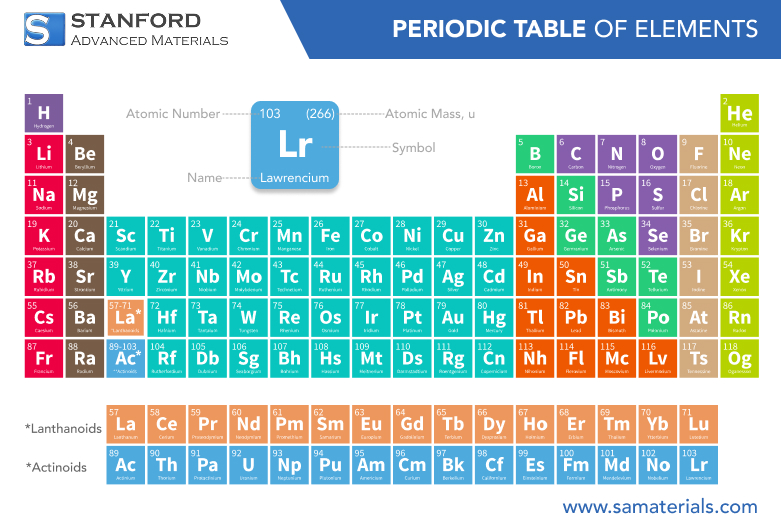
Lawrencium, element 103, is a synthetic radioactive metal, very distinct in both chemical and physical properties, used in advanced research and niche industries. Since it is the last member of the actinide series, from the point of view of superheavy elements and nuclear reactions, it is significantly valuable.
Introduction to the Element
Lawrencium is an artificial element that was synthesized for the first time in the middle of the 20th century. It holds a very special place in the periodic table as the last actinide with the atomic number 103. It cannot be found in nature but is prepared by bombarding lighter elements with high-energy particles either in nuclear reactors or in particle accelerators.
The discovery of lawrencium marked the frontier in superheavy elements and nuclear chemistry. The means for its production, nuclear reactions at very high energies, have provided extremely valuable information on atomic structure, electron configurations, and the forces that stabilize atomic nuclei. It has no direct industrial application, since it is so rare and its half-life is so short, but lawrencium is very important in scientific experiments testing the boundaries of modern physics and chemistry.
History and Naming
The first synthesis of lawrencium was done in 1961 at the University of California in Berkeley by a research group headed by Albert Ghiorso, Glenn T. Seaborg, and others. The element was produced by bombarding californium, element 98, with boron ions in a particle accelerator. This nuclear reaction resulted in the formation of lawrencium, which is a very highly unstable element with an extremely short half-life.
The name "lawrencium" is a memorial to Ernest O. Lawrence, a pioneer physicist and inventor of the cyclotron - a particle accelerator. This invention by Lawrence was crucial for the development of nuclear physics and, eventually, making synthetic elements like lawrencium possible. Naming this element after Lawrence was done in appreciation of the contributions he made towards this area of research.
Since the discovery of lawrencium, it has been extensively studied; its synthesis and the investigation into its chemical and physical properties have helped scientists to extend knowledge of the whole actinide series and behavior of superheavy elements. However, because of its instability, lawrencium remains more of a tool for scientific research than a material with practical applications.
Actinoid Series
Lawrencium is part of the actinide series, a group of elements that includes some of the heaviest naturally occurring and synthetic elements in the periodic table. The actinides are usually characterized by having their outer electrons in the 5f subshell, which makes them exhibit a complex chemistry with a wide range of properties. The series includes both radioactive and non-radioactive elements from actinium, element 89, to lawrencium, element 103.
The general characteristic of the actinides is their radioactivity, wherein most of the elements in this series are unstable and undergo radioactive decay. Despite the fact that elements like uranium and thorium occur naturally, most actinides, including lawrencium, are artificially prepared in laboratories by means of a particle accelerator.
One of the hallmarks of the actinides is the prevalence of the +3 oxidation state; this is the most common state by far for the later elements such as lawrencium, uranium, and thorium. However, as you proceed down the series, the chemistry gets increasingly complicated. For instance, some of the heavier actinides exhibit a +4 oxidation state, which is especially stable for such elements as thorium and uranium.
In addition to their chemical properties, the most important role of the actinides has to do with nuclear chemistry and physics. Some of the elements have been used in nuclear reactors to generate energy, while others, particularly plutonium and uranium, are vital to the production of nuclear weapons. Further work on these elements, including lawrencium, has provided important information on the way atomic nuclei behave and on the forces that hold them together.
Chemical Properties Description
Its chemical properties are still the active subject of investigation today. Predicted to act similarly to other members of the actinide family, lawrencium is presumed to form a +3 oxidation state as its lighter homologues do. However, the electron configuration of lawrencium indicates that it should have a somewhat different set of bonding characteristics compared to other members, due to relativistic effects.
Relativistic effects arise because electrons in heavy atoms can attain speeds close to the speed of light. These relativistic effects result in an element differing in chemical behavior from that predicted by its position in the periodic table. In particular, this is true of lawrencium, which is one of the heaviest actinides and is affected by significant relativistic contraction of the electron orbitals.
Although its +3 state is predicted, the exact chemical behavior of lawrencium is still hard to study due to its very short half-life and the challenge of synthesizing amounts enough to conduct experiments. Thus, many of the theoretical predictions regarding lawrencium's chemical properties are yet being tested by experimental studies conducted at specialist research facilities.
Physical Properties
Most of the physical properties of lawrencium remain theoretical because the element is highly unstable and hardly ever isolated in substantial amounts. However, due to its position within the periodic table and also trends observed in other actinides, scientists have been able to make many accurate predictions about the element's characteristics.
|
Property |
Data |
Remarks |
|
Atomic Number |
103 |
Position in the periodic table |
|
Atomic Weight |
~262 |
Estimated value, varies by isotope |
|
Phase at Room Temp |
Solid (predicted) |
Based on periodic trends |
|
Density (predicted) |
~15 g/cm³ |
Theoretical estimate |
|
Melting Point |
Unknown |
Difficult to measure |
|
Half-life |
Several hours |
Depends on the specific isotope |
Due to its high atomic number and instability, the density and melting point of lawrencium are still somewhat speculative. The half-life of isotopes of lawrencium is dependent on the particular isotope in question but is generally about a few hours.
Common Uses
Extremely rare and of short half-life, lawrencium has limited applications because it decays rapidly and cannot be used in industrial products. Nonetheless, very significant applications of the element involve scientific research, especially in nuclear physics and chemistry.
In laboratory settings, it is applied as a means of studying nuclear reactions and the properties of super-heavy elements. It serves to understand the behavior of atomic nuclei with high atomic numbers, knowledge which should help to further develop the models of nuclear stability and predict the properties of even heavier, so far unknown elements.
There is also interest in the electron configuration and chemical behavior of lawrencium from those studying the actinide series and the effect of relativistic forces upon element chemistry. These studies are crucial in the advancement of superheavy element chemistry and in the furthering of our understanding of the fundamental forces in atomic structure.
Methods of Preparation
The preparation of lawrencium involves complicated nuclear reactions, necessitating state-of-the-art technology. It is prepared, in general, by bombarding a heavy target element such as californium with accelerated ions using large equipment such as cyclotrons or linear accelerators. The extreme conditions necessary for this reaction involve high energies where the reactions take place and highly unstable resultant elements.
The difficulty of production of sizable amounts of lawrencium is due to its short half-life, and only traces of this element are usually available for investigation. Synthesis is carried out in controlled conditions because lawrencium is radioactive, hence requiring strict measures to manipulate it.
Frequently Asked Questions
What is lawrencium, and how is it produced?
Lawrencium is a synthetic radioactive element produced through high-energy nuclear reactions in particle accelerators; it is obtained by bombarding a target element with accelerated ions.
What are the major chemical properties of lawrencium?
Lawrencium mostly possesses an oxidation state of +3 and resembles other actinides. Nevertheless, its detailed chemical nature has not yet been established because relativistic effects come into play.
How is lawrencium used in research?
The major use of lawrencium is in studies to expand our knowledge about nuclear reactions, electron configurations, and superheavy elements.
What are the difficulties in preparing lawrencium?
Synthesis of lawrencium requires advanced nuclear technologies and strict safety precautions because of its radioactivity and the complexity of the nuclear reactions involved.
Are there any industrial products related to lawrencium?
While lawrencium itself has no applications in industrial products, the development of technology for its synthesis has improved nuclear instrumentation in general, thus enhancing the production of certain specialized radioactive isotopes and detectors.


 Chin Trento