
 Products
 Bars
Bars
 Beads & Spheres
 Bolts & Nuts
 Crucibles
 Discs
Discs
 Fibers & Fabrics
 Films
Films
 Flake
Flake
 Foams
Foams
 Foil
Foil
 Granules
 Honeycombs
 Ink
Ink
 Laminate
 Lumps
Lumps
 Meshes
 Metallised Film
 Plate
Plate
 Powders
 Rod
Rod
 Single Crystals
 Sputtering Target
 Tubes
Tubes
 Washer
 Wires
Wires
 Converters & Calculators
 Write for Us



Mendelevium Element 101

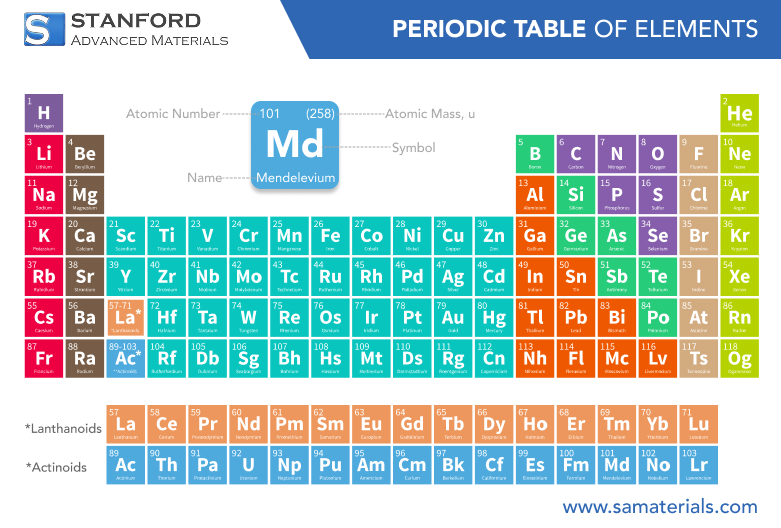
Mendelevium is a synthetic, highly radioactive actinide element used exclusively in scientific research to deepen our understanding of nuclear structure, actinide chemistry, and the fundamental limits of the periodic table.
Discovery, History, and Naming
The discovery of mendelevium was the result of deliberate nuclear transmutation experiments carried out by a research team led by Albert Ghiorso, Glenn T. Seaborg, Bernard Harvey, and Gregory Choppin. The team bombarded einsteinium-253 with alpha particles, producing mendelevium-256 through a fusion reaction.
At the time, the amount of material produced was so small that traditional chemical identification methods were impossible. Instead, the researchers relied on recoil techniques and decay analysis to confirm the formation of a new element. This marked the first time an element was identified atom by atom, setting a precedent for the discovery of even heavier elements.
The name "mendelevium" was officially adopted to honor Dmitri Mendeleev's systematic organization of the elements and his successful prediction of undiscovered elements based on periodic trends. The naming also symbolized the transition from discovering elements in nature to creating them artificially through nuclear science.
Position of the Element in the Periodic Table and Its Atomic Structure
Mendelevium belongs to the actinide series and is placed between fermium (100) and nobelium (102). Similar to other actinides, it is characterized by the filling of 5f orbitals, which influence its chemical and physical behavior strongly.
The best-known isotope is mendelevium-258, which has a half-life of about 51 days and thus is also one of the more stable isotopes of this element. But even this "long-lived" isotope decays rather rapidly according to human timescales, mainly by alpha decay or spontaneous fission.
Due to relativistic effects and electron-electron interactions among the 5f orbitals, mendelevium shows some subtle deviances from simple periodic trends. Effects such as these are of great interest to researchers who wish to learn how atomic behavior evolves in very heavy elements.
Chemical Properties Description
The chemistry of mendelevium has to be inferred from what little there is to work with, since there is so little available to actually observe. Looking at experimental results and calculations, mendelevium appears to have a +3 oxidation state, a condition that represents its most stable form. This is not unlike other late actinides.
Investigations undertaken using quick chemical separation methods have verified that the element acts like fermium and einsteinium in aqueous solutions. This is because its ions are considered to produce weak complexes, and its general tendency of chemical reactions is low compared with lighter actinides like uranium and plutonium.
Mendelevium compounds have been known to be short-lived and can only be formed under controlled conditions. Working with these compounds demands strict radiation safety procedures, as these pose certain hazards with respect to alpha radiation and decay heat.
Physical Properties Overview
Many of mendelevium's physical properties are estimated rather than experimentally measured, relying on extrapolation from neighboring actinides. Despite these limitations, scientists have developed reasonable models of its behavior.
|
Property |
Value |
Remarks |
|
Atomic Number |
101 |
Synthetic element |
|
Atomic Weight |
~258 |
Based on most stable isotope |
|
Melting Point |
~827 °C |
Estimated from actinide trends |
|
Density |
~13 g/cm³ |
Predicted value |
|
Electron Configuration |
[Rn] 5f¹³ 7s² |
Expected configuration |
These estimates provide a useful reference framework for nuclear chemists and physicists studying heavy-element behavior.
Preparation and Synthesis Methods
Mendelevium production occurs only in nuclear reactions in scientific settings. The most popular method of production is bombarding einsteinium isotopes with alpha particles in a particle accelerator. Other methods include neutron capture reactions and subsequent beta decay in high-flux reactors.
In fact, the probability of forming a mendelevium atom is so low that only a few mendelevium atoms can be produced in a given irradiation. This is due to the fact that detection of mendelevium is based on specific signatures rather than macroscopic samples. Such processes demand sophisticated equipment, such as radiation detectors.
Scientific Uses and Research Value
Mendelevium has no commercial or industrial application, due to its rarity, radioactivity, and the high cost of production. Its value is totally in basic scientific research. Scientists investigate mendelevium to gain a better insight into actinide chemistry, nuclear decay mechanisms, and electron behavior in heavy atoms.
The research that is being performed with mendelevium also refines nuclear models and will make predictions more accurate for yet heavier elements. New experiments involving mendelevium help guide research in the quest for new elements and expand our knowledge about nuclear stability limits.
Institutes like SAM commonly stand ready with reference information and educational resources in support of advanced and synthetic elements for research communities and academic study alike.
Frequently Asked Questions
What is mendelevium?
Mendelevium is a synthetic radioactive element with atomic number 101, belonging to the actinide series.
How was mendelevium discovered?
It was first synthesized in 1955 by bombarding einsteinium with alpha particles in a particle accelerator.
Why is mendelevium named after Dmitri Mendeleev?
The name honors Mendeleev's foundational role in developing the periodic table and predicting elemental behavior.
Does mendelevium have any practical uses?
No, its use is limited to scientific research due to its extreme scarcity and radioactivity.
Why is mendelevium important to science?
It helps researchers study nuclear structure, actinide chemistry, and the limits of the periodic table.


 Chin Trento