
 Products
 Bars
Bars
 Beads & Spheres
 Bolts & Nuts
 Crucibles
 Discs
Discs
 Fibers & Fabrics
 Films
Films
 Flake
Flake
 Foams
Foams
 Foil
Foil
 Granules
 Honeycombs
 Ink
Ink
 Laminate
 Lumps
Lumps
 Meshes
 Metallised Film
 Plate
Plate
 Powders
 Rod
Rod
 Single Crystals
 Sputtering Target
 Tubes
Tubes
 Washer
 Wires
Wires
 Converters & Calculators
 Write for Us



Californium: Element Properties and Uses

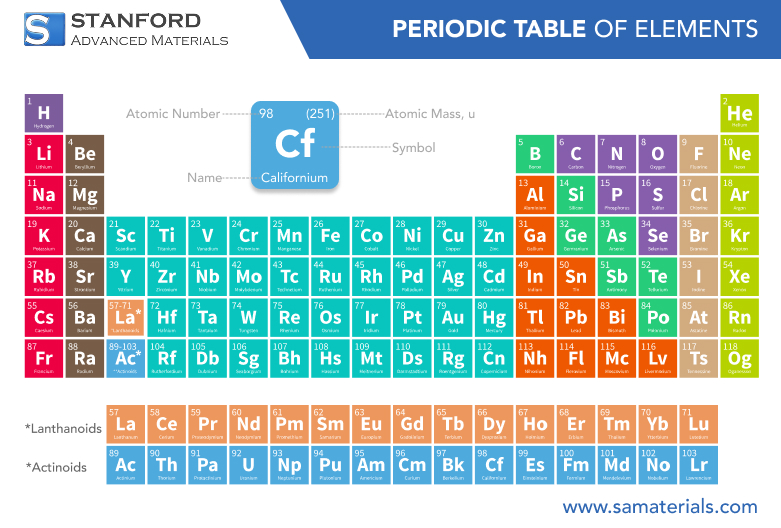
Californium is a synthetic radioactive element found at the bottom row of the periodic table, alongside other actinides. As an element that is exclusively man-made—unable to be found in nature—californium is both rare and expensive. Produced through neutron bombardment in high-flux isotope reactors or particle accelerators, the most commonly used isotope, Californium-252 (Cf-252), plays a crucial role in various nuclear and scientific applications.
Discovery and Development
Californium made its appearance in the early 1950s through continuous nuclear experiments at the University of California, Berkeley. Named for California, where the work took place, the metal was produced by bombarding curium, element 96, with helium ions in a cyclotron. Officially discovered in 1950, this proved to be a milestone in both nuclear chemistry and physics.
The birth of californium mattered because it showed that transuranic elements-those with atomic numbers beyond uranium-could be forged. This breakthrough opened new ways to explore both the actinide series and the behavior of superheavy, radioactive elements. In its early days, its applications were mainly in nuclear research, but as time went on, its peculiar properties came to light, turning californium into a key material for fields that range from atomic reactors to medical uses and special scientific instruments.
Chemical Properties
Several properties of californium represent the general behavior of the actinide series. It is a relatively reactive metal and most stably resides in a +3 oxidation state, though higher states-for instance, +4-can occur under certain conditions.
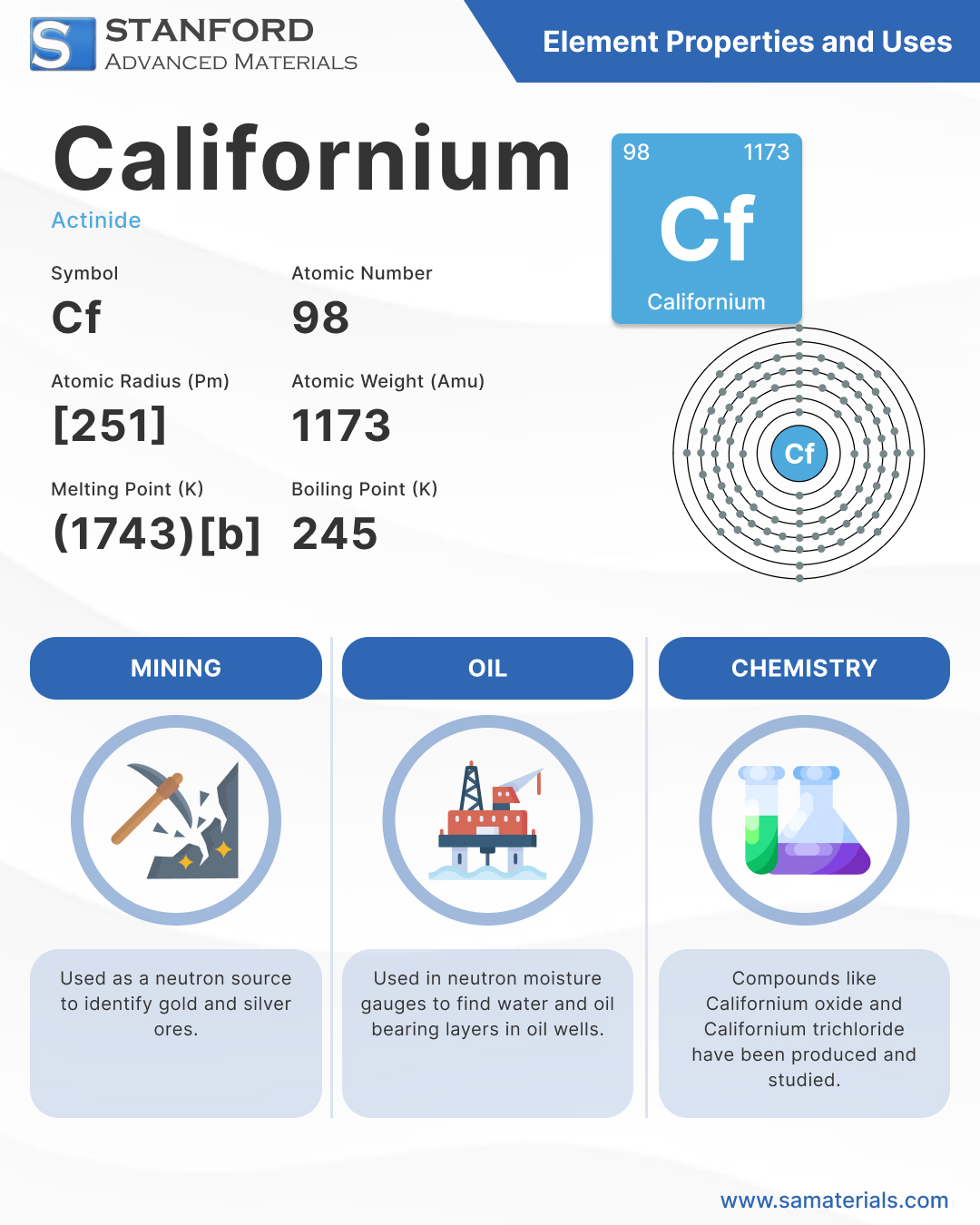
The radioactivity of californium endows it with great value for the production of neutrons, as it undergoes alpha decay and neutron emission. It is this neutron-emitting behaviour that lies at the heart of many of its applications, both inside nuclear reactors and in radiography. The oxides of californium formed by the reaction with oxygen are quite stable; the main compound is californium(III) oxide, Cf₂O₃, a stable and non-volatile compound. In aqueous solutions, the behavior of californium resembles that of other actinides, which imposes strict limitations due to its radioactivity.
Physical Properties
Californium, like many other actinides, has unique physical characteristics that set it apart from other elements. The following table summarizes some of its key physical properties:
|
Property |
Value |
Unit |
|
Atomic Number |
98 |
- |
|
Atomic Weight |
~251 |
g/mol |
|
Density |
15.1 |
g/cm³ |
|
Melting Point |
900 |
°C |
|
Boiling Point |
1470 |
°C |
|
Half-life (Cf-252) |
2.645 |
years |
For more information, please check Stanford Advanced Materials (SAM).
Isotopes of Californium
Several isotopic flavors of californium exist, and by far the most famous and well-used is Californium-252, Cf-252. It is so valued primarily because this isotope emits a copious stream of neutrons-one that is so incredibly useful in nuclear reactors and a wide range of scientific applications.
Besides Cf-252, some other isotopes of californium have been discovered, such as Cf-249, Cf-251, and Cf-253. Of these, all the isotopes have different half-lives and radioactivities, out of which Cf-249 is considered to be the most stable. These isotopes have been studied for gaining further insight into the nuclear properties of californium and possible applications in several areas.
Common Applications of Californium
Even though californium is scarce and costly, it still performs a number of very practical functions in nuclear science and industry due to its neutron-emitting properties. Key applications include the following:
- Source of Neutrons for Nuclear Reactors: Cf-252 acts as an important neutron source for initiating fission in reactors, providing the initial neutron burst necessary for activation.
- Neutron Radiography: The high neutron flux provided by californium-252 makes neutron radiography-a nondestructive method for imaging an object's internal structure of everything from metals and ceramics to complex machinery possible without damage. Neutron radiography has a broad application range in industrial inspections and materials research.
- Specific Fields of Application: - Oil Exploration: The neutrons from Californium assist in oil-well logging in the oil sector, thereby helping in characterizing underground formations and identifying the rock types and porosity, which helps in locating oil and gas reserves.
- Scientific Research: Californium is used in nuclear physics, radiochemistry, and actinide chemistry as one of the most important tools with which various experiments are conducted using its isotopes to study nuclear reactions and characteristics of heavy elements.
Preparation Methods
The production of californium is a complicated, highly regulated process:
Targets of curium or plutonium are bombarded with neutrons in a nuclear reactor. Such targets capture neutrons in high-flux reactors and transmute into isotopes of californium. Following irradiation, the californium is separated chemically from by-products through special procedures involving the use of solvent extraction, ion exchange, and precipitation.
Frequently Asked Questions
What is californium?
Californium is a synthetic, radioactive element with atomic number 98. It is used primarily as a neutron source in various nuclear and scientific applications.
How is californium produced?
Californium is produced by irradiating curium or plutonium targets with neutrons in a nuclear reactor, followed by chemical separation to obtain pure californium.
What are the common uses of californium?
Californium is commonly used as a neutron source in nuclear reactors, in neutron radiography, in oil exploration, and in scientific research related to nuclear physics and radiochemistry.
What safety measures are required when handling californium?
Handling californium requires strict radiation shielding, remote handling, and specialized laboratories to manage its high radioactivity safely.
Can californium be found naturally?
No, californium is an entirely synthetic element and does not occur naturally in the environment.


 Chin Trento