Products
 Bars
Bars
 Beads & Spheres
 Bolts & Nuts
 Crucibles
 Discs
Discs
 Fibers & Fabrics
 Films
Films
 Flake
Flake
 Foams
Foams
 Foil
Foil
 Granules
 Honeycombs
 Ink
Ink
 Laminate
 Lumps
Lumps
 Meshes
 Metallised Film
 Plate
Plate
 Powders
 Rod
Rod
 Single Crystals
 Sputtering Target
 Tubes
Tubes
 Washer
 Wires
Wires
 Converters & Calculators
 Write for Us



Einsteinium: Element Properties and Uses

Description
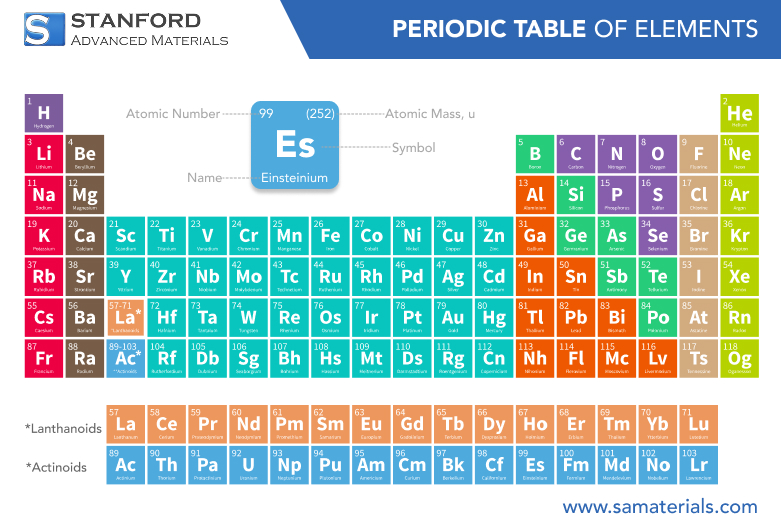
Einsteinium (Es) is an artificially produced, very highly radioactive metallic element with atomic number 99. Renowned for emitting a weak glow because of its radioactivity, the element is useful in nuclear science, especially to obtain heavier transuranium elements. Even though there is little practical application, einsteinium is an essential tool for basic research on the actinides.
Introduction to the Element
Einsteinium ranks among the most extremely rare and hardly producible elements in nature. This actinide metal was first detected in the aftermath of Cold War-era nuclear tests and appears among those heavy synthetic elements created by neutron bombardment. Its name honors Albert Einstein in recognition of his contributions to theoretical physics and nuclear science.
Although einsteinium has no commercial application because it is so rare and highly radioactive, the element has scientific importance far beyond its meager quantities. It provides insight rarely seen into the chemistry, structure, and nuclear behavior of heavy atoms.
Discovery of Einsteinium
Einsteinium was discovered in 1952 by a U.S. research team that analyzed the fallout from the first full-scale thermonuclear (hydrogen) bomb test, Ivy Mike, which took place on Enewetak Atoll in the Marshall Islands. The group headed by Albert Ghiorso discovered that the bomb blast had created isotopes of new transuranic elements by intense neutron bombardment of uranium.
The discovery remained secret for a number of years as the data fell under classification owing to the military importance of the test; when declassified, the findings were published in 1955, and officially Einsteinium was recognized as element 99. The identification of the element was an important milestone, since it proved that extreme nuclear environments could synthesize completely new elements.
Isotopes of Einsteinium
Generally, einsteinium is a radio-active element with no stable isotopes; more than 19 isotopes are known with mass numbers ranging from 241 to 257. Some of the most important isotopes include:
• Einsteinium-253 (Es-253)
o Half-life: ~20.5 days
o Uses: Commonly studied isotope; used in experiments to produce element 100 (Fermium).
• Einsteinium-254 (Es-254)
o Half-life: ~275 days
o Significance: One of the longest-lived isotopes; used in long-term chemical studies and neutron capture studies.
• Einsteinium-252 (Es-252)
o Half-life: ~1.29 years
o Notes: Useful for studying alpha decay sequences in heavy actinides.
The short half-life of these isotopes makes it highly difficult to accumulate and work with Einsteinium. Only microgram quantities have ever been produced at one time.
Chemical Properties Description
In spite of its extremely limited availability, an investigation into the chemistry of Einsteinium has been conducted in a well-controlled laboratory setting. It predominantly occurs in trivalent ions of Es³⁺ in aqueous solutions, just like most other actinides, including americium and curium. In more specialized conditions, it also assumes oxidation states of +2 and +4, among others, providing useful information on how electron configuration changes take place in heavy elements.
Einsteinium readily reacts with oxygen to form the Einsteinium(III) oxide, Es₂O₃. Its halide compounds, such as EsF₃ and EsCl₃, are also synthesized, provided that the reaction is done using remote handling tools because of its intensive radioactivity.
Physical Properties Data Table
|
Property |
Value |
Description |
|
Atomic Number |
99 |
Number of protons in Einsteinium. |
|
Atomic Weight |
~252 |
Approximate atomic mass based on its isotopes. |
|
Melting Point |
860°C |
Estimated melting point under laboratory conditions. |
|
Density |
~8.84 g/cm³ |
Estimated density based on experimental data. |
|
Radioactivity |
High |
No stable isotopes; exhibits intense radioactivity. |
For more information, please visit Stanford Advanced Materials (SAM).
Common Uses
Einsteinium has no commercial applications, but it has very valuable research uses:
• Synthesis of Heavier Elements
It has been used to produce Fermium, element 100, and plays its part in studies leading to the synthesis of elements beyond atomic number 100.
• Nuclear Reaction Research
Its isotopes help in studying neutron capture, radioactive decay, and behavior trends in transuranic elements.
• Advances in Nuclear Medicine and Safety
While Einsteinium itself is not used clinically, studies on Es isotopes have supported the development of better protocols for handling radiation, therapy concepts using isotopes, and management of nuclear materials.
Although prepared in microgram quantities, Einsteinium has played a considerable role in scientific progress.
Preparation Methods
A complicated process, producing Einsteinium requires powerful nuclear reactors with the capacity to sustain neutron bombardment cycles for months at a time. General steps include:
1. Starting with Plutonium or Curium Targets
Lighter actinides like Pu-239 or Cm-244 are exposed to intense neutron flux.
2. Neutron Capture Chain Reaction
Repeated neutron absorption converts the atoms in a series of steps:
Pu → Am → Cm → Bk → Cf → Es
3. Chemical Separation
Once formed, Einsteinium needs to be separated from a mixture of other actinides by:
- ion-exchange chromatography
- solvent extraction
- Redox-based separation
4. Remote Handling
Specialized hot cells, shielding, and robotic systems are needed because of the radiation levels involved, which can destroy instruments, much less people.
It could take months to years to produce even a few micrograms of Einsteinium.
Fun Facts about Einsteinium
• It glows in the dark.
The intense radioactivity of einsteinium heats up its surroundings to the point where it emits a faint blue glow.
• Only a few milligrams exist on Earth at any time.
Annual global production is estimated at less than 1 milligram.
It causes damage to its crystal structure.
The output of radiation from the element is so strong that it physically degrades the sample over time.
• Einsteinium was once used to help confirm theories about the island of stability.
Experiments including heavy Einsteinium isotopes supplied crucial data for the prediction of long-lived superheavy elements.
• Its discovery was once top secret.
Since it emanated from nuclear weapons testing, scientists couldn't publish the findings for years.
Frequently Asked Questions
What is einsteinium?
Einsteinium is a synthetic, highly radioactive actinide element, atomic number 99, named after Albert Einstein.
How is einsteinium produced?
It is produced in nuclear reactors through neutron bombardment of plutonium or curium in order to create heavier actinides that subsequently decay into einsteinium.
What are its main chemical properties?
Interestingly, einsteinium predominantly forms trivalent ions, Es³⁺, and reacts with oxygen and halogens under laboratory conditions.
Why is einsteinium not commercially used?
The intense radioactivity, extreme scarcity, and production cost of technetium preclude large-scale applications.
How does Einsteinium research contribute to other areas?
Various experiments conducted with Einsteinium have, over time, contributed to nuclear reactor design, radiation shielding, and techniques for handling radioactive materials.

 Chin Trento