Products
 Bars
Bars
 Beads & Spheres
 Bolts & Nuts
 Crucibles
 Discs
Discs
 Fibers & Fabrics
 Films
Films
 Flake
Flake
 Foams
Foams
 Foil
Foil
 Granules
 Honeycombs
 Ink
Ink
 Laminate
 Lumps
Lumps
 Meshes
 Metallised Film
 Plate
Plate
 Powders
 Rod
Rod
 Single Crystals
 Sputtering Target
 Tubes
Tubes
 Washer
 Wires
Wires
 Converters & Calculators
 Write for Us



Berkelium: Element Properties and Uses

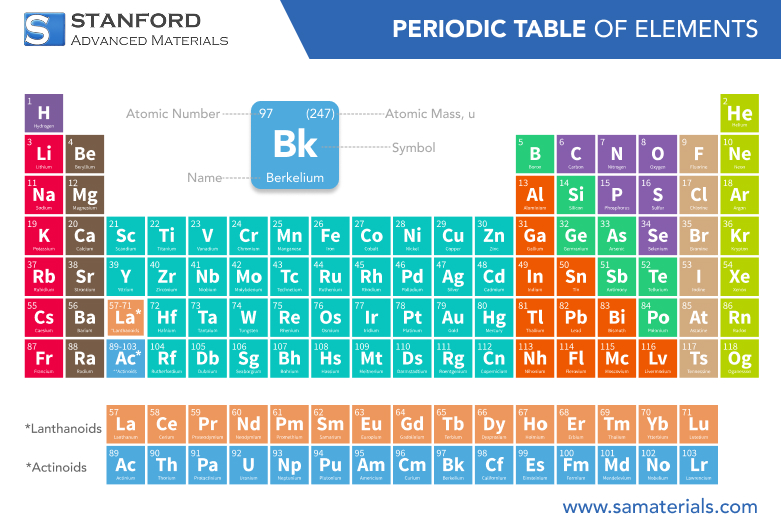
Berkelium, element 97, is a synthetic, radioactive actinide with distinct chemical and physical traits. Its value supports nuclear science research.
Introduction to the Element
Berkelium is a man-made radioactive element that is an actinide series element. This element is a synthetic radioactive element with atomic number 97. The element was discovered at the University of California, at Berkeley, in 1949, and it is a transuranic element. Therefore, it is not a naturally occurring element. The production level is minimal because it is produced in a nuclear reactor or a particle accelerator.
It is difficult to produce because of its radioactivity as well as a short half-life, making it accessible only to research labs. The research of berkelium has made great contributions towards improving knowledge of nuclear reactions as well as heavy elements.
Chemical Properties Description
Berkelium has chemical properties similar to those of heavy actinides. It has been known to exhibit +3 and +4 oxidation states. In its chemical reactions, berkelium is expected to lose electrons to form coordination compounds involving oxygen, halogens, and other Ligands. These compounds can exhibit green or yellow colors depending on the nature of the prevailing chemical environments.
The reactivity of berkelium is affected by the distinctive electron configuration of this particular element. The berkelium ions in the aqueous solution form a complex which helps in the study of the electronic configuration.
Physical Properties Data Table
|
Property |
Value |
Description |
|
Atomic Number |
97 |
Identifies berkelium in the periodic table |
|
Atomic Weight |
~247 |
Typical mass number of berkelium isotopes |
|
Melting Point |
~986°C |
Approximate temperature at which berkelium melts |
|
Boiling Point |
~2900°C |
Estimated temperature for boiling point |
|
Density |
~14 g/cm³ |
Estimated density for solid berkelium |
For details, please refer to Stanford Advanced Materials (SAM).
Common Uses
It has been widely used in nuclear research, where its properties of decay have been studied, and it has been used as a target for the production of transuranic elements. Such studies have been useful in learning more about nuclear reactions.
On top of these, berkelium is also utilized in high-energy physics research as a means of accurate calibration of very sensitive detection apparatus. Although its application in practical industrial materials is limited, the research it makes possible has indirect utility, which may include aspects of nuclear medicine and energy research concerning the handling of radioactive materials.
Preparation Methods
The production of berkelium is quite an advanced process, which takes place in facilities that are highly specialized. Berkelium is usually synthesized by bombarding lighter elements in the actinides with neutrons or charged particles. The result of this nuclear reaction is the creation of berkelium elements. This elusive element can only be created in facilities like reactors or particle accelerators, which provide favorable conditions for the creation of the element.
Frequently Asked Questions
What is berkelium?
Berkelium is a laboratory-created radioactive element with an atomic number of 97 that is part of the group of actinides.
Berkelium is prepared by bombarding
It is prepared by bombarding lighter actinide targets with neutrons or charged particles in dedicated nuclear facilities.
What are the common uses of berkelium?
Its major application domain revolves around scientific research, specifically the observation of nuclear reactions and the synthesis of heavier transuranic elements.
Why is Berkelium used so rarely in industry?
Because of its high radioactivity, shorter half-life, and restricted synthesis, its use is limited to scientific purposes but not commercial purposes.
Are there related industrial products associated with berkelium?
Yes, in fact, berkelium production facilities produce other radioactive elements used in nuclear and medical diagnostics.


 Chin Trento