
 Products
 Bars
Bars
 Beads & Spheres
 Bolts & Nuts
 Crucibles
 Discs
Discs
 Fibers & Fabrics
 Films
Films
 Flake
Flake
 Foams
Foams
 Foil
Foil
 Granules
 Honeycombs
 Ink
Ink
 Laminate
 Lumps
Lumps
 Meshes
 Metallised Film
 Plate
Plate
 Powders
 Rod
Rod
 Single Crystals
 Sputtering Target
 Tubes
Tubes
 Washer
 Wires
Wires
 Converters & Calculators
 Write for Us



Curium: Element Properties and Uses

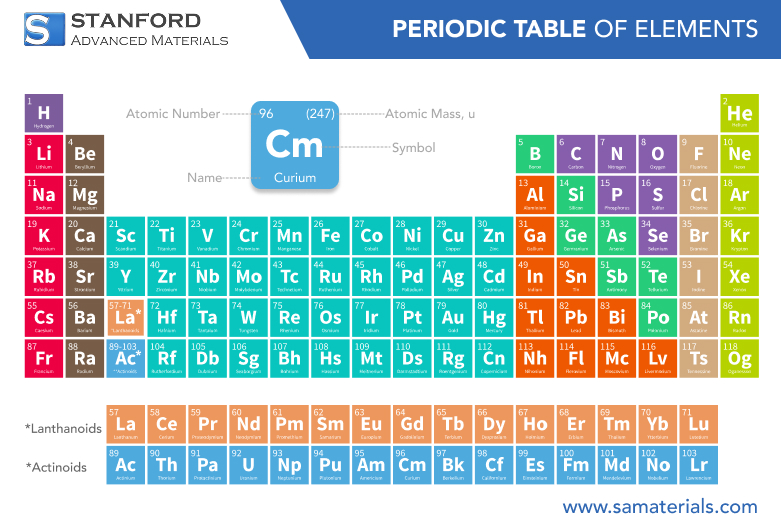
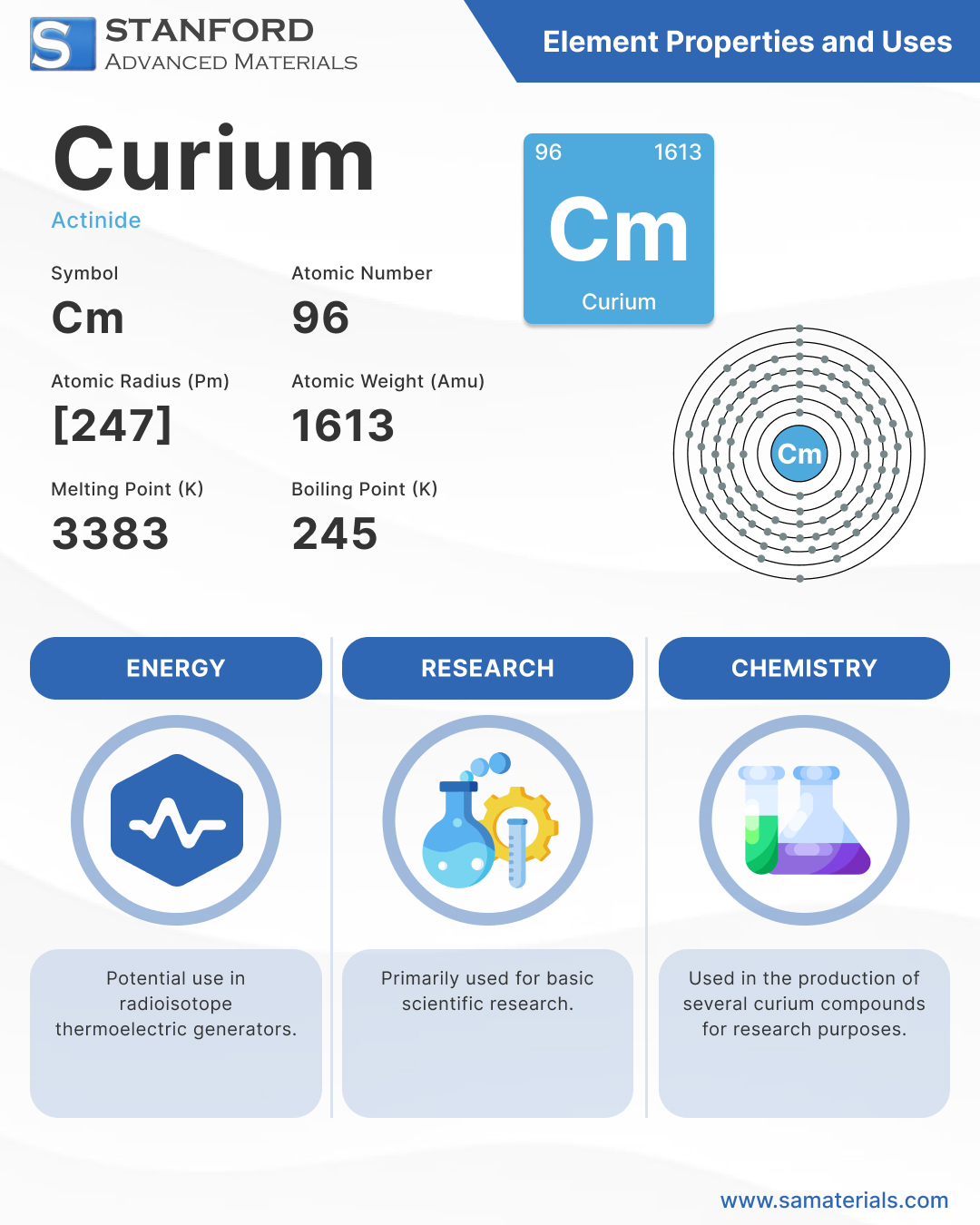
Curium is a radioactive, silvery element with an atomic number of 96. This element has been synthesized in nuclear reactors. Curium emits strong alpha radiation. This element is used as a space power source as well as a research tool.
Introduction to the Element
Curium is a man-made chemical element discovered in the mid-20th century. The element takes its name from Marie and Pierre Curie, who are recognized as holding a special place within the category of man-made elements because they are radioactive. Curium, as a member of the transuranic elements, is man-made and synthesized within specialized facilities because it is not naturally found within the environment, as are other chemical elements. The element has gained recognition because of scientific research, specifically the development of nuclear chemistry and physics.
Chemical Properties Description
Curium has varied chemical properties that make it different from most other elements. It is an actinide series element and has an oxidation number of +3 in most of its compounds, but it may also have variable oxidation states in special cases.
The element is known to react with oxygen, halogens, and nonmetals. The compounds formed are of high value in the study of nuclear chemistry. The radioactivity exhibited by the said element makes it necessary for the handling of the resultant compounds in a controlled laboratory. This ensures the safety of the scientists as well as the surrounding environment.
Physical Properties Data Table
|
Property |
Value |
|
Atomic Number |
96 |
|
Atomic Weight |
~247 (approx.) |
|
Density |
~13.5 g/cm³ |
|
Melting Point |
~1340 °C |
|
Boiling Point |
~3110 °C |
|
Common Isotope |
Cm-244 |
For further information, please refer to Stanford Advanced Materials (SAM).
Common Uses
Although curium has not been widely used in applications beyond research laboratories, it has some major applications. Its radioactivity has qualified it for applications in radioisotope thermoelectric generators, which can convert heat generated by radioactive elements into electric energy. These devices have been considered for different applications where there is a need for fuel that can last for a long time.
Curium is used in scientific research to analyze nuclear reactions and the production of heavier elements with an even mass number. The properties of curium in various chemical states help in formulating theories concerning the structure of an atom in the actinide series group of elements.
Preparation Methods
Curium can be synthesized using sophisticated nuclear reactions. In general, this element can be made by bombarding other heavier elements such as plutonium or americium using either neutrons or alpha particles. This process involves the use of either a nuclear reactor or a particle acceleration facility, in which the element to be bombarded undergoes nuclear reactions to create different isotopes of curium. This is a rather costly process, which can only be undertaken by research institutions.
Frequently Asked Questions
What is Curium?
The element curium is a man-made radioactive element with an atomic number of 96. The element is produced in nuclear reactors and is mainly applied for research purposes.
What is Curium?
Curium can be produced by bombarding certain elements like plutonium or americium with alpha particles or neutrons in a nuclear reactor.
What are the chemical properties of curium?
Curium has a +3 oxidation state; it has been found to react with various non-metal elements. The resulting compounds are of immense research interest in actinide series studies.
What are the uses of curium?
Its main applications are as a heat source in radioisotope thermoelectric generators and as a research subject for nuclear reactions and the production of heavier elements.
What are industrial products related to Curium?
Curium finds application in some specialized fields like fuel elements in nuclear batteries, calibration sources for radiation detectors, and research power sources in high-tech sectors.

 Chin Trento