Products
 Bars
Bars
 Beads & Spheres
 Bolts & Nuts
 Crucibles
 Discs
Discs
 Fibers & Fabrics
 Films
Films
 Flake
Flake
 Foams
Foams
 Foil
Foil
 Granules
 Honeycombs
 Ink
Ink
 Laminate
 Lumps
Lumps
 Meshes
 Metallised Film
 Plate
Plate
 Powders
 Rod
Rod
 Single Crystals
 Sputtering Target
 Tubes
Tubes
 Washer
 Wires
Wires
 Converters & Calculators
 Write for Us



Americium: Element Properties and Uses

Description
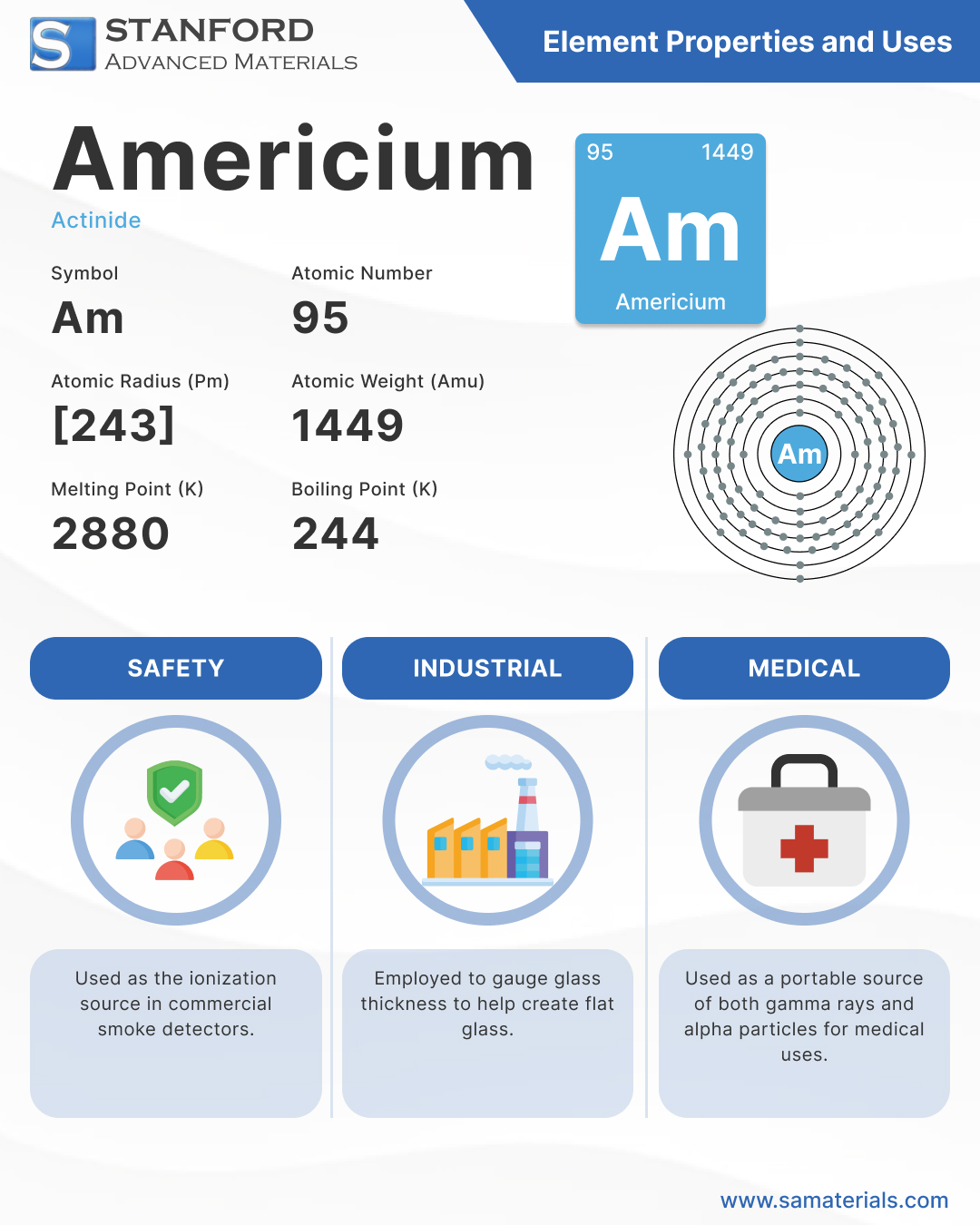
Americium is a synthetic radioactive element valued for its unique chemical and physical properties. While it does not occur in any meaningful natural quantities, this man-made actinide has found surprising usefulness in scientific research, industrial diagnostics, and even in some common household safety devices.
Introduction to the Element
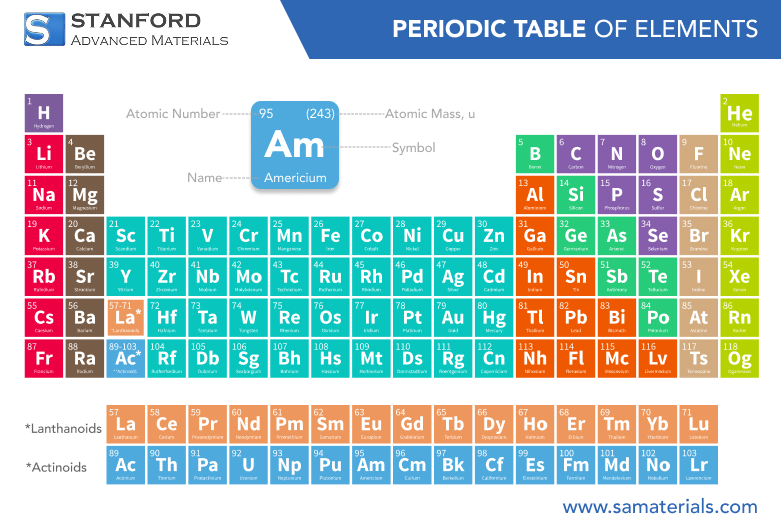
Americium was first synthesized during the 1940s as part of pioneering research into nuclear chemistry. Created at the University of California, Berkeley, it was produced through neutron bombardment of plutonium-an ambitious scientific achievement that showed that humanity was not only able to study the periodic table but also to extend it. The element derived its name from the Americas, similar to the way its periodic table neighbor europium was named after Europe.
As one of the first synthetic actinides, americium has become a valuable tool in exploring radioactive decay pathways, transuranic chemistry, and neutron-capture processes. Its creation marked a turning point in nuclear science, showing that completely new elements could be made in controlled environments and studied for their unique behaviors. Even though americium is not naturally abundant, this radioelement has continued to find broader roles in research and technology well past its initial discovery over seven decades ago.
Chemical Properties
The electron configuration and position of americium in the actinide series dictate its chemical behavior. It predominantly exists in the +3 oxidation state, as do most its neighboring actinides. In this state, americium forms a wide variety of compounds-including oxides, chlorides, fluorides, and nitrates-that are stable under controlled laboratory conditions.
Higher oxidation states, especially +4 and occasionally +6, can be achieved in the case of americium with strong oxidizing agents. These higher states provide researchers with unique opportunities to study complex redox chemistry and evaluate how electron behavior shifts as elements become heavier.
Americium also forms stable complexes with organic ligands, a property that allows the element's utility in separation chemistry and radioactive waste processing, and in analytical methods that are designed to isolate particular actinides from fuel mixtures. The studies demonstrate that americium's reactivity concerning acids and bases decisively influences the design of purification processes and strategies for long-term storage in nuclear engineering.
Physical Properties
The physical properties of americium contribute a great deal to the way it is handled and applied in real-world situations. Being a heavy metal, it is dense, metallic, and structurally stable at room temperature. However, because it emits both alpha particles and gamma radiation, all handling requires strict shielding and remote manipulation.
|
Property |
Value |
Unit |
|
Atomic Number |
95 |
- |
|
Atomic Weight |
~243 |
amu |
|
Melting Point |
1176 |
°C |
|
Boiling Point |
2600 |
°C |
|
Density |
13.69 |
g/cm³ |
|
Crystal Structure |
Double Hexagonal close-packed |
- |
For more details, please look at Stanford Advanced Materials (SAM).
The most striking physical feature about americium is its long-lived radioactivity. Americium-241, the most widely used isotope, has a half-life of approximately 432 years and is an excellent and stable source of alpha radiation. Stability is one of the reasons americium found its way into consumer devices.
Common Uses
Inspite of its highly radioactive nature, americium has practical applications associated with millions of households across the globe.
1. Ionization Smoke Detectors
The most common application of americium is in smoke detectors, in which americium-241 serves as a constant source of alpha particles. These particles ionize air within the detector; when smoke enters the chamber, ionization is disrupted, which triggers an alarm.
This technology has been used for decades in the home and public building setting, making americium one of the few synthetic radioactive elements with a direct consumer function that can save lives.
2. Oil Well Logging
Americium is used in the energy industry, where the gamma radiation it emits is utilized in oil well logging to determine the density and composition of subsurface rock strata. The knowledge of how different forms of radiation interact with geological layers allows for enhanced assessments of possible reservoirs of oil and gas.
3. Neutron Sources
It is possible to combine americium with beryllium to form small, portable neutron sources. Such devices find uses in scientific research, instrument calibration, and in certain industrial inspection techniques.
4. Specialized Research
Because americium falls precisely at a key juncture in the actinide series, it is particularly important in understanding the processes of radioactive decay, neutron interactions, and the synthesis of even heavier transuranic elements.
Preparation Methods
The process of producing americium is rather complicated, involving several successive stages inside nuclear reactors. The most widely used method consists of the bombardment of plutonium with neutrons. If plutonium-239 undergoes neutron capture, it turns into plutonium-240, and under further bombardment, it eventually turns into curium and then americium isotopes through radioactive decay.
After irradiation, americium is extracted from spent reactor fuel by specialists using various methods, including:
• Solvent extraction
Ion exchange chromatography
• Oxidation-state-based separation methods
These processes demand heavily shielded hot cells, remote handling equipment, and rigorous safety protocols due to the highly radioactive and chemically reactive nature of the materials involved.
Frequently Asked Questions
What is americium?
Americium is a synthetic radioactive element that is used in smoke detectors, neutron sources, and other industrial and scientific applications.
How is americium produced?
It is produced through the neutron irradiation of plutonium in nuclear reactors and is then chemically separated.
Why is americium used in smoke detectors?
Americium-241 provides a constant source of alpha radiation capable of ionizing the air.
Is americium dangerous?
Yes, americium is radioactive; however, its risks are considerably reduced when properly sealed or handled in controlled environments.
Is americium found in nature?
It exists in nature only in trace amounts; all usable americium is produced synthetically.

 Chin Trento