
 Products
 Bars
Bars
 Beads & Spheres
 Bolts & Nuts
 Crucibles
 Discs
Discs
 Fibers & Fabrics
 Films
Films
 Flake
Flake
 Foams
Foams
 Foil
Foil
 Granules
 Honeycombs
 Ink
Ink
 Laminate
 Lumps
Lumps
 Meshes
 Metallised Film
 Plate
Plate
 Powders
 Rod
Rod
 Single Crystals
 Sputtering Target
 Tubes
Tubes
 Washer
 Wires
Wires
 Converters & Calculators
 Write for Us



Uranium: Element Properties and Uses

Description
Uranium is a dense, silvery-gray metal; it's perhaps best known for its radioactivity and its central role in nuclear energy. Being among the heaviest naturally occurring elements, uranium presents this unique combination of chemical reactivity, multiple oxidation states, and nuclear characteristics, making it indispensable in modern technology, energy production, and scientific research.
Introduction to the Element
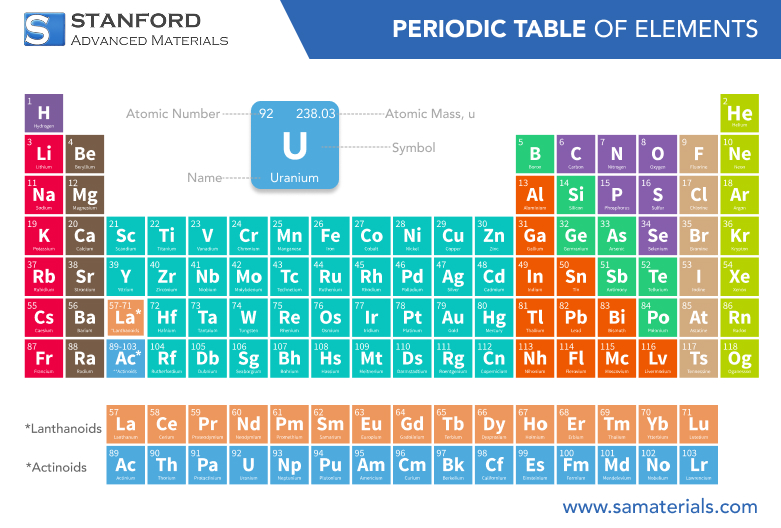
The great interest in uranium by scientists, chemists, and engineers has always been connected with its unique position in the periodic table. It has the atomic number 92, making it one of the last naturally abundant elements and a bridge between natural heavy metals and the synthetic transuranic elements. German chemist Martin Heinrich Klaproth discovered it in 1789, but it was recognized simply as a heavy metal with peculiar properties until the late 19th century, when the discovery of radioactivity by Henri Becquerel showed the true scientific importance of uranium.
Major minerals containing uranium include uraninite, carnotite, and brannerite; it is mined in many parts of the world. Its high-density feature, being almost twice as heavy as lead, and ability to undergo nuclear fission make it an important material in both civilian and defense industries.
Chemical Properties Description
Chemically, uranium is highly versatile, taking forms ranging from +3 to +6 oxidation states, with an additional common and stable form being represented by +4 and +6. This flexibility allows the element to form a wide array of compounds, many of which play essential roles in nuclear fuel cycles and industrial applications.
• Uranium dioxide is the main form used in nuclear fuel pellets because it is stable, highly refractory, and compatible under reactor conditions.
• The common intermediate forms during processing include uranium trioxide (UO₃) and triuranium octoxide (U₃O₈).
• Uranium hexafluoride (UF₆) is one of the most chemically significant uranium compounds. Its volatility makes it ideal for enrichment processes which separate isotopes required for reactor-grade or weapons-grade material.
The solubility of uranium in environmental systems is strongly affected by pH and by the presence of carbonate or phosphate ions. This chemistry controls how uranium moves in groundwater, how it is extracted by mining, and how it must be managed in environmental remediation projects.
Physical Properties
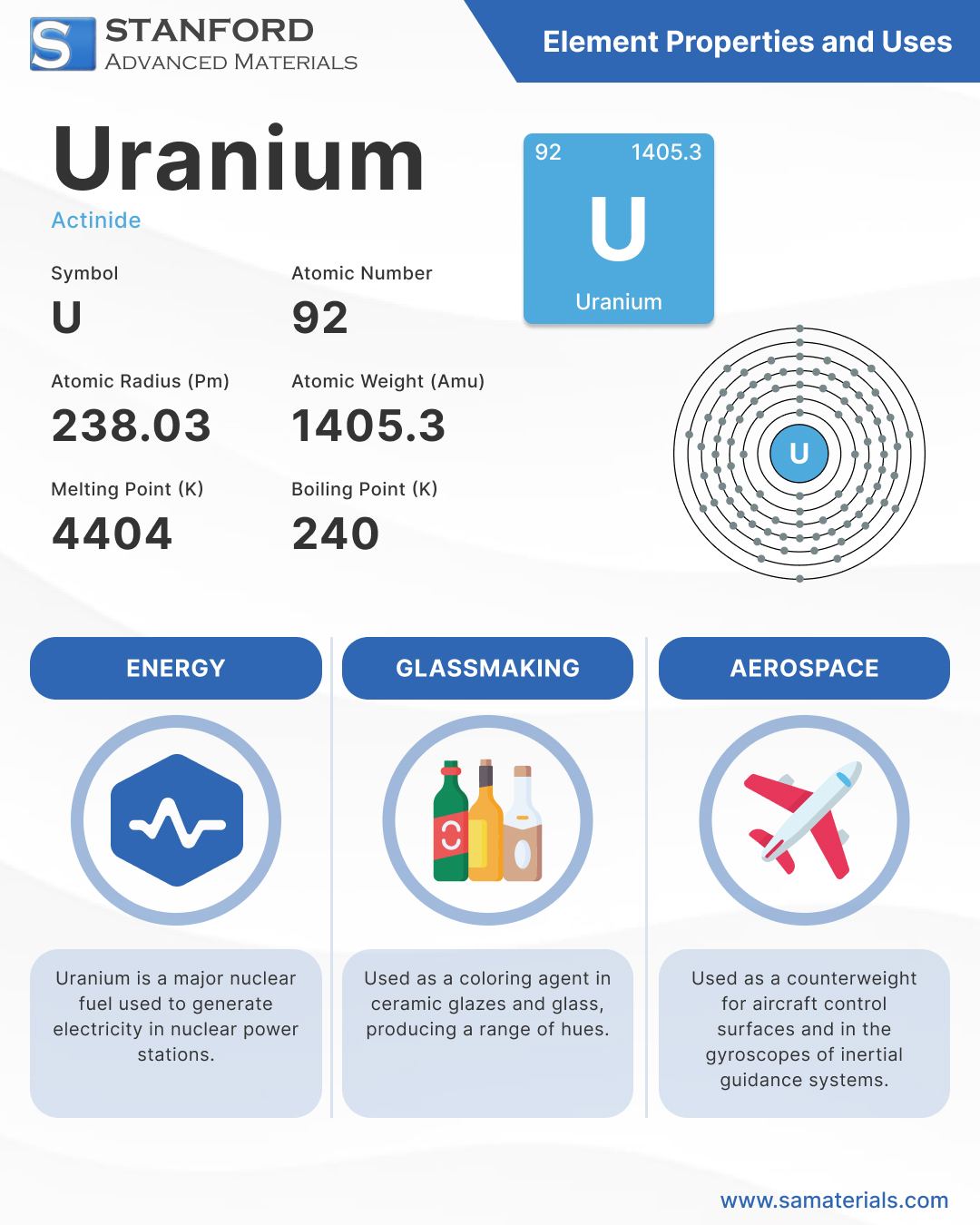
Property.Value.Unit.Description
Atomic Number 92 — Number of protons in the nucleus
Atomic Weight 238.03 g/mol Average mass of uranium atoms
Density 19.1 g/cm³ Extremely high density; almost twice that of lead
Melting Point 1132 °C Temperature at which solid uranium becomes liquid
Boiling Point 4131 °C Temperature at which uranium vaporizes
Specific Gravity 19.1 — Relative density compared to water
For more information, please visit Stanford Advanced Materials (SAM).
Pure uranium metal is malleable and ductile, but it tarnishes when exposed to air and readily reacts to form a range of uranium oxides. While it is radioactive, the decay products are predominantly alpha particles, which cannot penetrate the skin, although internal exposure is hazardous, and handling controls should be stringent.
U-235 and U-238: The Important Isotopes
Two isotopes define uranium's technological importance: U-238 and U-235.
U-238
About 99.3% of natural uranium consists of U-238. While not readily fissile, the isotope is fertile-that is, it can absorb a neutron and ultimately become plutonium-239, a fissile isotope used in both reactors and nuclear weapons. This characteristic ensures that U-238 plays an important part both in mixed oxide fuels (MOX) and in breeder reactor technologies.
U-235
Only 0.72% of natural uranium is U-235, but it is the only naturally occurring isotope capable of sustaining a chain reaction. The isotope splits into smaller atoms when struck by a slow neutron, releasing a large quantity of energy and more neutrons. This chain reaction is the basis of
• Nuclear power generation
• Nuclear submarine propulsion
• Atomic weapons
• Research reactor operations
Due to its rarity, U-235 has to be enriched in many cases to increase its concentration for application in reactors. Enrichment, which is normally done by gaseous diffusion or centrifugation of UF₆, generates enriched uranium suitable for electricity generation.
Where Uranium Is Found
Uranium is a relatively common element in Earth's crust, occurring in approximately the same abundance as tungsten or molybdenum. It takes mostly mineral forms and is mined by conventional techniques and in situ leaching. Major uranium-producing countries include:
• Kazakhstan is currently the world's largest uranium producer, reliant mostly on in situ leach mining
• Canada has some of the richest high-grade deposits in the world.
• Australia - has vast reserves located in various large open-pit and underground mines
Namibia, Niger, Uzbekistan, and the United States: significant producers with long histories of uranium extraction
Uranium is also found in trace amounts in phosphate deposits, seawater, and even in some granitic rocks. Seawater uranium extraction technologies are improving, which may provide a virtually unlimited supply of uranium in the future.
Common Uses
The unique nuclear and physical characteristics of uranium give rise to several important applications:
1. Nuclear Energy Production
The most important use of uranium is as fuel in nuclear reactors. When U-235 undergoes fission, it produces large amounts of heat. This heat generates steam which, in turn, drives turbines to produce electricity. Nuclear energy from uranium provides a significant portion of the world's low-carbon electricity.
2. Defense and Military Applications
Enriched uranium is used to form the core of nuclear weapons. Depleted uranium (DU)—primarily U-238—is employed in armor-piercing munitions and armored vehicle plating, since its extreme density allows it to both penetrate and self-sharpen upon impact.
3. Scientific and Medical Applications
Uses for uranium compounds include the dating of rocks in geology, environmental tracing studies, and research reactors producing medical isotopes for the treatment of cancer.
Preparation Methods
Mining and milling are the initial steps in the commercial preparation of uranium. After extraction, the ore is processed by crushing, grinding, and chemical leaching—generally using sulfuric acid or alkaline solutions—to separate uranium from other minerals.
The final solution is purified by:
• Solvent extraction
Ion exchange
• Precipitation into "yellowcake," usually U₃O₈
Yellowcake is converted into either UF₆ for enrichment, or into UO₂, for fabrication into fuel pellets.
Frequently Asked Questions
What is so special about uranium?
Unique among the naturally occurring elements is the fact that uranium combines radioactivity, high density, multiple oxidation states, and the ability to undergo fission.
How is uranium extracted?
Traditional mining methods, in-situ leaching, and chemical purification that separates uranium from ore.
Why are U-235 and U-238 important?
U-235 is fissile and capable of undergoing a chain reaction, whereas U-238 is fertile and can be converted into usable nuclear fuel.
Why is uranium important to industry?
Its nuclear properties form the basis for the global energy production and defense technologies.
How do preparation methods ensure safety?
Strict protocols, radiation protection standards, and controlled chemical processes ensure uranium is handled and used safely.


 Chin Trento