
 Products
 Bars
Bars
 Beads & Spheres
 Bolts & Nuts
 Crucibles
 Discs
Discs
 Fibers & Fabrics
 Films
Films
 Flake
Flake
 Foams
Foams
 Foil
Foil
 Granules
 Honeycombs
 Ink
Ink
 Laminate
 Lumps
Lumps
 Meshes
 Metallised Film
 Plate
Plate
 Powders
 Rod
Rod
 Single Crystals
 Sputtering Target
 Tubes
Tubes
 Washer
 Wires
Wires
 Converters & Calculators
 Write for Us



Neptunium: Element Properties and Uses

Description
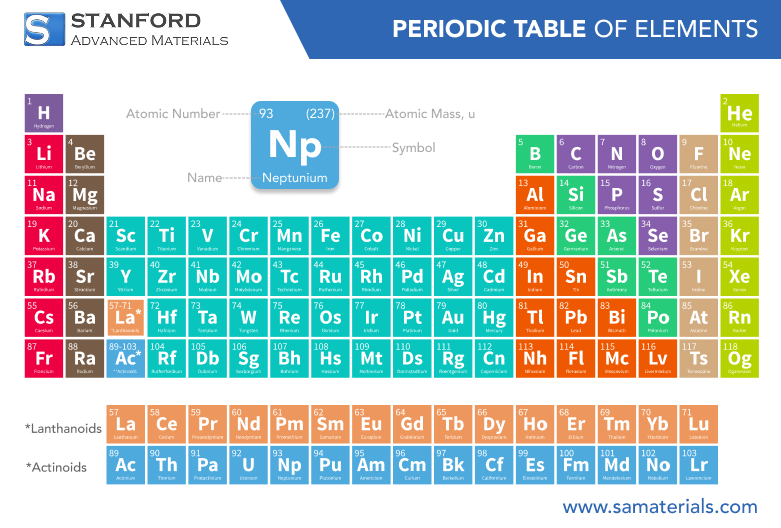
Neptunium is a radioactive, silvery metal belonging to the actinide series of the periodic table with the atomic number 93. It is the first transuranic element and is largely produced in nuclear reactors. Neptunium has applications in nuclear research and may be utilized in the production of plutonium-239 for nuclear weapons and energy.
Introduction to the Element
Neptunium was the first transuranic element to be discovered after uranium and occupies a privileged place in nuclear science. Discovered in 1940 by several brilliant scientists, it boasts an atomic number of 93 and belongs to the actinide series. The discovery of neptunium represented an important breakthrough in knowledge about elements beyond uranium, giving a glimpse into the complicated behavior of active metals.
Neptunium is silvery in its pure metallic state and gradually tarnishes in air due to its reactive nature. Its study has offered a lot of information on the nuclear fuel cycle as well as the properties of heavy elements.
History and Discovery
Neptunium was the first of the transuranic elements to be produced synthetically and thus represented a milestone in nuclear chemistry and in the discovery of elements beyond uranium. It was produced in 1940 at the Berkeley Radiation Laboratory by Edwin McMillan and Philip H. Abelson after several years of predictions and attempts at its production in nuclear reactors with heavy elements.
The work of McMillan and Abelson consisted of the bombardment of uranium with deuterons, nuclei of hydrogen isotopes, by which neptunium was formed. The name "neptunium" was given to the element, since by analogy with the naming of uranium after Uranus, the planet Neptune was the next in series. Actually, the discovery of neptunium opened the way to extensive studies of elements lying beyond uranium; after neptunium came plutonium, americium, curium, and other elements from the actinide series.
The discovery of neptunium was important, not just because of the properties of the element itself but also because it had provided insight into the behavior of heavy elements that would later play a key role in nuclear reactors and weapons. Thus, the ability of the element to undergo neutron capture to eventually form plutonium isotopes has had a lasting impact on energy production and nuclear defense.
Chemical Properties Description
Neptunium exemplifies a variety of oxidation states, most importantly +3, +4, +5, and +6. These states have a great influence on its reactivity and compound formation. Its ions come in different colors, from green to orange, depending on the general oxidation state in aqueous solutions.
It forms several compounds with oxygen and halogens, with general chemical behavior analogous to that of other actinides, such as uranium and plutonium. These characteristics are essential for nuclear scientists and engineers who rely on the accurate description of chemical properties in order to manage and manipulate neptunium in a safe way.
Its reactivity in acidic environments and its tendency to form complexes with organic and inorganic ligands have contributed to numerous research studies focusing on nuclear waste management and environmental impact.
Physical Properties Data Table
|
Property |
Value |
|
Atomic Number |
93 |
|
Atomic Weight |
~237 g/mol |
|
Density |
~20.45 g/cm³ |
|
Melting Point |
~637°C |
|
Boiling Point |
~4000°C |
|
Radioactivity |
Highly radioactive |
Detailed information can be found at Stanford Advanced Materials.
Common Uses
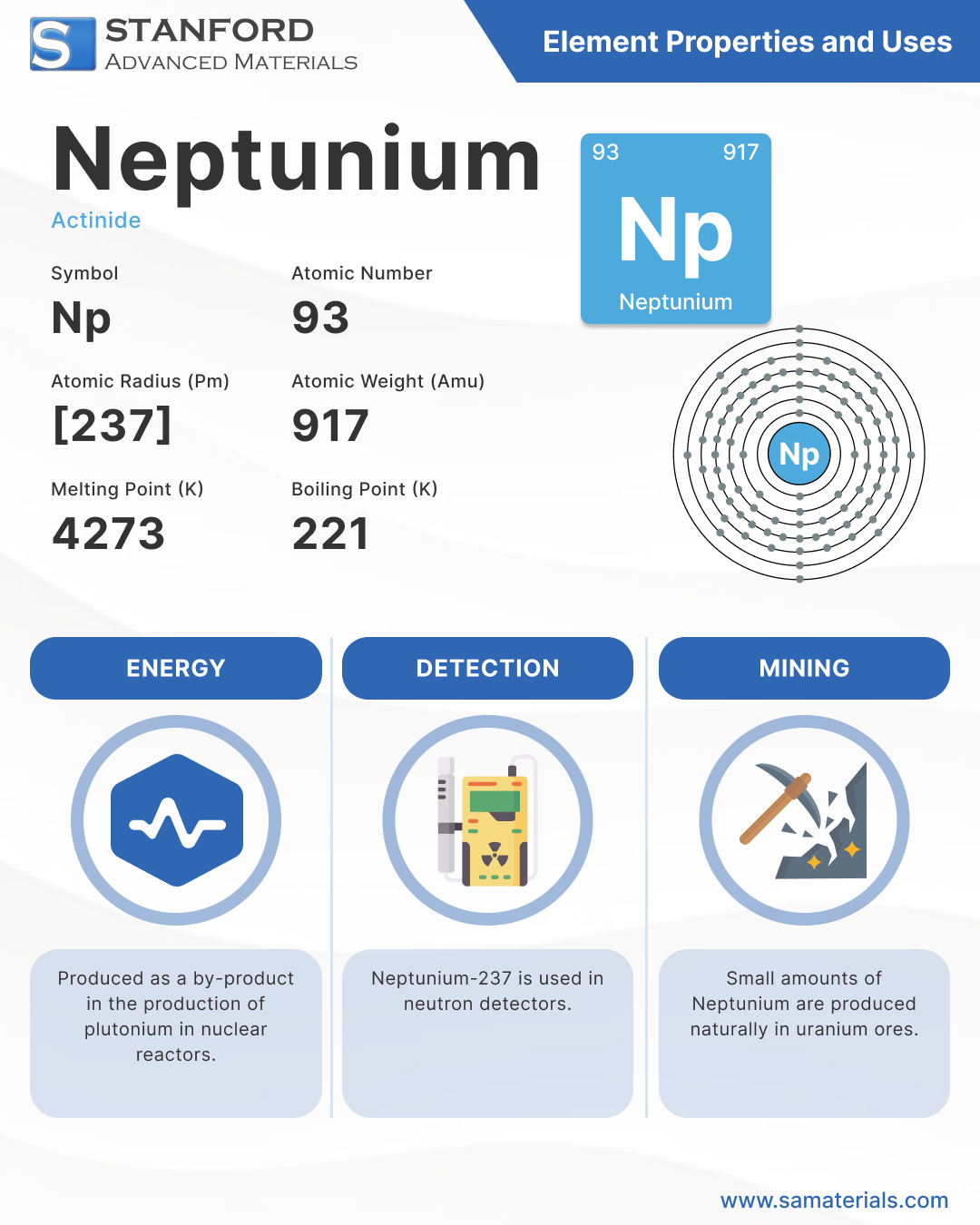
Neptunium is utilized in research on nuclear fuel cycles, where it serves as an indicator of the behavior of actinides in reactor environments. It also takes part in the processes for synthesizing plutonium isotopes, thereby providing relevant information to scientists about nuclear transmutation processes. In some very specific applications, neptunium is used in neutron detection systems, contributing to safety in nuclear applications and promoting further progress in nuclear forensics.
Preparation Methods
The most common method of production involves the generation of neptunium as a by-product in nuclear reactors. In such operation of the reactors, some uranium-238 atoms capture neutrons to eventually produce a series of isotopes, including neptunium-237. This is an isotope of particular interest due to its long half-life and possible uses in nuclear research. The methods of preparation include isolation from spent nuclear fuel using sophisticated separation techniques such as ion-exchange chromatography and solvent extraction.
Frequently Asked Questions
What is Neptunium?
Neptunium is a radioactive actinide element with atomic number 93, known as the first element beyond uranium and used primarily in nuclear research.
How is Neptunium prepared?
It is generated as a by-product in nuclear reactors during the absorption of neutrons by uranium-238; purification is effected by ion-exchange and solvent extraction methods.
What are the common uses of Neptunium?
Its main applications are in nuclear fuel cycle studies, the synthesis of plutonium isotopes, and in neutron detection systems and advanced material research.
Can Neptunium be used safely for industrial purposes?
Because it is highly radioactive, its use is strictly regulated; it is handled in special facilities that have tight safety standards to protect against exposure and negative environmental impact.
Why is neptunium important in nuclear research?
Its various oxidation states and reactivity provide key insights into nuclear transmutation processes, assisting the development of safer nuclear fuels and waste management techniques.


 Chin Trento