
 Products
 Bars
Bars
 Beads & Spheres
 Bolts & Nuts
 Crucibles
 Discs
Discs
 Fibers & Fabrics
 Films
Films
 Flake
Flake
 Foams
Foams
 Foil
Foil
 Granules
 Honeycombs
 Ink
Ink
 Laminate
 Lumps
Lumps
 Meshes
 Metallised Film
 Plate
Plate
 Powders
 Rod
Rod
 Single Crystals
 Sputtering Target
 Tubes
Tubes
 Washer
 Wires
Wires
 Converters & Calculators
 Write for Us



Protactinium: Element Properties and Uses

Description
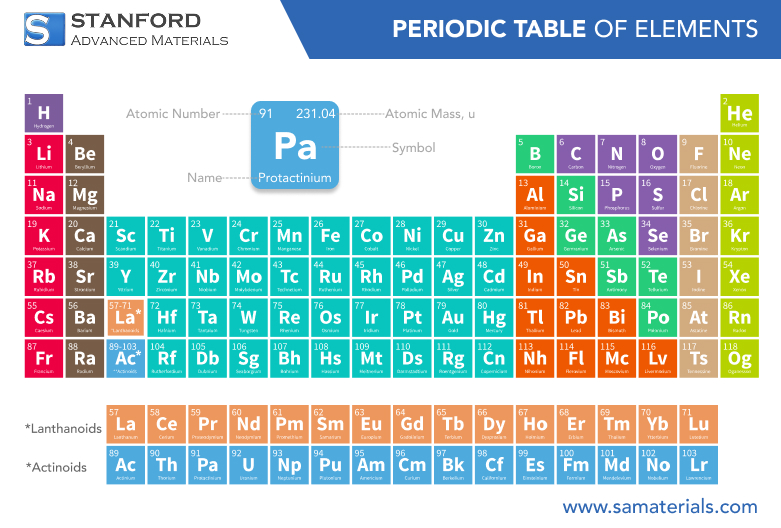
Protactinium is a rare and highly radioactive element in the series of actinides within the periodic table. It possesses several distinctive chemical and physical properties, which make it very valuable for scientific research, especially nuclear physics and studies of radioactive decay. Though scarce in nature, its remarkable characteristics have influenced many specialized industrial applications, especially in research related to nuclear energy and material science.
History and Discovery
Protactinium was first discovered in 1899 by the German chemists Otto Hahn and Lise Meitner, although it was not fully recognized as an element until 1913. It was originally thought to be a byproduct of the decay of uranium, but further research revealed it to be a distinct element. The name “protactinium” comes from the Greek word "protos," meaning "first," because it was identified as a precursor to actinium, another actinide element. Protactinium's discovery was significant in the development of the theory of radioactive elements and their chains of decay, making it an important subject for scientists in the early 20th century.
Chemical Properties Description
Protactinium predominantly exists in the +5 oxidation state, which is its most stable form. Under certain conditions, it can exist in the +4 oxidation state, though this is less common. Its electron configuration, [Rn] 5f² 6d¹ 7s², allows the formation of a wide range of chemical compounds, especially with halogens and oxygen. Protactinium exhibits strong metallic bonding in its elemental form, which gives it a high melting point of 1572°C, making it suitable for research in extreme conditions. Additionally, it has a tendency to form complex salts, which are often used in nuclear chemistry as tracers in reactions including heavy elements.
Physical Properties Data Table
|
Property |
Value |
Unit |
|
Atomic Number |
91 |
- |
|
Atomic Weight |
231 |
g/mol |
|
Density |
15 |
g/cm³ |
|
Melting Point |
1572 |
°C |
|
Boiling Point |
4000 |
°C |
|
Crystal Structure |
Tetragonal |
- |
For more information, please check Stanford Advanced Materials (SAM).
Common Uses
Despite its rarity and also highly radioactive nature, protactinium has many usages in scientific and research areas. Its most common applications are:
1. Nuclear Physics: Protactinium is of vital importance in investigations regarding radioactive decay and nuclear reactions. Its extreme properties explain the behavior of heavy elements and the subtleties of nuclear processes to the scientist.
2. Tracer Element: Protactinium is utilized in a number of experiments on nuclear chemistry as a tracer for the study of radioactive disintegration chains and other reactions. It yields useful information for refining models of nuclear processes, especially those concerning the actinide series.
3. Research in Nuclear Reactors: Though utilized to a very limited extent due to its scarcity, the main potential applications of protactinium involve experimental nuclear reactors, where it is used to research the behavior of actinides in reactor environments, especially the influence of long-lived isotopes.
Although its high radioactivity and limited availability restrict the wide use of protactinium, it is a very important material for the development of nuclear physics and materials science knowledge.
Methods of Preparation
Because of the rarity and radioactivity of protactinium, the extraction and preparation of this element are difficult. Protactinium usually occurs in traces in uranium ores, from which the element is obtained by processing. The standard method for the isolation of the element involves several steps for the separation:
1. Solvent Extraction: This method of separation involves the use of organic solvents on the uranium ore to separate protactinium, followed by selective precipitation to obtain the element in pure form.
2. Ion Exchange: The ion-exchange resins selectively remove protactinium ions from the solution, which are then concentrated and further purified.
3. Radiochemical Separation: The final purification often requires radiochemical separation methods which exploit the radioactive properties of protactinium to separate it from other elements that may have similar chemical behavior.
The process requires very precise control right through the stages because of the element's high radioactivity.
Safety and Handling
Because it is intensely radioactive, there are considerable safety hazards with the handling of protactinium, demanding expertise and a rigid regime of safety procedures. Laboratories working with protactinium have to be fitted out with high-quality radiation shielding, and the element is invariably handled in sealed environments to avoid contamination. Where there is a requirement for personnel to work with protactinium, the wearing of PPE-gloves, lead aprons, and radiation badges-is compulsory.
Frequently Asked Questions
What is Protactinium?
Protactinium is a rare radioactive actinide element that has the atomic number 91. It is highly radioactive and used basically in nuclear research.
How is protactinium prepared?
Protactinium is extracted from uranium ores by modern chemical techniques like solvent extraction, ion exchange, and radiochemical separation.
What are the chemical properties of Protactinium?
Protactinium predominantly exists in the +5 oxidation state and forms compounds with halogens and oxygen. Its electron configuration gives it the capability of entering into most complex chemical reactions.
What are the uses of Protactinium in research?
Protactinium is utilized as a tracer in experiments concerning nuclear physics, as well as a subject of study related to radioactive decay and nuclear reactions. It is also useful in research on nuclear reactors and the behavior of heavy elements.
Are there any safety concerns for handling Protactinium?
Yes, protactinium is a highly radioactive element, and its handling requires strict safety measures, including the use of radiation shielding, protection equipment, and working in controlled conditions.
Summary
Protactinium is a rare and highly radioactive element with major importance in research on nuclear chemistry and physics. Being rare and radioactive, its chemical and physical properties make it particularly valuable for studying nuclear processes and reactions concerning heavy elements. Although its industrial applications are very limited, the role of protactinium in scientific research is undeniable, furthering our understanding of the fundamental properties of radioactive decay and heavy elements.


 Chin Trento