Products
 Bars
Bars
 Beads & Spheres
 Bolts & Nuts
 Crucibles
 Discs
Discs
 Fibers & Fabrics
 Films
Films
 Flake
Flake
 Foams
Foams
 Foil
Foil
 Granules
 Honeycombs
 Ink
Ink
 Laminate
 Lumps
Lumps
 Meshes
 Metallised Film
 Plate
Plate
 Powders
 Rod
Rod
 Single Crystals
 Sputtering Target
 Tubes
Tubes
 Washer
 Wires
Wires
 Converters & Calculators
 Write for Us



Interesting Facts about Radium

Radium is perhaps the most fascinating and historically significant element in the periodic table. Highly radioactive, radium has fascinated scientists, entrepreneurs, and the public for more than a century. From its discovery by Pierre and Marie Curie to its disastrous application in industry in the early 20th century, the history of radium is a page-turner and a cautionary one. Ten brilliant facts about radium are provided below, with emphasis on its chemistry, history, and uses.
1. Radium Discovery
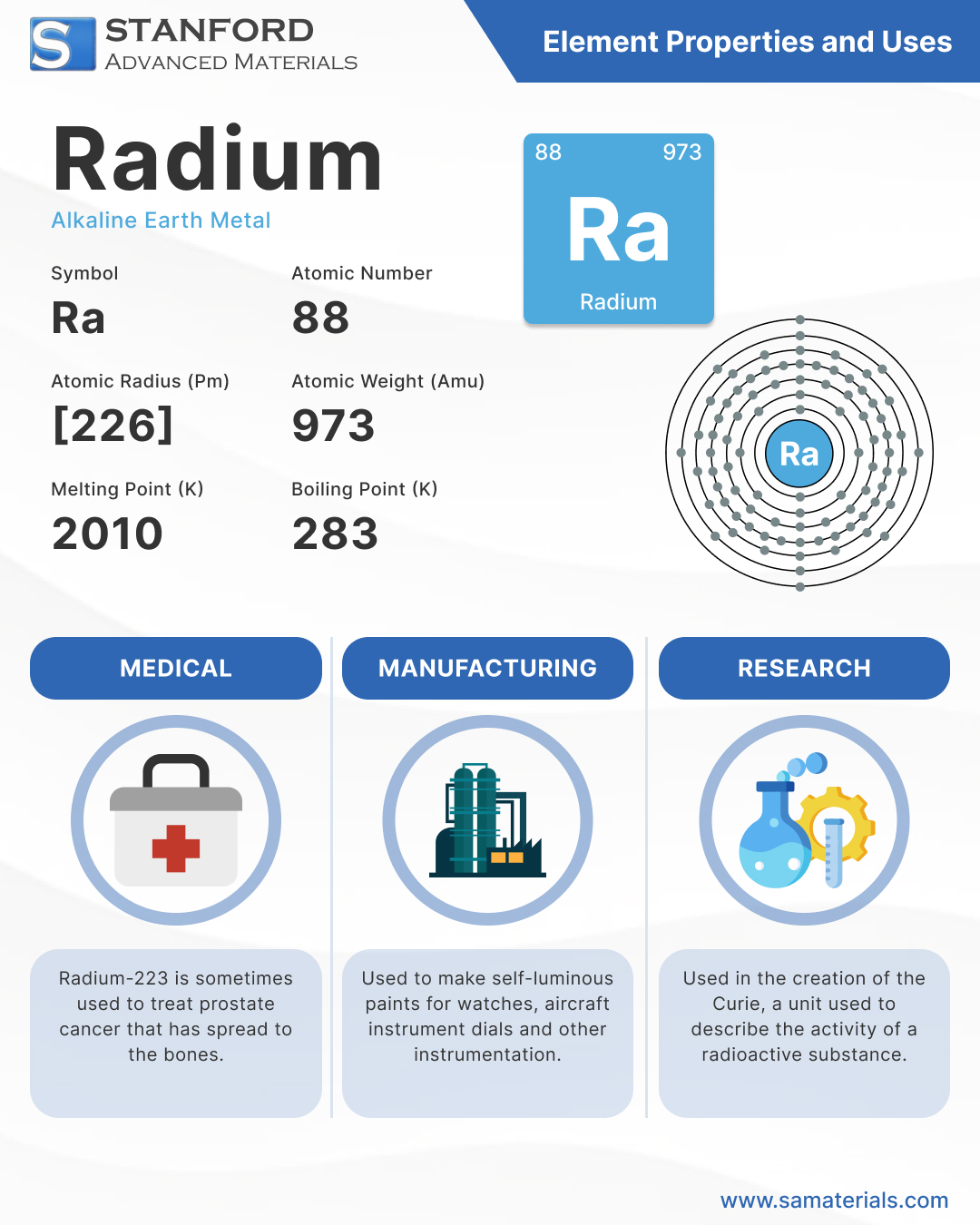
Radium (Ra, atomic number 88) was discovered in 1898 by Marie and Pierre Curie during an investigation of the uranium ore's radioactivity. The Curies separated radium through the mineral pitchblende by slowly processing tons of ore to produce tiny milligrams of the element. Their research was revolutionary—not only in the discovery of a new element, but in the advancement of the study of radioactivity, which was still in its early stages. Purification of radium also earned Marie Curie her second Nobel Prize in Chemistry in 1911, a first since she was the first woman to receive the award.
2. Radium on the Periodic Table
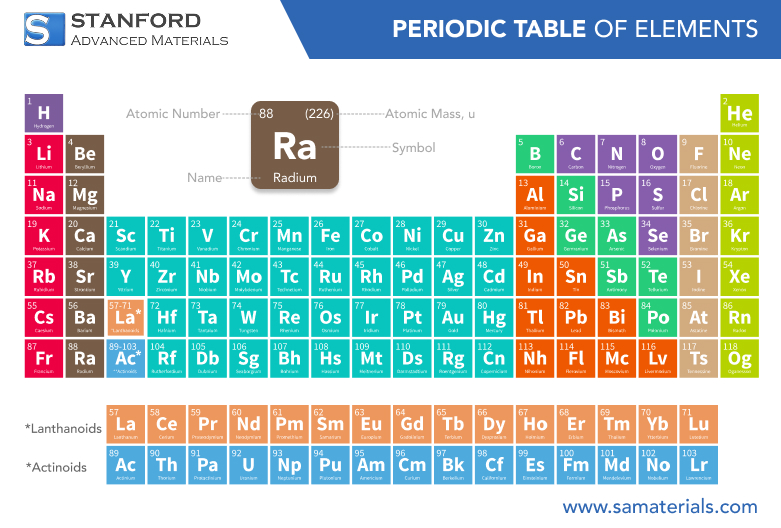
Radium is in Group 2 and hence an alkaline earth metal, with the close cousins calcium and barium. Its placement confers on it typical features of the group: it's reactive to water, oxides and hydroxides precipitate upon it, and it's silvery-white metallic in appearance. But with the exception of its lighter congeners, the most striking feature of radium is radioactivity, which overshadows its chemical behavior. Its half-life isotopes, primarily radium-226, decay to radon gas and hence render it scientifically fascinating but harmful.
3. Radium and Madame Curie
Marie Curie's work with radium was revolutionary in science and gender obstacles. Besides the discovery of the element, she precisely measured the radioactivity of the element and learned that radium continuously emitted energy in the form of radiation without experiencing any known chemical reaction. This find was the foundation of nuclear physics and the medical application of radioisotopes. Curie's meticulous experiments, many performed in rough laboratories without modern safety measures, exposed her to high doses of radiation, ultimately leading to health issues—a warning of the power of the element.
4. The Radium Girls
In the 1920s, radium was industrial glory—and shame—in the Radium Girls, American factory women hired to paint watch faces with radium-laced luminous paint. Women were taught to "point" the tips of the brush on their paint pen with their lips, unwittingly ingesting radium. They subsequently became afflicted with horrific ailments, such as anemia, bone decay, and cancers. Their plight led to basic reform of job safety, setting a precedent for worker protection and public concern over radioactive danger.
5. Radioactivity of Radium
Radium is highly radioactive and produces predominantly alpha radiation. Radium-226, the most common isotope, has a half-life of 1,600 years and breaks down into radon-222, a radioactive gas. This decay releases much energy and makes radium both scientifically interesting and a health risk. The high radioactivity also produces visible blue fluorescence in radium salts, which was in part the reason for its initial popularity for consumer products, including clock faces, jewelry, and even health tonic in the early 20th century.
6. Radium Compounds
There are many radium compounds, many of which are white or colorless and very water-soluble. A few include:
• Radium chloride (RaCl₂): Formerly used in medical studies and glow-in-the-dark paint.
• Radium bromide (RaBr₂): Similar uses as RaCl₂, often researched for radioactive decay series.
• Radium sulfate (RaSO₄): Insoluble and employed in some experiments for researching radium behavior in solids.
The chemical properties of radium are similar to those of barium but are treated cautiously due to its radioactivity.
7. Properties and Applications
Those peculiar properties of radium have found certain applications, especially in medicine. Radium therapy administered in the early 20th century involved the insertion of radium sources alongside tumors to destroy cancer cells, a precursor to brachytherapy. Radium has been utilized to study radioactive decay and nuclear reactions in physical studies.
Industrial uses today are restricted by the toxicity of radium and by regulation. But the historical impact of the element is enormous: it gave birth to the field of nuclear science, established medical radiotherapy as a potentiality, and shaped protection against radiation standards that remain in place.
Conclusion
Radium is a radioactive element, but it's also a symbol for scientific discovery, industrial progress, and the moral dilemmas of applying powerful materials. From the early work of the Curies to the sad experience of the Radium Girls, radium has spotlighted both the potential and danger of radioactivity. Its chemistry, history, and early medicine use provide radium as a radiant element—literally and figuratively—whose history still gives cause for warning, interest, and scientific research.

 Chin Trento