Products
 Bars
Bars
 Beads & Spheres
 Bolts & Nuts
 Crucibles
 Discs
Discs
 Fibers & Fabrics
 Films
Films
 Flake
Flake
 Foams
Foams
 Foil
Foil
 Granules
 Honeycombs
 Ink
Ink
 Laminate
 Lumps
Lumps
 Meshes
 Metallised Film
 Plate
Plate
 Powders
 Rod
Rod
 Single Crystals
 Sputtering Target
 Tubes
Tubes
 Washer
 Wires
Wires
 Converters & Calculators
 Write for Us



Actinium: Element Properties and Uses

Description
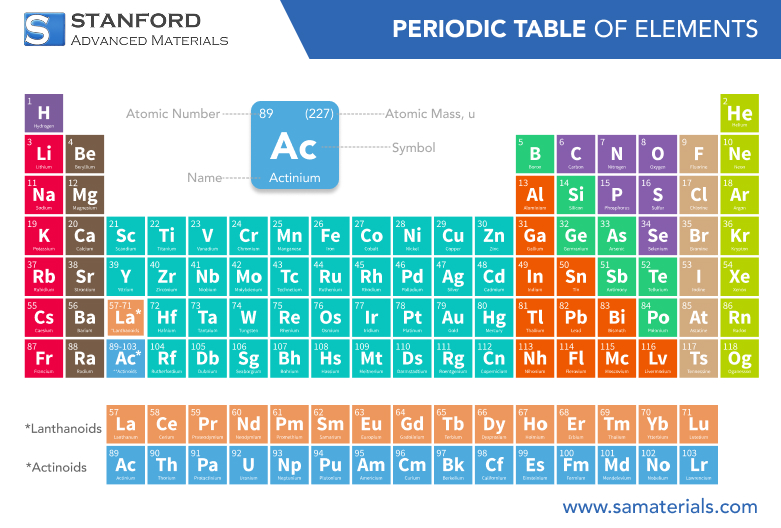
Actinium is a highly radioactive, silvery-white metal with the atomic number 89. This intensely reactive metal produces a faint blue light due to its radioactivity, and is applied in a very specialized way in neutron sources and scientific research and emerging cancer treatments. It is still an extremely rare element and challenging to purify in its absolute form.
Introduction to the Element
Actinium is a naturally occurring radioactive substance and the first member of the actinide series. It was discovered in the late 19th century and appears to be a soft, silvery metal which tarnishes right away if exposed to air. Actinium looks like a typical lanthanide chemically, particularly favoring the +3 oxidation state. Although it looks like a metal, the substance is actually highly reactive since it constantly undergoes radioactive decay and easily oxidizes.
History and Development
Actinium was independently discovered by André-Louis Debierne in 1899 and by Friedrich Oskar Giesel in 1902. Its identity and classification were initially a matter of scientific controversy, but continued research established it to be the first element of the actinide series.
Over the years, nuclear science development, especially the technology of reactors and radiotherapy, expanded interest in actinium. The discovery of the isotope Ac-225 opened new pathways in targeted alpha therapy (TAT), a promising cancer treatment that uses focused alpha radiation to damage tumor cells while minimizing effects on surrounding tissues.
Today, the challenge of producing actinium in meaningful quantities remains one of the driving areas of research into isotope generation, separation technologies, and radiochemical safety.
Chemical Properties Description
The chemistry of actinium is typical of early actinides and is marked by a preponderance of the +3 state, which is similar to the lanthanides. Actinium is fairly reactive, and on being exposed to air, it rapidly forms a thin oxide film.
In acidic solutions, actinium dissolves to form Ac³⁺ ions, which may further react with chloride, nitrate, or fluoride ligands to yield a variety of coordination complexes; such compounds are important in the study of actinide behavior, especially nuclear chemistry and environmental radiochemistry.
Physical Properties Data Table
|
Property |
Value |
|
Atomic Number |
89 |
|
Atomic Weight |
Approximately 227 |
|
Density |
~10.07 g/cm³ |
|
Melting Point |
~1050 °C (approximate) |
|
Boiling Point |
~3200 °C (approximate) |
|
Common Oxidation State |
+3 |
For further details, refer to Stanford Advanced Materials (SAM).
Common Uses
Although actinium is not extensively used industrially, there are many important specialized applications for the element:
• Neutron sources: Actinium-227 is combined with beryllium to create neutron sources for scientific and calibration uses.
• Targeted radiotherapy: Actinium-225 is gaining interest in cancer therapy due to its high-energy alpha emissions.
• Nuclear research: Actinium is used as a tool for studying actinide behavior, decay processes, and radiation detection technologies.
Both researchers and engineers depend on actinium-based materials to improve nuclear instrumentation and to further understand radioactive processes.
Preparation Types
Actinium is usually recovered as a byproduct during uranium ore processing, where it is present only in trace amounts. Its extraction involves multi-step purification. One of the most common methods is ion exchange chromatography, which works effectively in separating actinium from other radioactive species. Further purification will ensure stability within the samples and minimal contamination from other actinides or fission products.
Adverse Effects and Risks
Given that actinium is highly radioactive, its improper handling poses serious risks to health. Among these concerns are:
• Radiation Exposure: Actinium emits alpha particles, which are harmful upon inhalation, ingestion, or absorption through open wounds.
• Bone Deposition: Like other actinides, it is deposited in bones and thus can increase the risk of long-term damages and cancer.
• Environmental Risk: Improper disposal can contaminate soil or water, requiring strict controls and containment.
Because of these hazards, actinium is handled only by trained personnel in specialized facilities and with appropriate radiological precautions.
Frequently Asked Questions
What is the main use of actinium?
It can be used in neutron sources and nuclear calibration and, in its isotope form, in targeted radiotherapy.
How is actinium usually produced?
It is separated out of uranium ores by means of separation techniques, which include ion-exchange chromatography.
Why is actinium regarded as a rare element?
It occurs naturally only in minute quantities among other uranium ores, making isolation laborious.
What are the major chemical characteristics of actinium?
Actinium prefers the +3 oxidation state; it forms an oxide layer in air and dissolves in acids to form Ac³⁺ ions.
Are there industrial products that incorporate actinium?
Yes. Actinium is utilized in specific radiation detectors, calibration devices, and several parts of nuclear reactors.
 Chin Trento