Products
 Bars
Bars
 Beads & Spheres
 Bolts & Nuts
 Crucibles
 Discs
Discs
 Fibers & Fabrics
 Films
Films
 Flake
Flake
 Foams
Foams
 Foil
Foil
 Granules
 Honeycombs
 Ink
Ink
 Laminate
 Lumps
Lumps
 Meshes
 Metallised Film
 Plate
Plate
 Powders
 Rod
Rod
 Single Crystals
 Sputtering Target
 Tubes
Tubes
 Washer
 Wires
Wires
 Converters & Calculators
 Write for Us



Francium: The Radioactive Element

Introduction to Francium
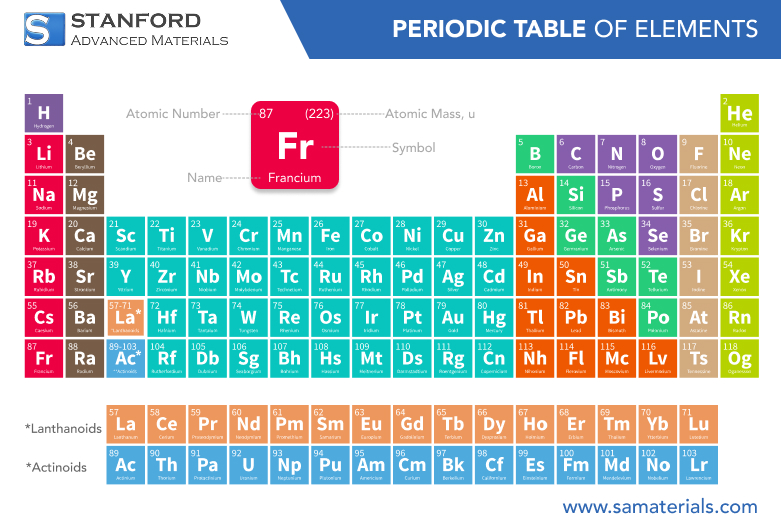
Francium is one of the naturally occurring rarest elements on earth, symbol Fr and atomic number 87. Francium is an element belonging to the group of alkali metals that is found below cesium in the periodic table. Though it was discovered in 1939 by Marguerite Perey at the Curie Institute in Paris, francium remains one of the least explored elements due to its very rarity and radioactivity.
Francium exists naturally only in trace amounts in uranium and thorium ores. The crust of the Earth contains a total of less than 30 grams of francium at any given time, making it practically impossible to isolate in large quantities. It has a half-life that ranges from 22 minutes for the most stable isotope, Fr-223, to seconds in others, which makes it even harder to research.
Francium was found in 1939 by French chemist Marguerite Perey when she was examining actinium decay products. She noticed a new radioactive kind and confirmed it as a new element. In honor of her homeland, she named it francium, following the pattern of naming elements after places, as with polonium or germanium.
The discovery was notable because francium is highly unstable and decays quickly enough that it does not accumulate naturally in measurable amounts. Perey's painstaking experimentation with spectroscopy and radiochemistry allowed her to separate francium for a brief period in quantities measured in micrograms.
Physical and Chemical Properties
Francium is a soft, highly reactive metal, but with physical properties generally theoretical because of the impossibility of investigating macroscopic amounts. It will be a silver-colored solid at room temperature, similar to cesium, and a density of approximately 2.48 g/cm³. Its melting point is approximately 27°C, meaning that it could melt in your hand if in normal conditions, and boils at approximately 677°C.
Chemically, francium is extremely reactive:
•It also violently reacts with water to form francium hydroxide (FrOH) and hydrogen gas, a reaction far more intense than for cesium or rubidium.
•As with the other alkali metals, francium readily produces salts when reacted with halogens, e.g., francium chloride (FrCl).
•Since it is radioactive, all francium compounds are unstable and spontaneously break down. For more information, please check Stanford Advanced Materials (SAM).
Isotopes and Radioactivity
Francium has 33 known isotopes ranging from Fr-199 to Fr-232. The most stable isotope, Fr-223, has a half-life of 22 minutes, beta decaying to astatine-223. Other isotopes have half-lives of a few fractions of a second, making it extremely difficult to work with in the lab.
The short half-life is such that francium is not only difficult to handle but very radioactive, with activity in megabecquerels per microgram. For reference, one microgram of Fr-223 emits some 40 billion decays per second, and this highlights the radiological precautions to be taken strictly.
Production of Francium in Laboratories
Because natural francium is actually impossible to accumulate in macroscopic amounts, most work utilizes artificial production. Francium is typically generated by bombarding thorium or radium targets with neutrons or protons within particle accelerators. For example:
• Fr-210 can be produced by neutron bombardment of radium-226, which in turn breaks down to francium via alpha emission.
• The produced atoms are stored in ion traps or vacuum systems for short experiments, usually no longer than a few minutes until they decay.
These production methods allow scientists to study francium's atomic spectra, ionization energy, and chemical properties, though in very tiny amounts (often fewer than 10,000 atoms at a time).
Applications of Francium
Francium has no industrial applications due to its rarity and radioactivity. Its sole major application is in scientific research, namely:
1. Atomic Physics:
Francium's simple electron structure (single valence electron) makes it an ideal subject for experiments to investigate quantum electrodynamics (QED) and relativistic corrections in heavy atoms.
2.Nuclear Physics:
Studies on francium isotopes provide insight into nuclear decay modes and the decay properties of unstable heavy nuclei.
3.Spectroscopy Experiments:
Francium's atomic spectrum has been measured quantitatively and compared with cesium to establish alkali metal ionization potential and atomic size trends.
There are no practical uses of francium except in research because it cannot be stored, shipped, or handled safely in large amounts.
Frequently Asked Questions
Why is francium so rare?
Francium is the last of the naturally occurring alkali metals to be discovered. It only appears in trace amounts in thorium and uranium minerals and has a very short half-life, so accumulation is impossible.
What is the most stable francium isotope?
Fr-223 is the most stable one with a half-life of 22 minutes, which decays into astatine-223.
Is francium safe to touch?
Only in ion trap labs, vacuum chambers, and radiation shielding labs, as even microgram quantities emit extreme radiation.
Does francium have any industrial or commercial application?
No, because of its extreme rarity and radioactivity, it cannot be utilized commercially or industrially; all uses are scientific.
How is francium different from other alkali metals?
It should be the most reactive of all the alkali metals, more reactive than cesium, with lower melting points and higher radioactivity.
Conclusion
Francium remains one of the world's least common elements, distinguished by its scarcity, instability, and radioactivity. While its theoretical interest in atomic and nuclear physics is immense, francium is not used for anything practical. Francium experiments are still conducted on even as few as a thousand atoms and continue to illuminate atomic physics, relativistic effects, and decay, showing how the most fleeting of elements can assist us in learning more about the material world.

 Chin Trento