
 Products
 Bars
Bars
 Beads & Spheres
 Bolts & Nuts
 Crucibles
 Discs
Discs
 Fibers & Fabrics
 Films
Films
 Flake
Flake
 Foams
Foams
 Foil
Foil
 Granules
 Honeycombs
 Ink
Ink
 Laminate
 Lumps
Lumps
 Meshes
 Metallised Film
 Plate
Plate
 Powders
 Rod
Rod
 Single Crystals
 Sputtering Target
 Tubes
Tubes
 Washer
 Wires
Wires
 Converters & Calculators
 Write for Us



Tungsten: Element Properties and Uses

Description
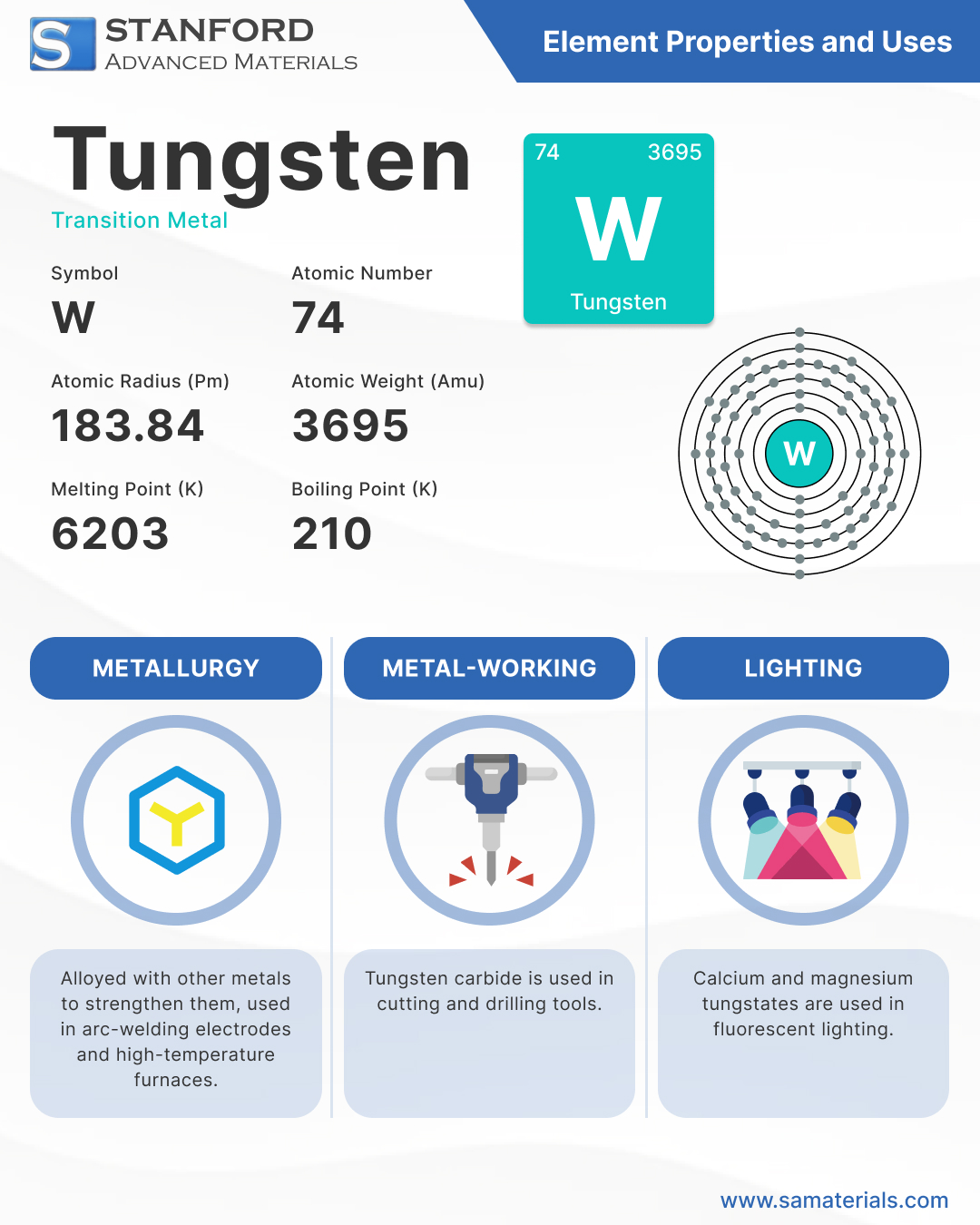
Tungsten is a rare, high-density element with exceptional properties, including the highest melting point of all metals. Its unique characteristics make it a crucial material for a wide range of industrial, scientific, and high-performance applications. Tungsten's high strength, thermal stability, and resistance to corrosion are highly valued, particularly in environments where extreme conditions prevail.
Introduction to the Element
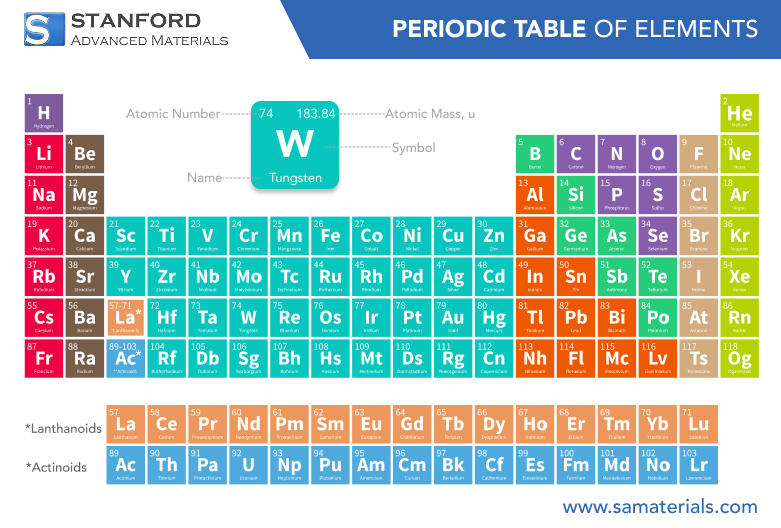
With an atomic number of 74 and an atomic weight of approximately 183.84, tungsten is represented on the periodic table by the symbol W. It is an interesting element that was first discovered during the late 18th century and has since gained the interest of several scientists and engineers alike.
Tungsten is a refractory metal capable of withstanding extremely high temperatures and mechanical stress. The brothers Juan José and Fausto Elhuyar, from Spain, were the first to isolate it in 1783, although it was first identified as present in the mineral wolframite by Carl Wilhelm Scheele of Sweden. Since then, attention has been attracted to a number of its physical and chemical properties which are unique and critical in a variety of high-performance applications.
With the ability to retain structure and resist degradation above 3000°C, tungsten is quite different from any other metal and thus finds applications in situations where materials are required to perform under intense heat and mechanical forces.
Chemical Properties Description
Its diverse span of applications is highly contributed by the chemical properties of tungsten. Among the most striking features that tungsten exhibits is its high resistance to corrosion and oxidation, even under extremely high temperatures. While many metals degrade or corrode under heat or exposure to aggressive chemicals, tungsten remains intact; these characteristics enable it to perform in extreme environments such as those in aerospace and nuclear industries.
• Oxidation States: Tungsten generally forms a stable +6 oxidation state but can also be found in other oxidation states like +5 and +4. These oxidation states of tungsten are common in its compounds such as tungsten oxide (WO₃) used in various chemical processes.
• Chemical Stability: Tungsten shows very high stability when exposed to acids, bases, and high temperatures, thus being suitable for application in extremely harsh environments where chemical corrosion would otherwise degrade less resistant materials.
Tungsten also forms compounds with oxygen, sulfur, and halogens, thereby enabling its use in specialized chemical processing. The compounds produced show multiple uses: from catalysis to high-temperature manufacturing.
Physical Properties
The physical properties of tungsten are some of the most outstanding in the periodic table. It has the highest melting point of all metals, a property that makes it indispensable in industries requiring high-performance materials under extreme conditions.
|
Property |
Value |
Units |
Notes |
|
3422 |
°C |
Highest melting point among metals |
|
|
Boiling Point |
5930 |
°C |
Approximate value |
|
Density |
19.25 |
g/cm³ |
At room temperature |
|
Thermal Conductivity |
173 |
W/m·K |
Efficient heat transfer capability |
|
Electrical Resistivity |
5.5e-8 |
Ω·m |
Enhances performance in electrical applications |
- Melting Point: The high melting point of tungsten is 3422°C, the highest among all metals; it can be used in extremely high-temperature applications such as filaments in electric bulbs, arc welding, and aerospace.
- Density: Tungsten is a very dense metal with a measured density of 19.25 g/cm³. Because of this, it is in demand when any application, especially those that require weight and stability, needs counterweights, radiation shielding, or ballast.
- Thermal and Electrical Properties: The thermal and electrical resistivities of tungsten further enhance its utility in high-performance applications, particularly in those situations where heat dissipation and electrical performance are at a premium.
Common Uses
Tungsten's physical and chemical properties make it a material of great importance in a series of industries. Some of the most common applications include:
- Lighting Industry: Tungsten is perhaps best known for its role in incandescent light bulbs, where its high melting point allows it to serve as the filament. Tungsten filaments can operate at high temperatures without melting, thus producing light with long service life.
- Aerospace and Defense: Because of its strong properties and high mass density, tungsten is often utilized in aerospace and defense industries to make the counterweights of aircraft, armor-piercing ammunition, and even radiation shielding.
- Electrical Contacts and Welding Electrodes: With great resistance to high temperatures, tungsten is electrically conductive, hence ideally usable in electrical contacts and welding electrodes. Tungsten electrodes find application in processes like TIG welding, where a stable arc is needed.
- Medical Field: Tungsten is applied in both radiation shielding and medical devices owing to its dense nature and the ability to absorb radiation of high energy, including X-ray tubes and cancer radiation therapy.
- High-Speed Tools and Machinery: For the manufacture of cutting tools, drills, and milling machines, tungsten is also indispensable due to its resistance to wear and stability at high temperatures.
What Are Refractory Metals?
Refractory metals are a group of metals that resist extremely high temperatures without melting or losing their mechanical strength. They usually possess a very high melting point, great hardness, and resistance to wear and corrosion. Tungsten is classified as one of the five main refractory metals, along with other refractory metals like molybdenum, niobium, and tantalum.
Key Characteristics of Refractory Metals:
- High Melting Points: The melting points of all refractory metals are above 3000°C, making them indispensable in extremely high-temperature applications.
- High resistance to oxidation: Because they are resistant to oxidation and degradation at high temperatures, these metals also find immense applications in aerospace, defense, and electronic industries.
- Durability and Strength: Refractory metals retain their hardness and strength at high temperatures, unlike most other metals, which become soft or brittle.
Applications of Refractory Metals:
• Aerospace - Used in jet engine components, rocket nozzles, and heat shields because of the critical high-temperature stability aspect.
• Electronics: These are used in vacuum tubes, filaments, and electrical contacts.
• Nuclear: In nuclear reactors, refractory metals find a very important application, both in reactor cores and in fuel assemblies, because of their resistance to radiation and high heat.
Preparation Methods
Tungsten ores include wolframite (FeWO₄) and scheelite (CaWO₄). Tungsten is obtained by extracting the ores in a series of complicated steps:
1. Ore Concentration: Tungsten ores are concentrated after raw material crushing and grinding.
2. Chemical Conversion: Concentrated ore then undergoes chemical treatment, converting it into tungsten oxide (WO₃).
3. Reduction: The tungsten oxide is reduced into pure tungsten metal in a high-temperature furnace using hydrogen or carbon.
Modern industrial methods involving solvent extraction and ion exchange have made it possible to improve efficiency and sustainability in the extraction of tungsten. Consequently, higher purity yields with a reduced environmental impact are achieved.
Frequently Asked Questions
What is tungsten primarily used for?
Tungsten is widely used in lighting filaments, welding electrodes, and heavy-duty industrial tools that call for high-temperature applications owing to the extreme heat resistance and durability it exhibits.
How is tungsten extracted from its ores?
The extraction of tungsten from ores like wolframite and scheelite involves several steps: ore concentration, chemical conversion into tungsten oxide, and reduction at high temperatures.
What special property makes tungsten exceptional among metals?
Tungsten is differentiated from other metals by its resistance to the highest melting point of any metal, as well as its great chemical stability at high temperatures.
Does tungsten occur in consumer products?
Yes, consumer and industrial products such as electronics, medical devices, machinery components, and even jewelry make use of this element because of its strength and durability.
How do tungsten-based products contribute to industrial performance?
Tungsten products demonstrate incomparable resistance to heat, high durability, and first-class performance during stress conditions. These materials are indispensable in very sharp conditions in industrial segments like aerospace, electronics, and energy production.
 Chin Trento