
 Products
 Bars
Bars
 Beads & Spheres
 Bolts & Nuts
 Crucibles
 Discs
Discs
 Fibers & Fabrics
 Films
Films
 Flake
Flake
 Foams
Foams
 Foil
Foil
 Granules
 Honeycombs
 Ink
Ink
 Laminate
 Lumps
Lumps
 Meshes
 Metallised Film
 Plate
Plate
 Powders
 Rod
Rod
 Single Crystals
 Sputtering Target
 Tubes
Tubes
 Washer
 Wires
Wires
 Converters & Calculators
 Write for Us



Lattices: The Building Blocks of Crystals

Understanding Lattices and Crystal Structures
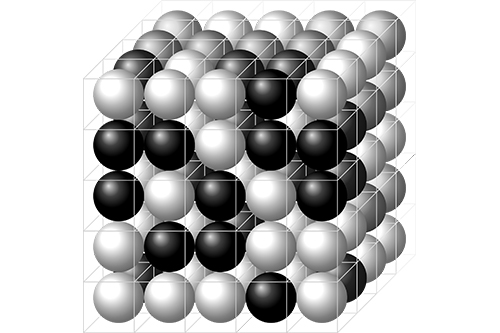
If you have ever asked yourself why diamonds are so hard, metals warp in different ways, or semiconductors work the way they do, the reason is lattices — the unseen scaffolding that keeps atoms together. Essentially, a lattice is a regular, repeating arrangement of points in space, and when atoms sit on the points, you have a crystal structure.
Think of it like a city grid: the lattice is the grid, and the atoms are the buildings. The pattern of the grid dictates traffic flow — or, in our case, electron flow, heat transfer, or stress distribution within a material.
The Lattice in Practice
Lattices are not purely abstract concepts; they directly affect the properties of materials. Take the cases of aluminum and tungsten. They are both metals, yet aluminum has an FCC lattice, while tungsten has a BCC lattice. This difference in atomic structure is what causes aluminum to be light and flexible (readily stretched or molded), while tungsten is extremely dense and hard but brittle.
Even small changes in lattice spacing have enormous consequences. Silicon, for instance, in semiconductor technology has a lattice constant of 5.43 Å (angstroms), and minor dopant variations within that lattice can literally alter the conductivity in a fundamental way. Engineers factor this into account when designing transistors and microchips, where atomic precision is necessary.
Basic Concept of Crystal Structure
A crystal structure is simply the lattice and the atoms (or molecules) at the lattice points. The smallest unit that can reproduce the entire structure is a unit cell. The volume and shape, known as the lattice parameters, define the entire crystal.
Examples:
• Cubic unit cells (such as in sodium chloride) have equal edges and 90° angles.
• Hexagonal cells (e.g., graphite) with two equivalent axes at 120° and another height on the third axis.
These differences are not superficial. They define mechanical strength, optical quality, and even chemical reactivity. Diamonds, for instance, have a cubic lattice that is capable of making strong covalent bonds in all directions — that is why diamonds are the hardest natural material. Graphite, which has a hexagonal lattice, is slippery and soft because the layers slide past each other effortlessly.
Lattice Models in Physics
Physicists make complex problems simpler by utilizing lattice models. Instead of tracking every particle, they simulate interactions at a finite set of lattice points.
Among the earliest are the Ising model, which models magnetic behaviour in materials. Magnetic spins are assigned to all points on a lattice, and used to study phase transitions, e.g., when a material is ferromagnetic at a temperature when cooled. Another is the tight-binding solid-state model, modeling electron dynamics in a crystal lattice — the foundation for semiconductor and superconductor understanding.
Types of Crystal Lattices
Crystals are classified based on their symmetry and geometry. There are seven primary systems:
1. Cubic: Equal axes, 90° angles (NaCl, copper).
2. Tetragonal: One axis of a different length (tin).
3. Orthorhombic: Three unequal axes, all 90° (sulfur).
4. Hexagonal: Two equal axes at 120° (graphite, zinc).
5. Trigonal (Rhombohedral): Equal axes, oblique angles (calcite).
6. Monoclinic: Unequal axes, one non-right angle (gypsum).
7. Triclinic: Unequal axes and angles (kyanite).
These systems also correspond to the 14 Bravais lattices, the complete set of potential lattice shapes in 3D space.
Frequently Asked Questions
What's the difference between a lattice and a crystal?
The lattice is the geometric arrangement; the crystal is the substance where atoms sit at lattice points.
How are lattices employed in physics?
They simplify complex interactions, enabling scientists to forecast magnetism, conductivity, and phase transitions.
Can non-crystalline materials exhibit lattice structures?
Yes, some amorphous materials possess short-range order but lack long-range periodicity.
Why are lattices useful in material design?
Mechanical, electrical, and optical characteristics are defined through lattice structure, enabling engineers to produce stronger, lighter, or more conductive materials.
Conclusion
Lattices are the material world's underlying structure. From the hardness of the diamond to the conductivity of the silicon, everything is known in terms of lattice structure. It is this that scientists and engineers apply to create new materials from electronics to pharmaceuticals to metallurgy, and it is this which makes the study of lattices fundamental and applied.
For more information and high-end crystal materials, go to Stanford Advanced Materials (SAM).



 Chin Trento