
 Products
 Bars
Bars
 Beads & Spheres
 Bolts & Nuts
 Crucibles
 Discs
Discs
 Fibers & Fabrics
 Films
Films
 Flake
Flake
 Foams
Foams
 Foil
Foil
 Granules
 Honeycombs
 Ink
Ink
 Laminate
 Lumps
Lumps
 Meshes
 Metallised Film
 Plate
Plate
 Powders
 Rod
Rod
 Single Crystals
 Sputtering Target
 Tubes
Tubes
 Washer
 Wires
Wires
 Converters & Calculators
 Write for Us



Anisotropy in Materials Science

What Is Anisotropy?
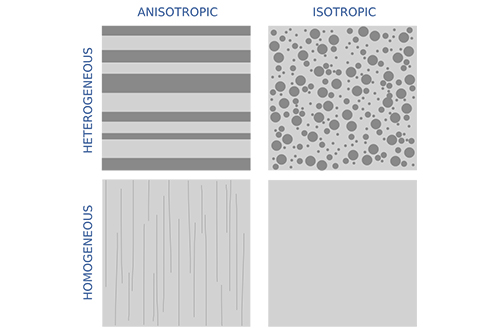
Anisotropy is the directional dependence of properties of a material; this means that with respect to different directions, the material may be performing differently. This is contrary to isotropy, whereby the properties are regular in all directions. Thus, anisotropic materials possess different physical, mechanical, and electrical properties that depend on orientation; hence, their behaviors are seriously dependent on how they are manipulated or used.
Causes of Anisotropy
The causes of anisotropy can be traced to several factors, including:
- Atomic Structure: The structure of atoms or molecules within the material can generate different properties in different material directions. Crystalline materials, for example, often show anisotropic behavior due to their ordered atomic arrangement.
- Manufacturing Processes: Manufacturing processes such as forging, rolling, and 3-D printing give rise to a grain or fiber alignment in a particular direction. This results in anisotropic mechanical properties. The main mechanical properties include strength, hardness, ductility among others that get affected.
- External Forces: The properties could also be affected by external forces such as pressure, temperature, or magnetic fields during manufacture or use that cause the material to behave differently under different conditions.
Materials That Exhibit Anisotropy
Anisotropy is a common feature in materials of many kinds, especially in those that have an ordered internal structure. Such examples include the following:
- Crystals: Crystalline materials usually possess anisotropic properties because of their atomic structure. In diamond, for example, a crystal lattice structure shows much higher thermal conductivity along some axes. Similarly, in materials such as graphene, electrical conductivity also depends on the direction because of their anisotropic structure.
- Metals: The mechanical treatment of metals, especially those that have undergone rolling or forging, normally exhibits anisotropic behavior. These kinds of treatments align the structure of the grains in one direction, leading to changes in properties such as strength, ductility, and hardness. As an illustration, steel that has been rolled is strongest in the rolling direction instead of the transverse direction.
- Polymers: For materials like fiberglass or other composites, the fibers oriented in a single direction create material that is far stronger in this direction compared with the direction perpendicular to it.
- 3D Printed Objects: Among several such growing areas where anisotropy becomes important is 3D printing. Due to the deposition process, the printed materials mostly exhibit different mechanical properties along the layers compared to the vertical direction. Such kinds of anisotropy are controllable by printing parameters and also with the selection of material.
Examples of Anisotropic Materials
Some examples of anisotropic materials include:
- Graphene: A single layer of carbon atoms in a hexagonal lattice, graphene possesses exceptional strength and electrical conductivity, yet only in the plane of the material.
- Wood: Wood serves as a classic example of an anisotropic natural material, whose strength and elasticity vary along the grain direction compared to across it.
- Composite materials: Carbon fiber composites are designed to be anisotropic, having very high strength and stiffness in the direction of fiber alignment, and much weaker in directions perpendicular to the fiber alignment.
Anisotropy in Materials Science
Anisotropy is an important factor in material behavior, especially in fields like crystallography, metallurgy, and materials science. Understanding how anisotropic properties manifest in different materials is important to tailor materials for specific applications.
Crystals
Crystallography: The relative arrangement of atoms in a crystal lattice determines the variation of various properties, such as thermal conductivity, electrical conductivity, and refractive index, depending on direction. Example:
Diamond: Having a highly ordered structure of atoms, it shows very high thermal conductivity along certain axes.
Quartz - Anisotropic optical behavior gives them application in devices like oscillators and sensors.
Metals
Metals are frequently anisotropic after a mechanical working process like rolling, forging, or extrusion. Such processes cause alignment in the internal grain structure of the metal, which affects its mechanical properties:
Strength: Metals such as rolled steel or aluminum have greater tensile strength in the rolling direction. This makes them effective for applications requiring strength in a particular orientation.
Ductility: The ability to stretch or deform a material depends upon the orientation of the grain; thus, the material could be more ductile in one direction and brittle in another direction.
3D Printing
It is very important to note that anisotropy in 3D-printed objects results from the additive process in a layer-by-layer manner. Each layer of material is deposited in a specific direction, and the bond between layers often does not have the same strength as the material within one layer. This originates from the fact that mechanical properties vary along the horizontal and vertical directions. The strength, flexibility, and overall durability of the printed object can be controlled by adjusting printing parameters such as the orientation of layers, the type of material used, and the speed of printing.
Magnetism and Anisotropy
Magnetic anisotropy means a dependence of the magnetic properties on direction. This is especially relevant for:
• Permanent Magnets: Magnetic anisotropy is needed such that magnetic alignment does not change direction easily in domains, a reason why the material retains its magnetism.
• Magnetic Storage: Magnetic storage devices, like hard drives, require anisotropic materials in order to store data stably. The stability of magnetic domains in the material over time will make it retain information.
Applications of Anisotropy
Anisotropic materials are used in several industries, exploiting their directional properties in enhancing functionality. Some of its uses include:
- Aerospace engineering makes use of anisotropic materials in order to perform under high directional stresses and temperature extremes, associated with aircraft wings or turbine blades among other components.
- Electronics: Anisotropic conductive films are used in flexible electronics, such as touchscreens and flexible circuits, where the electrical conductivity needs to be optimized in specific directions.
- Medical Devices: Materials possessing directionality, such as implants that are biocompatible, use anisotropy to their advantage by enhancing strength and flexibility where needed, hence improving both performance and safety in medical applications.
Frequently Asked Questions
What is anisotropy in simple terms?
Anisotropy means that properties differ in various directions. Unlike isotropic materials, whose properties are uniform, anisotropic materials show different behaviors depending on the direction of measurement.
How does anisotropy affect 3D printed objects?
Anisotropy in 3D printing means that the object will have different strengths, flexibilities, and durabilities between layers and in the vertical direction of the object. This affects the performance of the printed object as a whole.
Can anisotropy be controlled during its manufacturing process?
Certain manufacturing processes, such as fiber alignment in composites, grain structure manipulation in metals, and adjustment of printing parameters in 3D printing, enable the fabrication of materials with anisotropic properties that can be controlled and optimized.
Why is anisotropy important in magnetic materials?
The anisotropy in magnetic materials assures stability in the magnetic properties, such as strength and alignment of magnetic domains, which is crucial to maintaining permanent magnets and magnetic storage devices.
Are all crystals anisotropic?
Most crystalline solids are anisotropic to a certain extent because of their ordered atomic structures, though the degree of this anisotropy can vary widely depending on both the crystal type and the material symmetry.
 Chin Trento