
 Products
 Bars
Bars
 Beads & Spheres
 Bolts & Nuts
 Crucibles
 Discs
Discs
 Fibers & Fabrics
 Films
Films
 Flake
Flake
 Foams
Foams
 Foil
Foil
 Granules
 Honeycombs
 Ink
Ink
 Laminate
 Lumps
Lumps
 Meshes
 Metallised Film
 Plate
Plate
 Powders
 Rod
Rod
 Single Crystals
 Sputtering Target
 Tubes
Tubes
 Washer
 Wires
Wires
 Converters & Calculators
 Write for Us



Isotopes: Types and Examples

Isotopes are forms of the same element that enable key applications such as medical imaging, cancer treatment, radiometric dating, environmental tracing, and nuclear energy.
Description of Isotopes
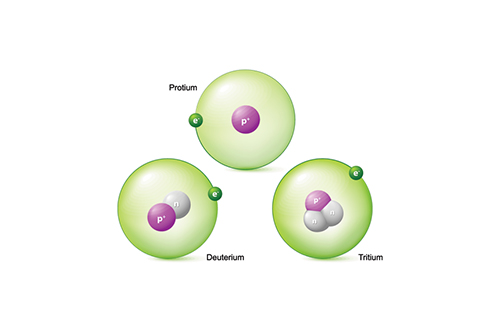
Isotopes are atoms of the same chemical element that have identical numbers of protons but different numbers of neutrons. This variation in neutron number results in different mass numbers for each isotope of an element. Despite these differences, isotopes exhibit nearly identical chemical behaviors because their electron configurations remain unchanged.
Examples of Isotopes
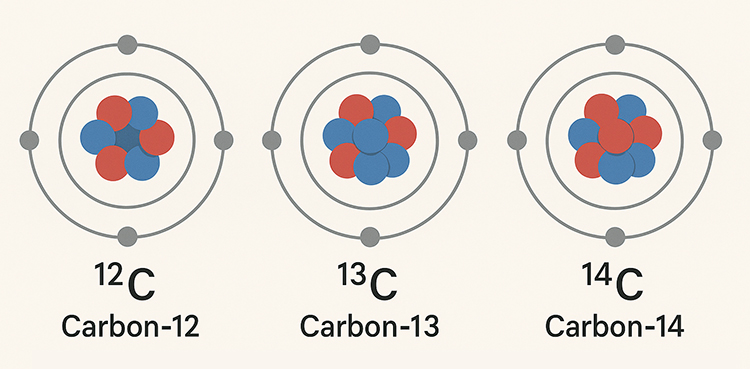
Several elements have multiple isotopes, each with distinct characteristics. Here are a few notable examples:
Carbon Isotopes
- Carbon-12 (^12C): The most abundant carbon isotope, making up about 98.9% of natural carbon.
- Carbon-13 (^13C): Constitutes about 1.1% of natural carbon and is used in various scientific studies.
- Carbon-14 (^14C): A radioactive isotope used in radiocarbon dating to determine the age of archaeological samples.
Hydrogen Isotopes
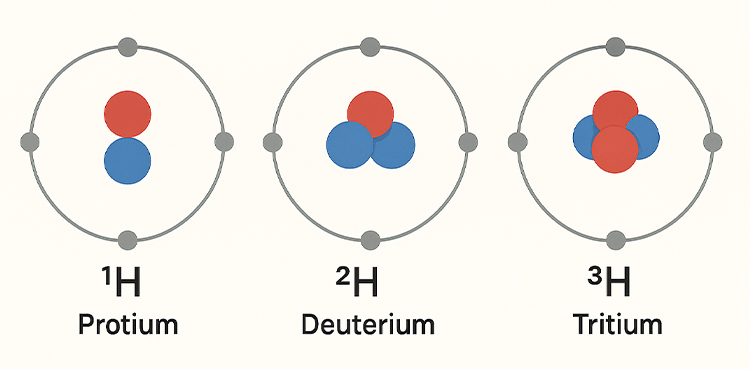
- Protium (^1H): The most common hydrogen isotope with no neutrons.
- Deuterium (^2H or D): Contains one neutron and is used in nuclear reactors and scientific research.
- Tritium (^3H or T): A radioactive isotope used in fusion reactions and as a tracer in biochemical studies.
For more information, please check Stanford Advanced Materials (SAM).
Types of Isotopes
Isotopes are atoms of the same element with the same number of protons but different numbers of neutrons, resulting in different atomic masses.
There are two main types: stable isotopes, which do not undergo radioactive decay and are commonly found in nature (e.g., Carbon-12, Oxygen-16), and radioactive isotopes (or radioisotopes), which are unstable and decay over time, emitting radiation (e.g., Carbon-14, Uranium-238).
Isotopes can be either natural, occurring naturally in the environment, or artificial, created in laboratories for various applications such as medical imaging, cancer treatment, and radiometric dating.
Uses of Isotopes
Isotopes have a wide range of applications across different fields due to their unique properties:
Medical Applications
- Diagnostic Imaging: Radioisotopes, such as Technetium-99m (^99mTc), are used in imaging to diagnose various conditions.
- Cancer Treatment: Isotopes such as Cobalt-60 (^60Co) are utilized in radiation therapy to target and destroy cancer cells.
Environmental Science
Tracing Pollution: Isotopes help track the movement of pollutants in ecosystems, aiding in environmental monitoring and remediation efforts.
Archaeology and Geology
Radiometric Dating: Isotopes like Carbon-14 (^14C) are essential for determining the age of archaeological artifacts and geological samples.
Industrial Applications
Non-Destructive Testing: Isotopes are used in techniques like radiography to inspect materials and structures without causing damage.
Frequently Asked Questions
What determines the stability of an isotope?
The stability of an isotope depends on the ratio of protons to neutrons in its nucleus. Isotopes with balanced ratios are generally more stable, while imbalances can lead to radioactivity.
How are isotopes used in medical diagnostics?
Isotopes like Technetium-99m are used in imaging techniques, such as SPECT scans, to visualize organs and diagnose conditions without the need for invasive procedures.
Can isotopes be used as energy sources?
Yes, certain isotopes like Uranium-235 are used as fuel in nuclear reactors to generate energy through nuclear fission.
What role do isotopes play in environmental science?
Isotopes help trace the sources and pathways of pollutants, monitor environmental changes, and study processes like water cycling and climate change.
How is Carbon-14 used in archaeology?
Carbon-14 dating measures the decay of radioactive carbon in organic materials, allowing archaeologists to determine the age of artifacts and fossils up to about 50,000 years old.
 Chin Trento