Products
 Bars
Bars
 Beads & Spheres
 Bolts & Nuts
 Crucibles
 Discs
Discs
 Fibers & Fabrics
 Films
Films
 Flake
Flake
 Foams
Foams
 Foil
Foil
 Granules
 Honeycombs
 Ink
Ink
 Laminate
 Lumps
Lumps
 Meshes
 Metallised Film
 Plate
Plate
 Powders
 Rod
Rod
 Single Crystals
 Sputtering Target
 Tubes
Tubes
 Washer
 Wires
Wires
 Converters & Calculators
 Write for Us



Glass Transition Temperature: Definition, Factors, and Why It Matters

What Is Glass Transition Temperature?
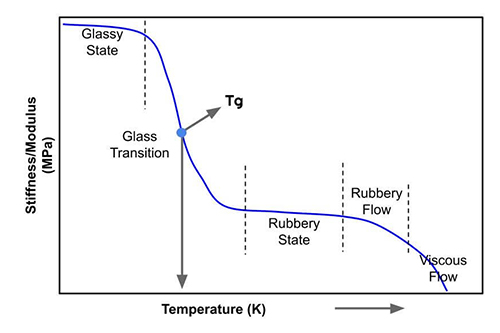
Glass transition temperature (Tg) is a fundamental property of amorphous and semi-crystalline materials, particularly polymers. It describes the temperature range where a material transitions from a hard, glassy state to a soft, rubbery state.
Below Tg, polymer chains are frozen in place. The material is rigid, brittle, and behaves like a solid—think of a plastic cup at room temperature. Above Tg, chains gain enough thermal energy to slide past each other. The material becomes flexible, elastic, and may deform under load—think of the same cup heated in boiling water.
This transition is not a melting point. Melting happens in crystalline regions; Tg happens in amorphous regions. For many polymers, both exist—which is why a material can have both a Tg and a melting point (Tm).
Why Tg Matters in Everyday Materials and Processing
Real-world examples
-
A polystyrene yogurt container is rigid in the fridge (below its Tg of ~100°C). Pour in boiling water, and it softens and distorts—that's crossing above Tg.
-
A rubber band is flexible at room temperature because its Tg is below -50°C. Dip it in liquid nitrogen, and it shatters like glass.
-
A silicone baking spatula stays flexible in a hot pan because its Tg is below room temperature, but it won't melt until much higher temperatures.
Tg in manufacturing
When injection molding a plastic part, the mold temperature relative to Tg affects cooling rate and final properties. Parts cooled slowly above Tg may develop different crystallinity (if semi-crystalline) or internal stress than those cooled rapidly. This is why processing parameters are tuned specifically for each material's Tg.
Glass Fibers and Their Applications
Glass fibers are widely used in composite materials due to their high strength and thermal stability. The glass transition temperature of the polymer matrix in fiber-reinforced composites is crucial for determining the performance and durability of the final product. Ensuring that the operating temperatures remain below Tg helps maintain the structural integrity of the composite.
These fibers offer:
- High Strength-to-Weight Ratio: Ideal for lightweight structural applications.
- Thermal Stability: Maintains properties over a wide temperature range.
- Chemical Resistance: Resistant to various chemicals, enhancing durability.
- Electrical Insulation: Excellent insulator, useful in electrical applications.
Glass Transition Temperature of Common Polymers
| Polymer | Typical Tg Range (°C) | Behavior at Room Temp | Common Applications |
|---|---|---|---|
| Polystyrene | 90 - 100 | Rigid, glassy | Disposable cups, packaging |
| PET (amorphous) | 70 - 80 | Rigid | Water bottles, food trays |
| Polycarbonate | 145 - 150 | Rigid, tough | Safety glasses, electronics |
| Epoxy Resins | 150 - 200 | Rigid (thermoset) | Adhesives, composites |
| Natural Rubber | -70 to -50 | Flexible, elastic | Tires, seals |
| Polyethylene (LDPE) | -120 to -100 | Flexible | Plastic bags, squeeze bottles |
| PVC (unplasticized) | 80 - 85 | Rigid | Pipe, window frames |
| PVC (plasticized) | -30 to 30 | Flexible | Hose, cable insulation |
Note: Semi-crystalline polymers (like PET and polyethylene) have both amorphous and crystalline regions. The Tg applies to the amorphous parts; the crystalline regions have a separate melting point.
Factors That Affect Tg in Polymers
Several molecular-level factors determine where a polymer's Tg falls:
Molecular Weight
Longer polymer chains have more entanglements, which restricts segmental motion. More thermal energy (higher temperature) is needed to reach the rubbery state. Tg increases with molecular weight up to a point, then levels off.
Chain Flexibility
Polymers with rigid backbones—like polycarbonate with its aromatic rings—require more energy to move, so Tg is high. Flexible backbones—like the simple carbon chain in polyethylene—move easily, giving very low Tg.
Cross-Linking
Cross-links tie chains together chemically, preventing them from sliding past each other. Highly cross-linked thermosets (like epoxy) have high Tg and don't flow even above Tg. Lightly cross-linked rubbers remain flexible but retain their shape.
Plasticizers
Small molecules wedged between polymer chains increase free volume and make it easier for chains to move. This lowers Tg—which is why plasticized PVC is flexible at room temperature, while unplasticized PVC is rigid.
Crystallinity
In semi-crystalline polymers, crystalline regions act as physical cross-links, restricting movement in nearby amorphous regions. Higher crystallinity generally increases the effective Tg.
Tg in Fiber-Reinforced Composites
In composite materials, reinforcing fibers (glass, carbon, aramid) provide strength and stiffness. But the polymer matrix—typically epoxy, polyester, or vinyl ester—determines the composite's temperature limits.
If the operating temperature approaches or exceeds the Tg of the matrix:
-
The matrix softens and loses its ability to transfer load between fibers
-
Composite stiffness drops significantly
-
Dimensional stability may be compromised
-
Creep and deformation under load become more likely
This is why Tg is a key specification when selecting prepreg materials or resin systems for composite manufacturing. Aerospace components, automotive underhood parts, and high-temperature industrial applications typically use matrices with Tg well above the maximum service temperature—often by a margin of 20-30°C or more.
The fibers themselves (glass, carbon) are inorganic and do not have a Tg. They retain their properties to much higher temperatures, but they rely on the matrix to hold them in place.
How Tg Is Measured
The most common method for determining Tg is differential scanning calorimetry (DSC). As a sample is heated, the instrument measures heat flow. At Tg, there is a step change in heat capacity—visible as a shift in the baseline—because the material absorbs more energy as chains begin to move.
Dynamic mechanical analysis (DMA) is also used, particularly for composites and structural materials. DMA measures stiffness and damping as a function of temperature; Tg shows up as a peak in the damping curve and a drop in stiffness.
Frequently Asked Questions
Q: What is glass transition temperature in simple terms?
A: It's the temperature where a hard, glassy plastic becomes soft and rubbery. Below Tg, polymer chains are locked in place; above Tg, they can move past each other.
Q: Is Tg the same as melting point?
A: No. Melting happens in crystalline regions; Tg happens in amorphous regions. Many polymers have both—a Tg for the amorphous parts and a Tm for the crystalline parts.
Q: Why is Tg important for material selection?
A: If you need a material to stay stiff at high temperatures, choose one with Tg above your service temperature. If you need flexibility at low temperatures, choose one with Tg below your lowest expected temperature.
Q: Can additives change Tg?
A: Yes. Plasticizers lower Tg; fillers and reinforcements may raise it or broaden the transition. Cross-linking (as in thermosets) raises Tg significantly.
Q: Do all polymers have a Tg?
A: Amorphous polymers always have a Tg. Semi-crystalline polymers have both a Tg (amorphous regions) and a melting point (crystalline regions). Highly crystalline polymers with minimal amorphous content may have a Tg that's difficult to detect.
Q: What Tg range should I choose for high-temperature applications?
A: As a rule of thumb, select a material with Tg at least 20-30°C above the maximum service temperature. For structural composites under continuous load, a larger margin may be required.
Q: Do glass fibers have a glass transition temperature?
A: No. Glass fibers are inorganic and do not exhibit a Tg. In glass-fiber composites, Tg refers to the polymer matrix only.
Materials from Stanford Advanced Materials
Stanford Advanced Materials (SAM) supplies high-performance polymers, epoxy resins, and composite materials for research and industrial applications. Many of the materials listed above—including polycarbonate, PET, and epoxy systems—are available in various forms. We also provide technical data sheets that include Tg specifications.
[Contact us] for material recommendations, Tg data, or custom requirements.
 Chin Trento