Products
 Bars
Bars
 Beads & Spheres
 Bolts & Nuts
 Crucibles
 Discs
Discs
 Fibers & Fabrics
 Films
Films
 Flake
Flake
 Foams
Foams
 Foil
Foil
 Granules
 Honeycombs
 Ink
Ink
 Laminate
 Lumps
Lumps
 Meshes
 Metallised Film
 Plate
Plate
 Powders
 Rod
Rod
 Single Crystals
 Sputtering Target
 Tubes
Tubes
 Washer
 Wires
Wires
 Converters & Calculators
 Write for Us



Heat of Vaporization

Introduction
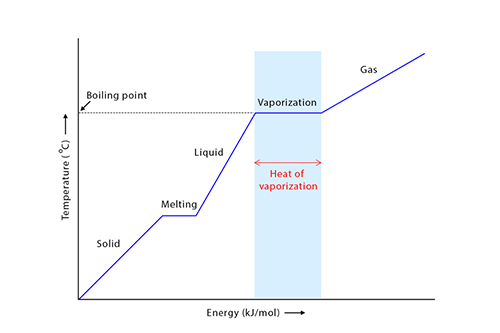
Vaporization heat is a thermodynamic principle that describes the energy required to transform a liquid into a gas at constant pressure and temperature. Heat of vaporization is a significant characteristic of several natural and industrial phenomena. From cooling the air to chemical production, scientists and engineers may quantify energy requirements for phase change, develop processes for optimal functioning, and regulate temperature phenomena based on vaporization heat.
Formulation
Energy of vaporization (ΔHvap) refers to the energy required to break intermolecular forces between molecules in a liquid. Specific heat capacity is related to rising the temperature of a substance, but ΔHvap doesn't concern energy with respect to phase transition from liquid to gas. It is often measured in joules per gram (J/g) or kilojoules per mole (kJ/mol) and reflects a quantity of the substance resisting vaporization.
Mathematically, heat of vaporization is expressed as:
ΔHvap = q / n
where (q) is the heat supplied to the system and (n) is the amount of substance vaporized.
Factors Influencing Heat of Vaporization
There are numerous factors upon which the value of a substance's heat of vaporization depends:
1. Forces between modules: Molecules that have strong hydrogen bonding, dipole-dipole forces, or van der Waals forces require more energy to vaporize. Water is an example of having very high ΔHvap due to extensive hydrogen bonding.
2. Molecular Structure and Size: More molecules or bigger molecules will have a higher ΔHvap due to more van der Waals interactions.
3. Pressure: An external pressure change affects heat of vaporization slightly because higher pressures require more energy to break the liquid-gas equilibrium.
4. Temperature: While ΔHvap is typically measured most commonly at boiling point, there exist potential variations in any other temperature due to changes in molecular kinetic energy.
Mechanism and Applications
At vaporization, energy is taken in by a liquid in order to break intermolecular forces such that molecules can transform into the gaseous state. This energy does not increase the temperature of the substance but facilitates a change of phase. The process is endothermic since it absorbs heat from the surroundings.
The heat of vaporization finds widespread application in natural and industrial environments:
•Climate and Environmental Science: Water's high ΔHvap allows it to cool temperatures by absorbing and holding enormous quantities of energy, regulating atmospheric and ocean temperatures, lake temperature, and earth temperatures.
•Biological Processes: Sweaty evaporation or plant transpiration utilizes water's heat of vaporization in an attempt to cool the body and regulate inner temperatures.
• Industrial Processes: Heat of vaporization is important in the case of distillation, refrigeration cycles, and chemical reactors where there needs to be targeted energy input to cause phase change.
• Energy Calculations: In design and engineering use of thermal systems, ΔHvap helps in finding the quantity of energy necessary for phase-change processes, e.g., power generation or refrigeration.
Water and Its Heat of Vaporization
Water's relatively large vaporization heat compared to most things is approximately 40.7 kJ/mol. Having a ΔHvap this large has several significant implications:
•Temperature Regulation: The ability of water to absorb gigantic amounts of heat energy without an increase in temperature provides the capacity to buffer environmental and biological systems.
•Climate Impact: The phase changes of water play a role in weather phenomena, cloud formation, and the patterns of precipitation.
•Evaporative Cooling: Living systems utilize the ΔHvap of water to maintain thermal homeostasis through sweating and transpiration.
Examples of Heat of Vaporization
|
Substance |
Heat of Vaporization (kJ/mol) |
Common Uses |
|
Water |
40.7 |
Climate regulation, biological processes |
|
Ethanol |
38.6 |
Solvent, fuel, beverages |
|
Mercury |
59.1 |
Thermometers, electrical applications |
|
Acetone |
31.3 |
Solvent, nail polish remover |
|
Benzene |
30.8 |
Chemical manufacturing, solvent |
For more information, please check Stanford Advanced Materials (SAM).
Frequently Asked Questions
1. What is heat of vaporization?
Heat of vaporization is energy required to transform a substance from liquid to gas state at constant pressure and temperature.
2.Why is water's heat of vaporization important?
Water's high ΔHvap allows it to take in and hold enormous quantities of energy, regulating temperature in natural and biological systems by transpiration and evaporation.
3.Why is heat of vaporization different between substances?
ΔHvap is related to diatomic forces, molecular shape and size, and influences how readily a substance evaporates from liquid to gas.
4.Is heat of vaporization experimentally determinable?
Yes, calorimetry allows for measurement of energy absorbed in vaporization, providing precise ΔHvap values.
5.Where is heat of vaporization applied?
It is applied in refrigeration systems, distillation, phase-change energy calculations, and chemical engineering processes for appropriate energy requirements.


 Chin Trento