
 Products
 Bars
Bars
 Beads & Spheres
 Bolts & Nuts
 Crucibles
 Discs
Discs
 Fibers & Fabrics
 Films
Films
 Flake
Flake
 Foams
Foams
 Foil
Foil
 Granules
 Honeycombs
 Ink
Ink
 Laminate
 Lumps
Lumps
 Meshes
 Metallised Film
 Plate
Plate
 Powders
 Rod
Rod
 Single Crystals
 Sputtering Target
 Tubes
Tubes
 Washer
 Wires
Wires
 Converters & Calculators
 Write for Us



The Magic of Superconductors: Levitation and Zero Resistance Explained

Introduction and Hook
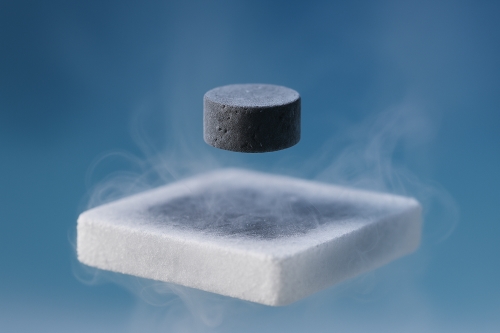
Imagine a small, shiny disc hovering above a magnet. It floats in mid-air as if by magic. This sight can capture anyone’s attention. Yet, it is no illusion. It is a real effect called superconductivity. When certain materials are cooled below a special temperature, they show no electrical resistance. They also push away magnetic fields. We will discuss how superconductors work and why their properties seem magical.
Core Concepts
Superconductivity Basics
Superconductivity refers to a state of matter where materials conduct electricity perfectly. In this state, there is no loss of energy. This happens only when the material is cooled below its critical temperature. The critical temperature is the point where all imperfections that cause resistance vanish. When the material reaches this low temperature, electrons can move without any hindrance. Many metals become superconductors when cooled to extremely low temperatures. Some ceramic materials can also be superconductors at higher temperatures, though these are still far below room temperature.
Superconductivity is a common subject in advanced physics courses. It gives useful insights into quantum mechanics. The idea is that electrons inside the material form pairs. These pairs move together in a coordinated way. The coordinated movement means they encounter no scattering. That is why there is zero resistance. This simple idea has deep roots in complex physical theory. Yet, the result is simple and amazing: perfect conduction of electricity.
Zero Resistance
Zero resistance means that once an electrical current starts in a superconducting loop, it will continue to flow forever. There is no energy lost as heat. In a typical metal circuit, resistance makes the current lose energy over time. That is why light bulbs eventually dim if connected to a leaky circuit. In a superconductor, this does not happen.
Simple experiments can show this effect. A loop of superconducting wire can be cooled and connected to a battery for a short time. When the battery is removed, the current keeps flowing for a very long time. This persistent current is proof of zero resistance. In labs, this effect has been measured for hours and even days. The absence of energy loss opens up many practical uses in electrical devices.
Magnetic Levitation (Meissner Effect)
Magnetic levitation is one of the most exciting outcomes of superconductivity. When a superconducting material is cooled below its critical temperature, it expels all magnetic fields from its interior. This is known as the Meissner Effect. As a result, if you place a cooled superconductor near a magnet, the superconductor will push away the magnetic field. The force creates a stable floating position above the magnet.
There is another related phenomenon known as flux pinning. Flux pinning holds the superconductor in place in a magnetic field. With flux pinning, the superconductor does not just float randomly; it stays fixed in position even if you tilt the magnet. This stability is important in many practical applications. The effect has been used to show levitation in a clear and exciting way in physical demonstrations.
Hands-On Demonstration
A simple experiment can show superconductivity and levitation. First, get a sample of a superconductor. These samples are often in the form of a small disc. Next, obtain liquid nitrogen. Liquid nitrogen is very cold. It cools the superconductor below its critical temperature.
Take safety precautions when using liquid nitrogen. Wear gloves and eye protection. Always work in a well-ventilated area. Pour the liquid nitrogen carefully over the superconductor sample. After a few minutes, the sample reaches the critical temperature and enters the superconducting state.
Now, bring the sample close to a strong magnet. You will see the disc suddenly levitate. It floats above the magnet with an almost fixed position. The floating effect is due to the superconductor expelling the magnetic field and the pinning of magnetic flux lines. For extra fun, you can try to move the superconductor gently. Notice how it stays in place or returns to balance.
Some teachers add interactive experiments. For instance, they connect a superconductor to a simple circuit. A very delicate instrument may be used to measure the resistance. You will find that the current flows without a drop in energy. This experiment clearly shows the notion of zero resistance.
STEM Connections
The ideas behind superconductors touch on many STEM disciplines.
• Physics: Superconductivity is linked to electromagnetism and quantum mechanics. The behavior of electron pairs in superconductors is a real-world application of quantum physics.
• Engineering: Superconductors play a role in transportation systems like Magnetic Levitation (Maglev) trains. In hospitals, superconducting magnets make Magnetic Resonance Imaging (MRI) machines work.
• Materials Science: There is a clear distinction between high-temperature and low-temperature superconductors. Research in material science focuses on finding new materials that might work at even higher temperatures.
• Chemistry: The chemical composition of superconductors matters. Cooling techniques, such as using liquid nitrogen, rely on understanding the chemical and physical properties of the materials used.
Applications and Future Prospects
Superconductors have many use cases in everyday technology.
- Consider transport. Maglev trains use superconducting magnets to float above the track. This reduces friction and helps the train travel faster. In power grids, superconductors can carry electricity without energy loss. This can lead to greatly improved energy efficiency. Superconducting wires are also used in particle accelerators. These machines help scientists study the smallest components of matter.
- New research in high-temperature superconductors holds much promise. They may someday work at room temperature. Though room-temperature superconductors have not yet become common, the progress is clear. As the materials are refined, everyday applications in consumer electronics may follow. Engineers and scientists are working hard to bring these benefits into common use.
- Applications in medicine are now important too. Superconductors make MRI machines more efficient and reliable. They are also used for very sensitive scientific instruments. A superconducting quantum interference device (SQUID) can measure the tiniest changes in magnetic fields. Such devices are invaluable in research labs and industrial settings.
Future prospects include energy-efficient power grids. In such grids, no electrical energy is wasted. This helps in reducing energy costs and protecting the environment. The technology also opens doors to more compact and efficient electrical systems in many industries.
The world has seen many great inventions. Superconductors may well be one of the most promising. They offer a clear path toward cleaner and more efficient energy use. They are not magic, but they perform tasks that seem magical to the untrained eye. With continued research and development, the impact of superconductors in everyday life will only grow.
Conclusion
Superconductivity shows us a world where zero resistance joins with magnetic levitation to create almost magical results. A tiny disc can float above a magnet with a stable balance due to quantum effects. This topic brings together ideas from physics, engineering, materials science, and chemistry. It also shows a clear pathway to better transportation, energy grids, and medical technologies. For more advanced materials, please check Stanford Advanced Materials (SAM).
Frequently Asked Questions
F: What happens to a superconductor above its critical temperature?
Q: It loses its superconducting state and regains usual electrical resistance.
F: Does a levitating superconductor always remain in one place?
Q: Yes, due to flux pinning, it maintains stable levitation.
F: Can superconductors be used in everyday transportation?
Q: Yes, they are used in maglev trains to reduce friction and improve speed.

 Chin Trento