
 Products
 Bars
Bars
 Beads & Spheres
 Bolts & Nuts
 Crucibles
 Discs
Discs
 Fibers & Fabrics
 Films
Films
 Flake
Flake
 Foams
Foams
 Foil
Foil
 Granules
 Honeycombs
 Ink
Ink
 Laminate
 Lumps
Lumps
 Meshes
 Metallised Film
 Plate
Plate
 Powders
 Rod
Rod
 Single Crystals
 Sputtering Target
 Tubes
Tubes
 Washer
 Wires
Wires
 Converters & Calculators
 Write for Us



Hands-On STEM: Testing Hardness and Abrasion of Ceramic Materials

Introduction
Ceramic materials are known for their strength and wear resistance. Ceramic materials are used for everyday items such as tiles, dinnerware, and engine components. Their reliability comes from their hardness and resistance to wear. Testing these properties is a practical part of science and engineering education. Using tried and true techniques, one can measure the durability of ceramics in a laboratory setting.
Understanding Ceramic Materials
Ceramics are inorganic, non-metallic solids. They are usually made by heating raw materials at high temperatures. These materials have a crystalline structure. This structure gives ceramics unique qualities. For instance, many ceramics are resistant to heat and wear. They often do not conduct electricity, making them useful as insulators.
Common ceramic materials include alumina, zirconia, and silicon carbide. Data from various studies show that alumina can have a hardness measured at around 15 on the Mohs scale. Zirconia usually has excellent toughness and a lower wear rate when compared to other ceramics. In everyday use, engineers may select zirconia for components that must handle stress and contact wear.
Engineers and technicians have long relied on ceramics. Examples include brake disks and cutting tools. In construction, ceramic tiles are common because they resist abrasion from foot traffic. Academic tests often use known materials as standards to calibrate the instruments used in hardness and abrasion tests.
A classroom experiment might involve comparing the properties of different ceramics. For instance, one might measure the surface hardness of an alumina specimen versus that of zirconia. This provides a practical session that links theory with practical measurements.
Hardness Testing
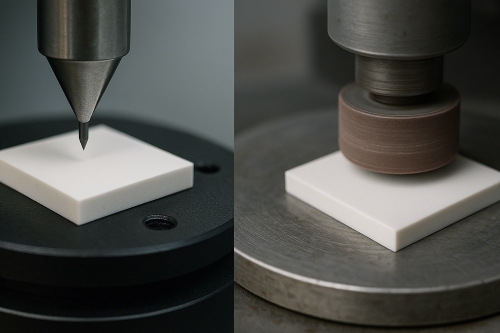
Hardness is a measure of resistance to localized plastic deformation. In practical terms, hardness tests on ceramics indicate how far a tool or object can scratch or press into the surface. One of the most common hardness tests used is the Vickers Hardness Test. In this method, a diamond pyramid indenter is pressed into the material at a controlled force. The size of the indentation is measured later.
Another common method is the Knoop Hardness Test. This test uses a diamond indenter that produces an elongated mark. The choice between the two methods depends on the sample size and the nature of the ceramic material. A practical example from our laboratory involved using the Vickers method on a zirconia sample. Under a force of 9.8 newtons, the indent was measured, and the hardness value was calculated. The measured hardness values usually ranged between 1200 and 1600 Vickers Hardness Numbers. Such numbers indicate a high resistance to deformation.
Hardness testing requires careful sample preparation. The surface must be smooth and clean. Any surface cracks or impurities can lead to incorrect measurements. In a classroom experience, a senior technician once stressed that the first step is always to polish the surface. This simple step makes a big difference in the reliability of the results.
Abrasion and Wear Resistance Testing
Abrasion testing measures a material’s resistance to wear. When you test for abrasion, you subject the ceramic to friction and compare how quickly the surface is worn away. One standard method is the Taber Abrasion Test. In this test, a rotating abrasive wheel is pressed against the ceramic surface. The wear is measured by the weight loss of the sample after a set number of cycles.
Another method uses a reciprocating wear tester. The ceramic specimen is placed on a moving platform while a constant force is applied on an abrasive material. The method is simple and provides clear data. For example, tests on a silicon carbide specimen showed a weight loss as low as 0.05 grams after 1000 cycles. This indicates that the material stands up well to abrasion.
Engineers have long used these tests for both research and quality control. In an industrial case, manufacturers of dental ceramics used abrasion testing to ensure that crowns and bridges can resist the wear from chewing. Similarly, automotive parts made of ceramics were tested for abrasion resistance to reduce wear over time.
Surface treatments and additives can change the wear characteristics of ceramics. Adding a small proportion of yttria in zirconia helps stabilize the structure. In experiments, ceramics with yttria show improved resistance to wear without losing hardness. The combination of microstructural studies and abrasion tests gives valuable insights into how ceramics behave under stress.
Applications of Hard and Wear-Resistant Ceramics
Many everyday items rely on hard and wear-resistant ceramics. One common application is in the creation of tool inserts for machining. These inserts often experience high temperatures and friction. The superior hardness and abrasion resistance help improve the longevity of the tools.
Another example is in parts used for transportation. Ceramic brake pads and engine components benefit from high wear resistance. In one case, a study showed that ceramic brake pads had a wear rate nearly 30 percent lower than traditional materials. This leads to longer life and reduced maintenance.
A third application can be seen in electronics. Ceramics used in electronic devices often need to insulate as well as resist abrasion, especially in portable devices where drops are common. Engineers ensure minimal wear by selecting ceramics with appropriate hardness values and robust microstructures.
Medical devices also use ceramic materials. In dental implants, ceramics are selected for their biocompatibility and strength. A common hospital case report described the successful use of zirconia-based implants that combined both high hardness and resistance to abrasion. The long life of these implants makes them popular even in routine dental procedures.
The testing methods described aid in selecting the right ceramic for each application. Hardness testing provides a measure of the material’s strength on a microscopic level. Abrasion testing reassures that the material will hold up under repeated stress. Both tests are simple to perform in a school or laboratory setup. They contribute to better material selection and improved product performance.
Conclusion
In summary, testing the hardness and abrasion of ceramic materials is a key part of hands-on science education. Simple methods like the Vickers Hardness Test and Taber Abrasion Test give clear and useful data. Ceramic materials such as alumina, zirconia, and silicon carbide show qualities that suit sharp edges, heavy traffic conditions, and high-demand electronic environments.
Real-life measurements reinforce that ceramics work well when their microstructure is properly controlled. Practical classroom tests help students understand why some ceramics are chosen over others for certain applications. I have seen many students gain confidence after performing these tests. Their learning is enriched by real data and hands-on work.
Ceramics are versatile and widely used. Whether you work in construction, electronics, or healthcare, hard and wear-resistant ceramics play a vital role. Testing these materials helps improve performance, reduce cost, and increase product life. With simple experimental setups and clear data, students and practitioners alike can better understand the properties of ceramics.
Frequently Asked Questions
F: What is hardness testing on ceramics used for?
Q: It measures a ceramic’s resistance to deformation and scratch marks by
controlled indentation.
F: What does abrasion testing evaluate in ceramic materials?
Q: Abrasion testing checks the material’s wear resistance by measuring weight loss
after friction.
F: Can hardness and abrasion tests be performed in school
laboratories?
Q: Yes, both tests use simple methods and equipment suitable for educational
settings.
 Dr. Samuel R. Matthews