Products
 Bars
Bars
 Beads & Spheres
 Bolts & Nuts
 Crucibles
 Discs
Discs
 Fibers & Fabrics
 Films
Films
 Flake
Flake
 Foams
Foams
 Foil
Foil
 Granules
 Honeycombs
 Ink
Ink
 Laminate
 Lumps
Lumps
 Meshes
 Metallised Film
 Plate
Plate
 Powders
 Rod
Rod
 Single Crystals
 Sputtering Target
 Tubes
Tubes
 Washer
 Wires
Wires
 Converters & Calculators
 Write for Us



Potassium: Element Properties and Uses

Description
Potassium is one of the most reactive chemical elements used in many biological and industrial processes. Its importance extends from plant life to animal life.
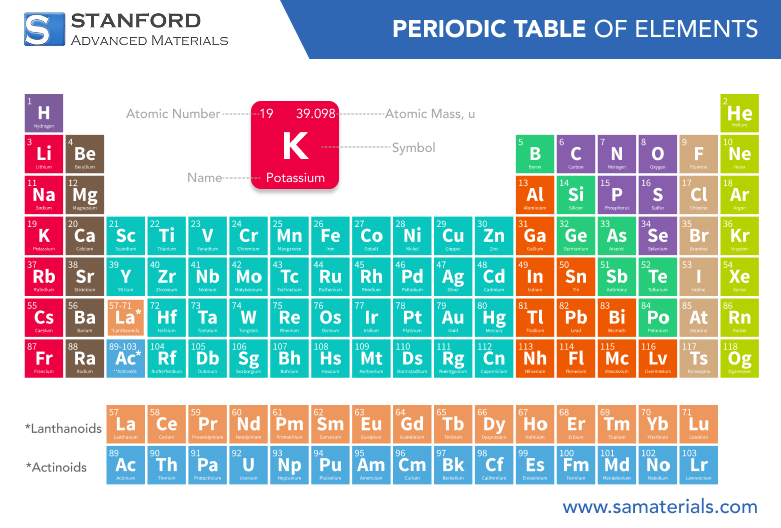
Potassium the Element
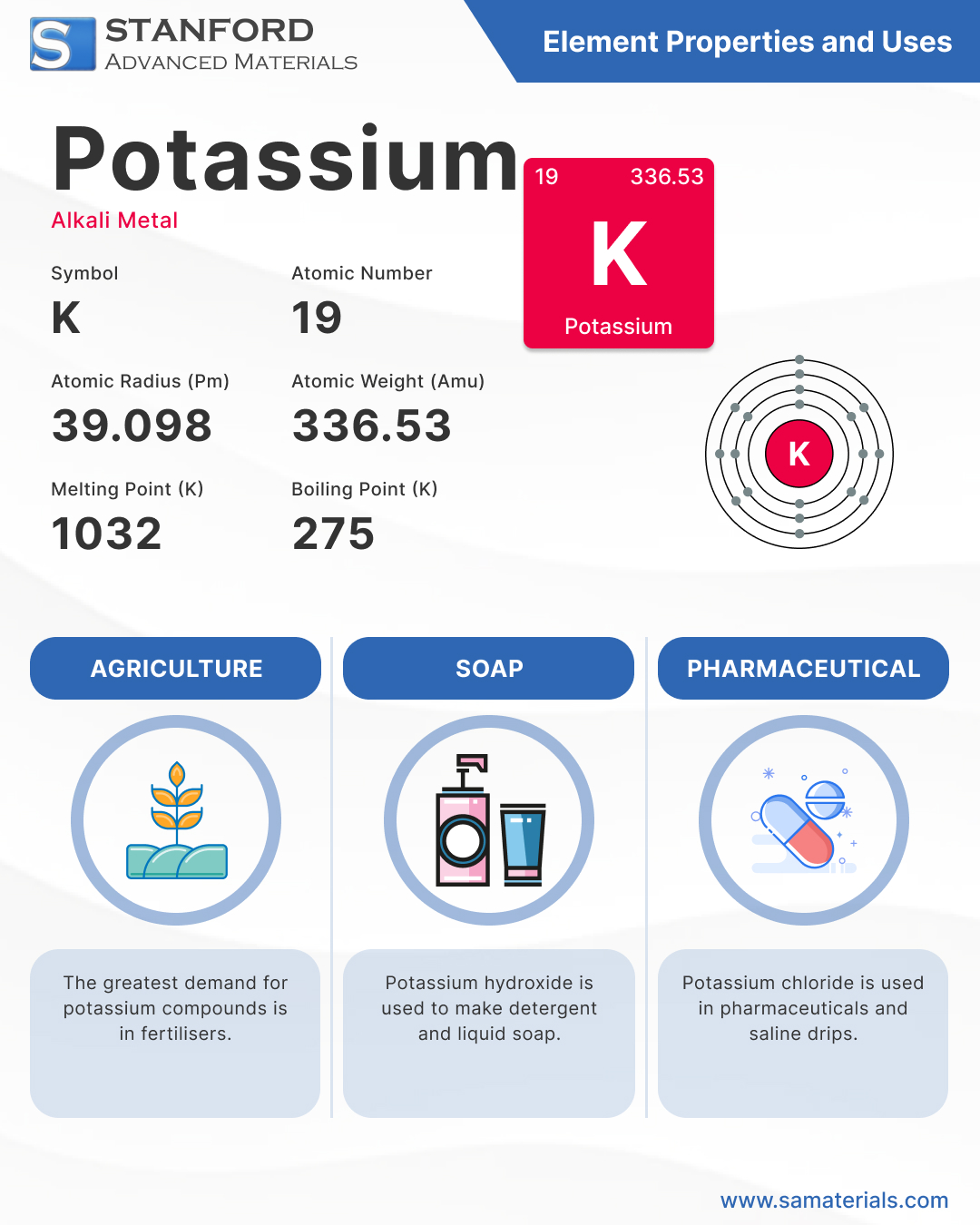
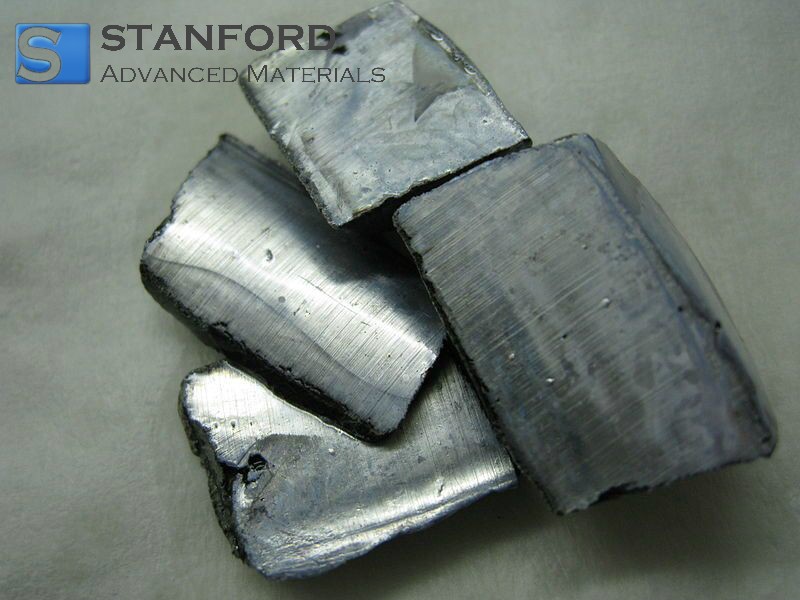
Potassium is a chemical element with the atomic number 19. On the periodic table, it is grouped in the family of alkali metals, sharing properties with other elements such as sodium and lithium. This soft, silvery-white metal is crucial in biological systems, and it is abundant in nature, mainly found in different types of minerals.
Potassium is highly reactive, particularly with water; it is used in fertilizers and thus holds great importance in agriculture. It also finds wide applications in industries, from manufacturing to medicine.
Chemical Properties Description
Potassium is a very reactive element, especially with water; it forms potassium hydroxide and hydrogen gas when it reacts with the water. This reaction is accompanied by the liberation of energy in the form of heat. Because of this reactivity, potassium does not exist freely in nature but always combined with other elements.
When potassium interacts with oxygen, it produces K₂O or KO₂. Potassium is also reactive with halogens, like chlorine, to produce potassium chloride, which is an important chemical for industries as well as agricultural use.
Besides its reaction with water and oxygen, potassium can form a series of salts that play an important role in fertilizers, food additives, and even some medical treatments.
Physical Properties
Potassium is a soft metal with a low melting point of 63.5°C (146.3°F). Its density is relatively lower compared to other metals, and it can be cut easily with a knife. Because of its physical properties, it is an ideal candidate for applications that utilize a lightweight, reactive metal.
|
Property |
Value |
|
Atomic Number |
19 |
|
Symbol |
K |
|
Melting Point |
63.5°C (146.3°F) |
|
759°C (1398°F) |
|
|
Density |
0.862 g/cm³ |
|
Color |
Silvery-white |
|
Reactivity |
Highly reactive with water |
|
Electronegativity |
0.82 |
For more details, refer to Stanford Advanced Materials.
Common Uses
Potassium and its compounds have a very wide range of applications in industry and everyday life. Most of the applications of this element are in fertilizers since it is one of the most vital elements of plant growth. Many agricultural products contain potassium compounds, especially potassium nitrate and potassium chloride, to increase the yield.
Apart from agriculture, potassium is utilized in the manufacture of soaps, detergents, and the preparation of glass. It also participates in the manufacture of different chemical substances, such as potassium hydroxide, used in cleaning products and batteries.
In medicine, potassium is necessary for the balance of electrolytes within the human body, and therefore potassium chloride is quite commonly used in medical treatments for a lack of potassium. Potassium compounds are also used in fire extinguishers.
Methods of Preparation
Potassium is usually prepared by the electrolysis of melted KCl. Here, potassium is formed at the cathode by passing an electric current through the molten salt. This process is very important because potassium does not occur in its native state due to its high reactivity.
Related Industrial Products
Several industrial products are related to potassium, mainly through its compounds. These are:
- Potassium Nitrate - KNO₃: Used in fertilizers, fireworks, and as an oxidizer.
- Potassium Hydroxide (KOH): Used in soap production, cleaning agents, and as a strong base in chemical processes.
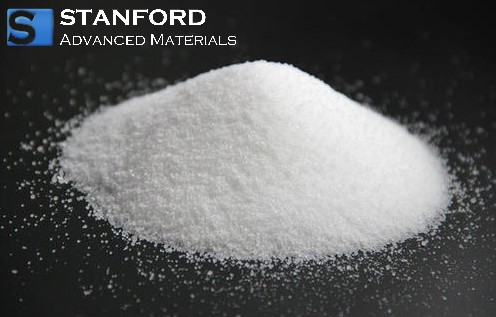
- Potassium Chloride (KCl): Commonly used in fertilizers, food processing, and medicine.
- Potassium Carbonate (K₂CO₃) is utilized for glass production and as a drying agent in the chemical industry.
Frequently Asked Questions
What is potassium used for in fertilizers?
Potassium is an important element for plants and helps in regulating water, activating enzymes, and photosynthesis. Potassium-based fertilizers help with the betterment of crop yields and health of plants.
Is potassium toxic to humans?
The potassium itself is not toxic to humans; rather, it is an essential nutrient. However, an imbalance-too much or too little-can lead to serious health issues, such as heart arrhythmias.
Why does potassium react so vigorously with water?
Since potassium is an alkali metal, it is very reactive because of the single electron in its outer shell, which it easily loses to form compounds, especially with water.
How does commercial preparation of potassium occur?
Potassium is prepared by the electrolysis of KCl. The passage of electric current through molten KCl results in the separation and formation of potassium at the cathode.
What are some products made from potassium compounds?
Some common products include fertilizers - potassium chloride and potassium nitrate, soaps - potassium hydroxide, and glass - potassium carbonate. Potassium salts are also used in food and medicine.
 Chin Trento