
 Products
 Bars
Bars
 Beads & Spheres
 Bolts & Nuts
 Crucibles
 Discs
Discs
 Fibers & Fabrics
 Films
Films
 Flake
Flake
 Foams
Foams
 Foil
Foil
 Granules
 Honeycombs
 Ink
Ink
 Laminate
 Lumps
Lumps
 Meshes
 Metallised Film
 Plate
Plate
 Powders
 Rod
Rod
 Single Crystals
 Sputtering Target
 Tubes
Tubes
 Washer
 Wires
Wires
 Converters & Calculators
 Write for Us



Sodium: Element Properties and Uses

Description
Sodium is a highly reactive alkali metal in great demand for industrial, commercial, and biological processes. It is of much importance in the manufacture of chemicals, in food preservation, in the fabrication of glass, and even for new battery technologies.
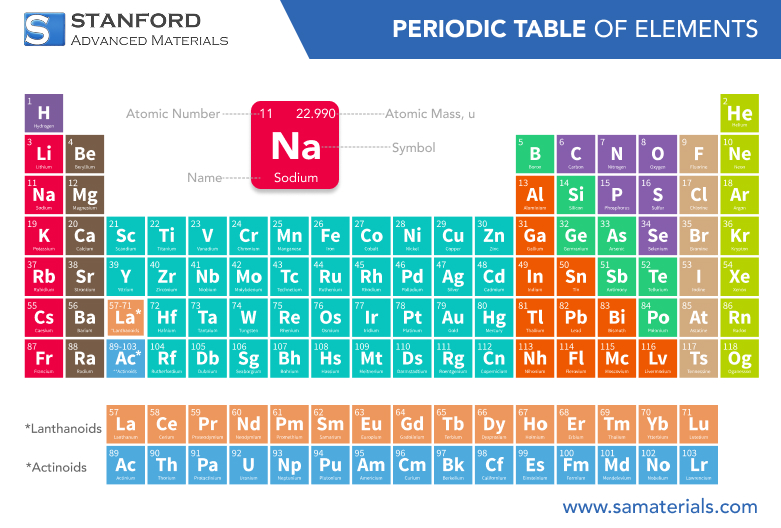
Sodium the Element
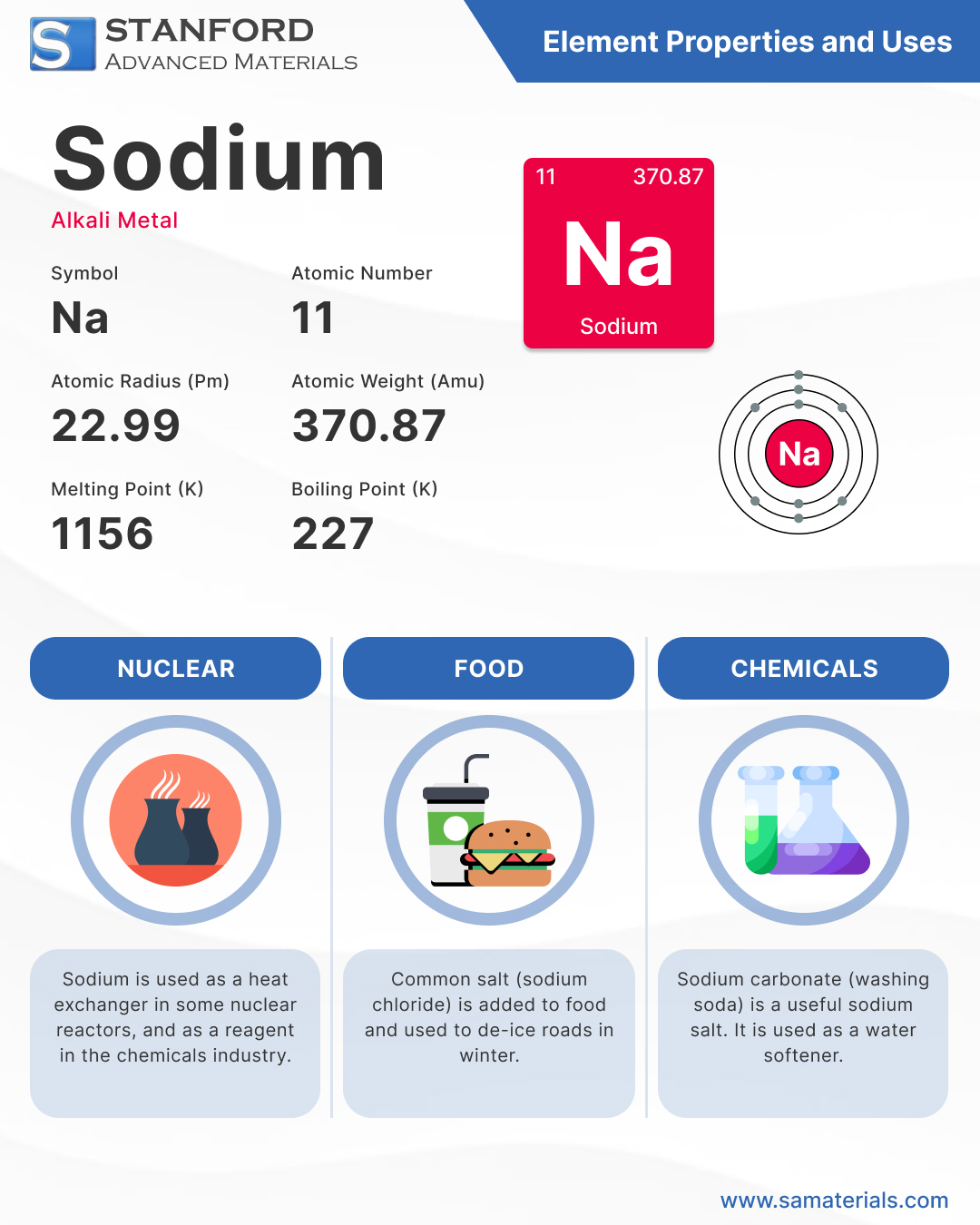
Sodium (Na), with an atomic number of 11, is a soft, silvery-white metal found abundantly in nature, primarily in the form of sodium chloride (NaCl), or common table salt. It is one of the most abundant elements in the Earth's crust and is a crucial part of many natural processes, including regulating bodily functions and maintaining cellular balance. Due to its high reactivity, sodium is rarely found in its pure form, as it readily combines with other elements to form salts and minerals.
It is a very reactive metal in its natural state, particularly with water, and has many uses in industry. While vital in both human physiology and industrial uses, the use of sodium is strongly controlled due to its reactivity and potential hazards.
Chemical Properties
Being an alkali metal, sodium has a number of key chemical properties. It is highly reactive, especially with water, with which it reacts to form sodium hydroxide, NaOH, and hydrogen gas, H₂, in a highly exothermic reaction that may be dangerous. It is also very reactive with oxygen and the halogens, including chlorine, to form important compounds, such as sodium chloride, NaCl, which is used in everyday life as table salt.
Thus, it readily loses its single valence electron to form Na⁺ ions and hence can combine with other elements to form ionic compounds. This really makes sodium good for a variety of chemical reactions, starting with industrial processes down to biological systems. Sodium reacts with oxygen to ultimately form sodium oxide or sodium peroxide depending upon the reaction conditions. For more information, please check Stanford Advanced Materials (SAM).
Physical Properties
Sodium is a soft, silvery-white metal that has the melting point of 97.72°C and a boiling point of 883°C. Besides that, it is very light due to its relatively low density of 0.968 g/cm³, which is lighter compared to many metals. Sodium possesses a body-centered cubic crystal structure and poor electrical conductivity. Its reactivity is perhaps a defining characteristic not only in industrial functions but also in biological functions.
Common Uses
Its versatility and chemical properties make the element useful in many aspects of life. Some of the most common uses of sodium include:
- Table Salt - NaCl: Commonly used as table salt, sodium chloride is the most common form of sodium, widely utilized for its preservative and food processing properties.
- Manufacture of Soaps and Detergents: The alkali, sodium hydroxide, or caustic soda, is used in the manufacture of soaps, detergents, and general cleaners.
- Glass Production: Sodium carbonate, commonly known as soda ash (Na₂CO₃), acts in glassmaking as a flux to decrease the melting point of silica and thereby makes the production process more efficient.
- Chemical Synthesis: Sodium is used as the vital ingredient in a number of chemical syntheses, in sodium vapor lamps that give off a characteristic yellow light.
- Batteries: Sodium-ion batteries are being researched as a substitute for lithium-ion batteries, since it is far more available and inexpensive than lithium.
Sodium and Health
In the human body, sodium is needed to balance fluids as well as for the conduction of nerve impulses. This is very important for various physiological processes, such as regulating blood pressure so that nerve impulses and muscle contractions will proceed appropriately. On the other hand, too much sodium intake, mainly from common salt and processed foods, can give a person hypertension, or high blood pressure, thereby increasing the risk of cardiovascular disease. The adequate intake of sodium is around 2,300 mg per day for an average adult, which is approximately 1 teaspoon of common salt. However, most people consume far beyond the suggested upper limit, which may result in poor health consequences.
On the other hand, deficiencies in sodium, though uncommon, can result in hyponatremia: a condition wherein the levels of sodium in the blood become too low, having symptoms such as nausea, headache, and confusion. For both health and wellness, proper balance must be maintained with regard to sodium.
Preparation Methods
Sodium metal is usually not found in its pure form because of its high reactivity; instead, it is extracted by special procedures. The most common method of production of sodium metal today is by the electrolysis of molten NaCl. In this method, it is cast into large billets at the cathode while gaseous chlorine is evolved at the anode. It can also be reduced from its compounds-primarily sodium hydroxide, NaOH-by highly reactive metals, such as calcium.
Related Industrial Products
Sodium is used in the manufacture of many important substances, including:
- Sodium Bicarbonate - NaHCO₃: Also known as baking soda, it is used in cooking, cleaning, and extinguishing fires.
- Sodium Hydroxide (NaOH): Used in the manufacture of soaps, various chemicals, and in water treatment.
- Sodium Carbonate (Na₂CO₃): It is used in glassmaking, the production of detergents, and as a pH regulator.
- Sodium Nitrate (NaNO₃): Fertilizer, explosives, and food preservative.
Frequently Asked Questions
What is sodium? Why is it important?
Sodium is a soft, highly reactive metal that serves very important functions in industry and everyday life for producing salt, soaps, glass, and batteries.
How is sodium produced?
Most of the sodium is produced by the electrolysis of fused sodium chloride, or by the reduction of sodium compounds with reactive metals like calcium.
What are the common uses of sodium?
The most common uses of sodium include the manufacture of table salt, soaps, glass, sodium vapor lamps, and batteries.
Is sodium harmful in its pure form?
Yes, sodium is highly reactive, especially with water, and should be handled with care. If mishandled it can burn or cause other injuries.
What industries depend on sodium?
It is needed in the industries dealing with the manufacture of chemicals, making glass, soap, food products, and batteries.

 Chin Trento