
 Products
 Bars
Bars
 Beads & Spheres
 Bolts & Nuts
 Crucibles
 Discs
Discs
 Fibers & Fabrics
 Films
Films
 Flake
Flake
 Foams
Foams
 Foil
Foil
 Granules
 Honeycombs
 Ink
Ink
 Laminate
 Lumps
Lumps
 Meshes
 Metallised Film
 Plate
Plate
 Powders
 Rod
Rod
 Single Crystals
 Sputtering Target
 Tubes
Tubes
 Washer
 Wires
Wires
 Converters & Calculators
 Write for Us



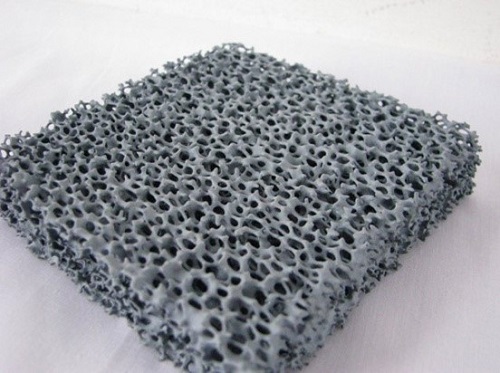
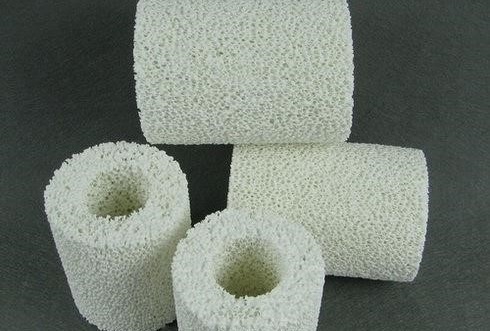
What is the Silicon Carbide Foam Ceramics?

Foam ceramics is a kind of special porous ceramics with a uniform three-dimensional network structure. It has uniform pore distribution, high porosity, small relative density, large specific surface area, selective permeability to liquid and gas media, as well as good energy absorption and pressure resistance and excellent thermal, electrical, magnetic, optical, chemical functions.
At present, the application of foamed silicon carbide ceramics has been widely used in metallurgy, chemical industry, energy, electronics, transportation, machinery, national defense, environmental protection, biology, and other fields. Therefore, the research on foamed silicon carbide ceramics has been paid more and more attention by scientists and engineers.
Application of silicon carbide foam ceramics
With the continuous improvement and innovation of the preparation technology of foamed silicon carbide, its superior performance will gradually expand its application scope and diversify its style. Silicon carbide foam ceramics are showing more and more advantages than other materials in many application fields.
* Catalyst carrier
Silicon carbide foam ceramics have the advantages of high porosity, thermal conductivity, mechanical strength, oxidation resistance, corrosion resistance, etc., and its surface is uneven and has many micro-pores. This special network structure greatly increases the contact area of the two phases, all these characteristics indicate that the silicon carbide foam ceramics will replace the traditional silica, alumina ceramics, and activated carbon as the new generation of the catalyst carrier.
* Filter
Foam ceramic filtration is a new technology that can remove nonmetallic inclusions from alloy and purify metal solution, and the application of silicon carbide foam ceramics in this field has greatly improved the qualified rate and mechanical properties of metals. Therefore, it is expected to obtain significant economic and social benefits to popularize the application of silicon carbide foam ceramics in the field of metal solution purification in the casting industry.
Foam ceramic carrier is widely used as the carrier material of exhaust gas purifier in the world. Silicon carbide foam ceramics have been successfully applied in automobile exhaust gas purifiers due to their characteristics of large porosity, good air permeability, large specific surface area, high thermal shock resistance, and controllable resistivity.
* Foam packing
The foamed SiC ceramics with developed specific surface area and low resistance loss can also be used in the distillation column. Compared with traditional filler, silicon carbide ceramic block has a lower pressure drop, more liquid holding capacity, and better mass transfer performance.
* Other applications
Foamed SiC ceramics can also be used in chemical industrial furnaces to strengthen the combustion process, including steam generators, radiant burners, high-pressure adiabatic burners, etc. They are getting more and more attention from all sectors of society because of their small size, fuel-saving, the wide range of power regulation and stable combustion, as well as fewer pollutant emissions.
Foamed silicon carbide ceramics have excellent corrosion resistance and can be heated by electricity, which is suitable for the heating of corrosive fluids in construction departments and semiconductor fields. Foamed silicon carbide ceramic material can also be used to make all kinds of heat exchangers. Because of its high porosity, low pressure, large heat exchange area, and special space network structure, the heat transfer coefficient can be greatly improved. In addition, foamed silicon carbide ceramics can also be used in the heat treatment of electronic components materials, mobile bed floor, humidifier, boiling water, microbial carriers, and other fields.
 Chin Trento