Products
 Bars
Bars
 Beads & Spheres
 Bolts & Nuts
 Crucibles
 Discs
Discs
 Fibers & Fabrics
 Films
Films
 Flake
Flake
 Foams
Foams
 Foil
Foil
 Granules
 Honeycombs
 Ink
Ink
 Laminate
 Lumps
Lumps
 Meshes
 Metallised Film
 Plate
Plate
 Powders
 Rod
Rod
 Single Crystals
 Sputtering Target
 Tubes
Tubes
 Washer
 Wires
Wires
 Converters & Calculators
 Write for Us



Polyaramid Honeycomb: Stability, Manufacturing, and Applications

Polyaramid honeycomb structures are made of high-strength, light, and dense core products that consist primarily of aramid fibers such as Nomex. Honeycombs are today a common feature in high-composite applications—anything ranging from interior utilization in aerospace to defense-level blast panels. This article is a technical summary of their structures and primary uses in various industries.
1. Introduction to Polyaramid Honeycomb Structures
Polyaramid honeycomb cores are made by expanding phenolic resin-impregnated or coated sheets of aramid fibers, typically Nomex® paper. This creates a cellular structure that is light in weight but with a hexagonal or over-expanded cell structure. The structure mirrors the strength properties of natural honeycomb and delivers better performance in sandwich composite systems.
They are also used as core material in sandwich panels, where thin high-strength composite skins bonded by adhesives (e.g., carbon or glass fiber-reinforced plastics) are bonded on each side. The polyaramid core provides stiffness, energy absorption, and insulation without weight penalty and is of particular value for those applications where weight is essential.
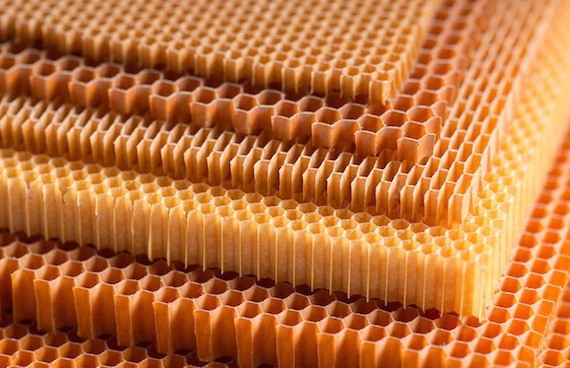
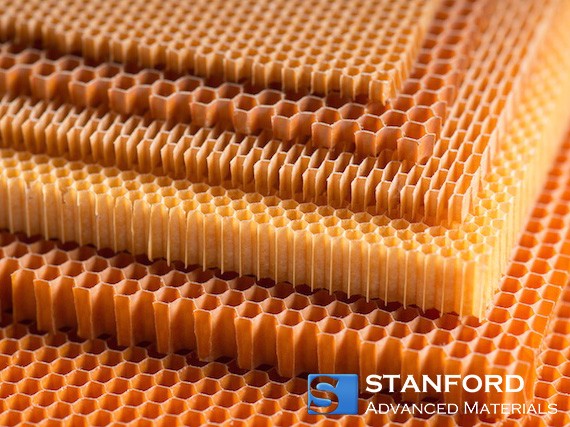
Fig. 1 Polyaramid Honeycomb
2. Mechanical Properties of Polyaramid Honeycomb Cores
Mechanical performance of polyaramid honeycomb is one of its typical strengths.
Its principal characteristics are:
- High strength-to-weight ratio: Despite their low weight, the cores have the ability to bear heavy loads, both in shear and compression.
- Fatigue resistance: Polyaramid honeycombs have the ability to withstand cyclic loading, which is useful in aircraft and transport elements under long-term loading.
- Damage tolerance: Unlike brittle core materials, polyaramid honeycombs deform plastically with high-impact strikes, producing a buffer zone against failure in a catastrophic manner.
These are the properties which render them well-suited for structural and semi-structural applications in both civilian and military platforms.
3. Thermal and Chemical Stability of Aramid-Based Honeycombs
Polyaramid honeycomb cores exhibit excellent chemical and thermal stability. They usually work quite well in environments up to 180°C (356°F) and exhibit broad temperature range dimensional stability. Moreover, their resistance to thermal degradation makes them suitable for high-temperature cure bonded assemblies.
Chemically, they are moisture, solvent, fuel, and mild acid-resistant. This trait is particularly beneficial in marine and humid service applications. Second, their fire performance is unquestionable—meeting requirements such as FAR 25.853 for flame, smoke, and toxicity for aircraft interiors.
4. Comparison with Other Honeycomb Materials
When engineers balance honeycomb material, weight, strength, durability, corrosion resistance, and cost in making their selection. This is where polyaramid honeycombs measure up:
- Vs Aluminum Honeycomb: While aluminum is stiffer and stronger with temperature, polyaramid honeycombs are lighter, corrosion-resistant, and more prone to FST (Flame, Smoke, and Toxicity) needs.
- Vs Thermoplastics: Thermoplastic honeycombs may be less prone to cost and recyclable, but usually lack greater mechanical strength and need less thermal stability compared to aramid-based cores.
- Vs Carbon/Kevlar Honeycomb: The cores of Carbon and Kevlar are more powerful but much more expensive, thus rendering polyaramid a reasonable compromise in terms of cost-performance.
All these comparisons put polyaramid honeycomb as a material of broad applicability across industries. For more honeycomb products, please check Stanford Advanced Materials (SAM).
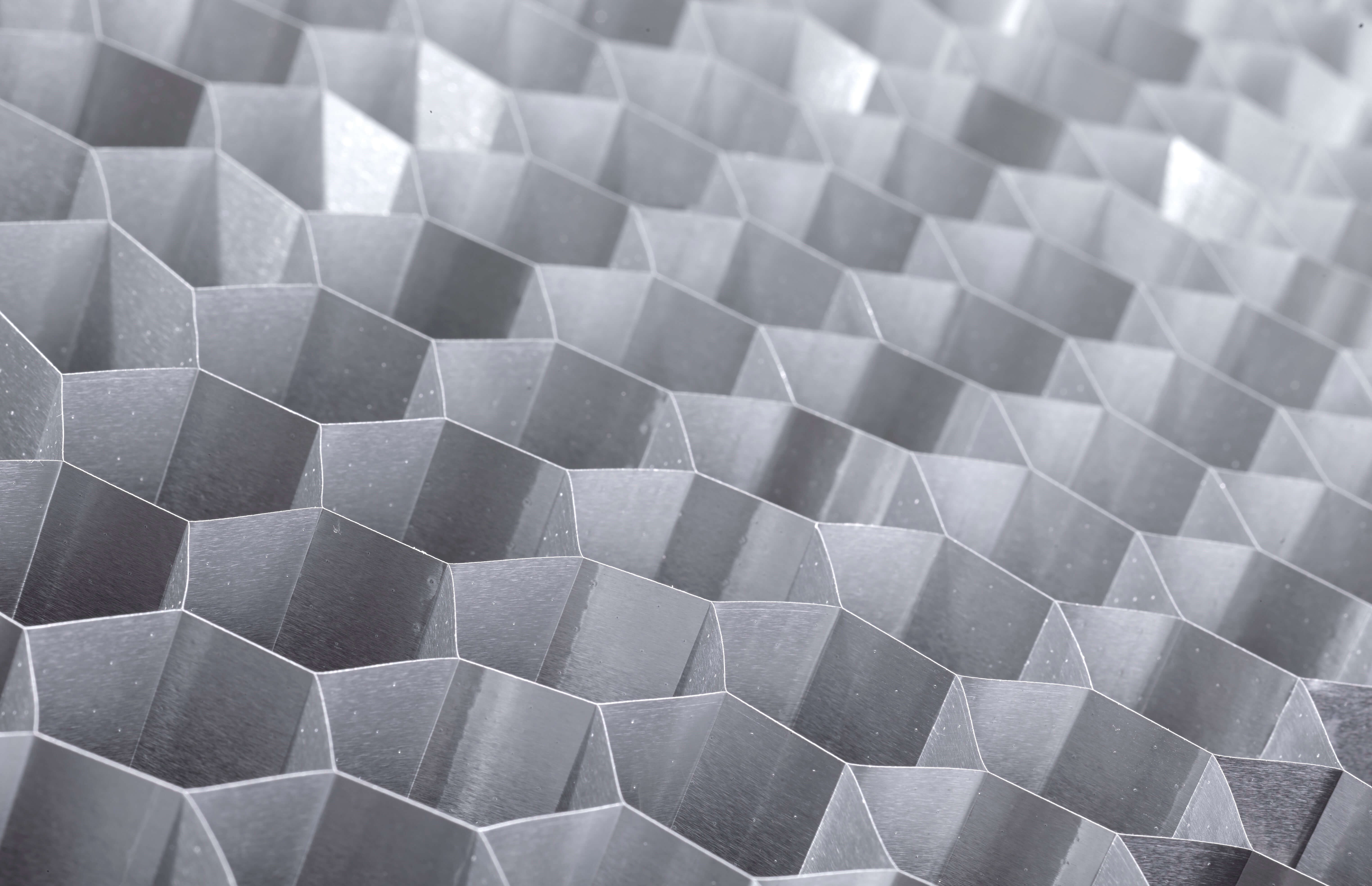
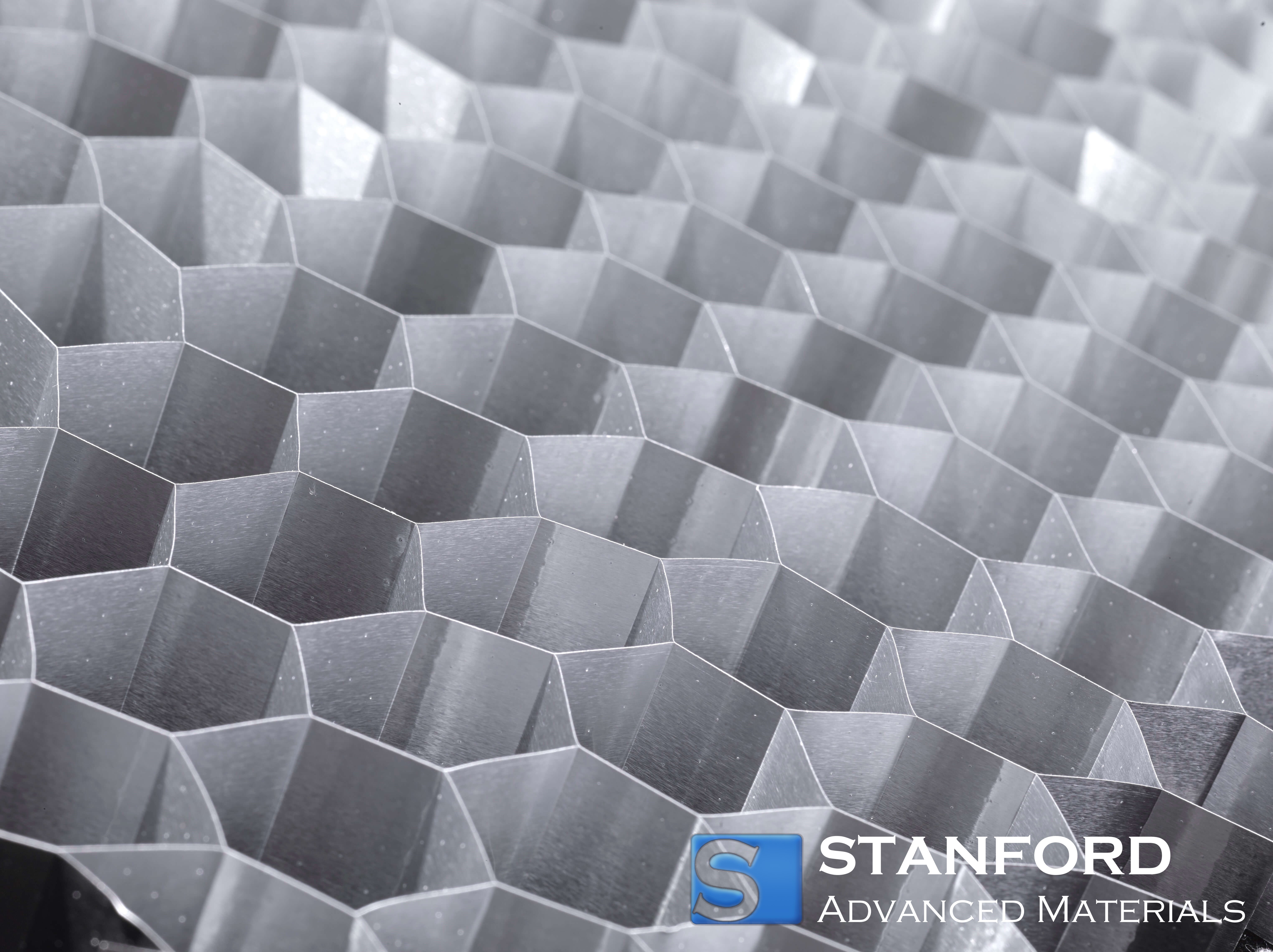
Fig. 2 Aluminum Honeycomb
5. Acoustic and Vibration Damping in Polyaramid Panels
The second important advantage is the sound and mechanical vibration absorption capability of polyaramid honeycomb. As a core for sandwich panels, the material absorbs vibrational energy and acts as an acoustic barrier. In transport industries—aircraft cabins, train cars, and automotive interiors—noise reduction improves comfort and customer satisfaction.
6. Applications of Polyaramid Honeycomb Cores
Aerospace Sandwich Structures
Polyaramid honeycombs have broad use in aircraft interiors like floorboards, sidewalls, ceilings, luggage compartments, and partitions. Both performance and safety are improved by their flame resistance, reduced smoke emission, and better mechanical properties. The material also facilitates weight savings in aircraft benefiting fuel efficiency and payload capacity directly.
Automotive Interiors
Aramid honeycombs are used in automobiles as core materials for door panels, trunk covers, and headliners. They aid in the fulfillment of fuel economy standards by reducing weight in the vehicle but without compromising the interior flammability requirements. The energy absorption capability also ensures safety for passengers in the event of an accident.
Marine and Rail Panels
In marine use, the corrosion resistance of polyaramid honeycomb is an excellent asset. It is used in ship interior, bulkheads, and deck building. In rail applications, it helps manufacturers meet weight targets and stringent fire protection demands, especially in high-speed trains and subway use.
Defense and Energy Absorption
Polyaramid honeycombs are employed in armor systems, vehicle blast panels, and deployable shelters in which energy absorption is critical. They are light in weight and possess impact deformation, making them ideal for structures that are intended to absorb and dissipate the blast or ballistic energy.
UAV and Drone Structures
Unmanned aerial vehicles (UAVs) and drones call for super-lightweight, strong structures. Polyaramid honeycomb cores are used in wings, fuselage shells, and control surfaces to ensure ultimate flight endurance and maneuverability without sacrificing structure integrity.
Conclusion
From aerospace to defense, polyaramid honeycomb meets technical requirements—mechanical, thermal, and acoustic—and is a vital core material in composite engineering. As new processing technologies and resin systems become accessible, polyaramid honeycomb will continue to be a pillar in next-generation lightweight structures.
 Chin Trento