
 Products
 Bars
Bars
 Beads & Spheres
 Bolts & Nuts
 Crucibles
 Discs
Discs
 Fibers & Fabrics
 Films
Films
 Flake
Flake
 Foams
Foams
 Foil
Foil
 Granules
 Honeycombs
 Ink
Ink
 Laminate
 Lumps
Lumps
 Meshes
 Metallised Film
 Plate
Plate
 Powders
 Rod
Rod
 Single Crystals
 Sputtering Target
 Tubes
Tubes
 Washer
 Wires
Wires
 Converters & Calculators
 Write for Us



How Photoinitiators Are Used in Ultraviolet Curing Technologies

What Are Photoinitiators
Photoinitiators are special chemicals that start a process when light shines on them. They are used to kick off chemical reactions that change materials quickly. When ultraviolet light hits the photoinitiator, it breaks apart or rearranges its structure. This change creates active species like free radicals or ions. These active species cause polymers to bond together. As a result, the liquid resin turns into a hard, durable solid.
In simple words, photoinitiators act as the spark for a curing process. They are very efficient and work in a matter of seconds when exposed to light at the proper wavelength. The key benefit is that curing happens at room temperature without the need for heat. This property is very helpful in industries where high temperatures can cause damage to materials.
Applications of Photoinitiators in Ultraviolet Curing
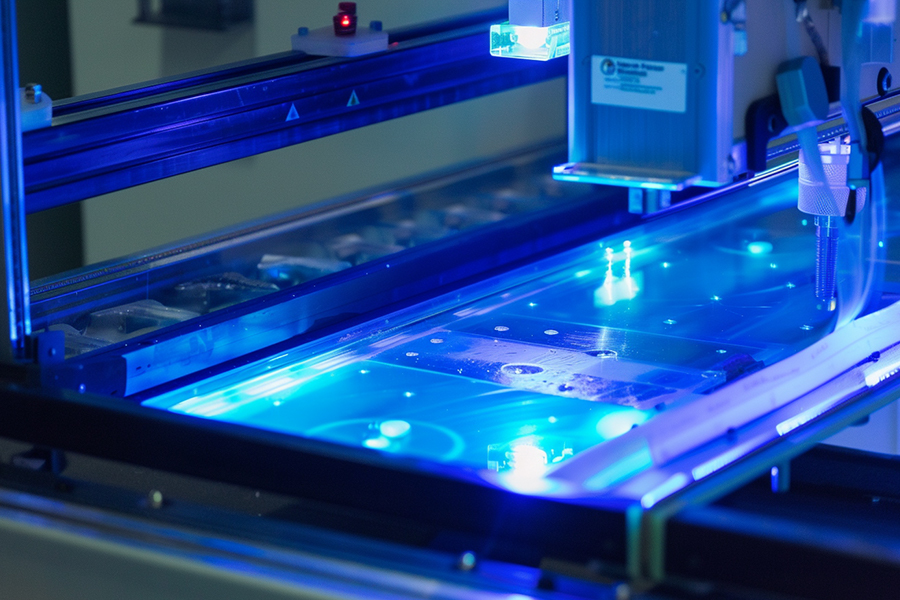
One of the main uses of photoinitiators is in ultraviolet curing. This process finds its way into many everyday products. For example, coatings on printed circuit boards use ultraviolet curing. Furniture and automotive parts sometimes receive coatings that harden quickly under ultraviolet light. In these cases, photoinitiators help form a tight, scratch-resistant layer on the surface.
Another common application is in printing inks. The printing process needs them to dry almost instantly. Many plastic lenses and optical devices also use ultraviolet curing to form protective layers. The technique helps reduce downtime in production because the material hardens right away.
There are also cases in the dental field. Some dental resins use photoinitiators to set under a light. This allows dentists to create strong fillings and repairs quickly. Data shows that production lines using ultraviolet curing have significantly reduced cycle times. They can cure a coating in less than a minute compared to several minutes using traditional methods.
How Photoinitiators Are Used in Ultraviolet Curing
The process starts when the material containing photoinitiators is exposed to ultraviolet light. Ultraviolet light is a part of the light spectrum with a short wavelength. During the exposure, the photoinitiators break down into reactive species. These reactive species then cause monomers and oligomers in the resin to link up. The molecules form long chains and cross-linked networks. This network gives the material strength and durability.
The success of the curing process depends on several factors. The wavelength of light must match the photoinitiator's absorption. If the light does not match, the process is slow or may not take place. The concentration of photoinitiators in the mixture also matters. Too little may lead to incomplete curing. Too much can cause unwanted side reactions, leading to defects in the material.
Using modern technology, engineers fine-tune the amounts and types of photoinitiators for each application. In some cases, a combination of different photoinitiators is used. The mix ensures that the curing happens evenly through thick or layered coatings. This method results in coatings with consistent hardness and good adhesion.
List of Photoinitiators in Ultraviolet Curing Technologies
|
Type |
Photoinitiator Name |
Abbreviation / CAS |
Typical Applications |
Light Absorption Range (nm) |
|
Type I (Cleavage) |
1-Hydroxycyclohexyl phenyl ketone |
Irgacure 184 / 947-19-3 |
Coatings, inks, adhesives |
~245–330 |
|
2-Hydroxy-2-methylpropiophenone |
Darocur 1173 / 7473-98-5 |
Clear coatings, 3D printing resins |
~240–320 |
|
|
Benzoin ether |
Benzoin methyl ether / 3524-62-7 |
UV inks, varnishes |
~250–340 |
|
|
Acyl phosphine oxide |
TPO / 75980-60-8 |
Pigmented systems, white coatings |
~350–420 |
|
|
Bis(2,4,6-trimethylbenzoyl)-phenylphosphine oxide |
BAPO / 162881-26-7 |
Thick films, dental composites |
~350–430 |
|
|
Type II (H-Abstraction) |
Benzophenone |
BP / 119-61-9 |
Inks, plastics, overprint varnishes |
~250–365 |
|
Thioxanthone derivatives |
ITX / 82799-44-8 |
Screen inks, UV flexo inks |
~350–420 |
|
|
Camphorquinone |
CQ / 10373-78-1 |
Dental resins and composites |
~400–500 |
|
|
Others / Specialty |
Ethyl(2,4,6-trimethylbenzoyl)phenylphosphinate |
Low-yellowing coatings, LED curing |
~360–420 |
|
|
2,4-Diethylthioxanthone / 82799-44-8 |
UV-curable inks and varnishes |
~365–400 |
Notes:
- Type I photoinitiators undergo homolytic cleavage when exposed to UV light, forming free radicals directly.
- Type II photoinitiators require a co-initiator (like an amine) and work via hydrogen abstraction.
- The absorption range indicates which wavelengths the photoinitiator responds to—important for matching with UV or LED light sources.
- Some initiators (e.g., BAPO, TPO-L) are preferred for LED curing due to longer wavelength sensitivity.
Conclusion
To sum up, photoinitiators play an important role in ultraviolet curing technologies. They make it possible to change liquid resins into hard, useful materials very quickly at room temperature. This fast curing process helps many industries, including electronics, automotive, printing, and dental care. The proper selection and controlled use of photoinitiators lead to better quality final products and faster production cycles.
Frequently Asked Questions
F: What triggers the curing process in ultraviolet light curing?
Q: Ultraviolet light breaks down photoinitiators, which then create reactive sites to link monomers in the resin.
F: Is ultraviolet curing a fast process?
Q: Yes, ultraviolet curing turns liquid resin into a solid state in seconds, making it ideal for fast production lines.
F: Can different photoinitiators be combined?
Q: Yes, combining different photoinitiators can ensure even curing in thick coatings or complex material formulations.
 Chin Trento