Products
 Bars
Bars
 Beads & Spheres
 Bolts & Nuts
 Crucibles
 Discs
Discs
 Fibers & Fabrics
 Films
Films
 Flake
Flake
 Foams
Foams
 Foil
Foil
 Granules
 Honeycombs
 Ink
Ink
 Laminate
 Lumps
Lumps
 Meshes
 Metallised Film
 Plate
Plate
 Powders
 Rod
Rod
 Single Crystals
 Sputtering Target
 Tubes
Tubes
 Washer
 Wires
Wires
 Converters & Calculators
 Write for Us



Major Applications of Dielectric Materials

Introduction
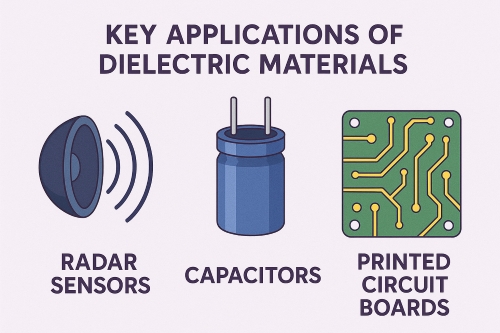
Dielectric materials are used in the majority of today's devices. They play a vital role in electronics, sensors, communication networks, and power networks. They are key components in advanced technology due to their electric energy storage and insulation properties.
What Is Dielectric Constant and How It Affects Radar Sensors
Dielectric constant is a measure of how effectively a material can store electric energy when there is an electric field. This parameter is crucial in radar sensors. When a radar sends a pulse, it is affected by the materials it meets. The greater the dielectric constant of a material, the more delayed and deformed the pulse becomes. This affects how the sensor detects boundaries and objects.
For example, the radar sensor used in weather stations must correct for different materials of matter in the atmosphere. This is a function of knowing the dielectric constant to correct the signal for enhancing the precision. In automobile systems, radar sensors aid in preventing collisions. When the sensors detect different materials, they utilize the dielectric response for precise distance measurements. The measurements that differ due to different dielectric constants can be very small but are important to provide reliable sensor operation.
The constant is also involved in applications such as smart structures and communication devices. Radar systems in these applications need to be capable of differentiating small differences. The devices function more uniformly, even in harsh conditions.
Dielectric Constant and Its Effects on Capacitor Properties
Capacitors store energy in devices. Capacitors usually use dielectric material as an insulating substance between two plates. The dielectric constant decides the amount of energy a capacitor can store. A larger constant means more storage of energy in less space.
In use, capacitors with a strong dielectric layer are more compact and efficient. Designers prefer to employ materials having high dielectric constants for small-sized electronic devices. Most modern-day mobile phones possess miniaturized capacitors with specially engineered dielectric films. The films save space without sacrificing energy density.
With a very slight variation in the dielectric material, there was improved performance. With a very slight variation in the constant, energy loss will be reduced and the life of the capacitor will be increased. In power supplies, high-quality dielectric materials can handle surges and use devices safely. In the majority of industrial uses, such as in power converters, capacitors of the right dielectric constant are a must for efficiency as well as reliability.
Examples in real life include ceramic capacitors used in common appliances and electrolytic capacitors used in energy-intensive applications. Both take advantage of different dielectric materials to sustain their performance traits. Choosing the proper materials may change the performance of the capacitor when exposed to heat, load, or with time. This helps engineers design devices that will perform under varying conditions.
Applications of Dielectric Materials in Printed Circuit Boards (PCBs)
Printed circuit boards form the backbone of modern electronics. The boards have the tiny elements that make devices work. Dielectric materials are used as substrates in the boards. The substrate's main role is to maintain the electrical traces separated from each other. A good dielectric material helps in regulating the signal flow and minimizing interference between traces.
Examples are the application of fiberglass-based materials. They hold copper layers in place safely and insulate and shield the circuits. In high-frequency PCBs, the dielectric constant is managed carefully to ensure signals travel at the right speed. It prevents signal loss and makes the board operate well in communication systems.
The substrate choice affects the performance in delicate applications like computers, phones, and health equipment. The dielectric material must accommodate high-speed and resilient thermal changes. With the widening application of miniaturized electronics, the proper selection of dielectric materials is even more critical.
The stability and reliability of the printed circuit board are typically dependent on the quality of these materials. Adequate insulation brings maximum performance and longer device life. Engineers are looking for material stable in properties even under stress and temperature fluctuation. The correct cost balance, dielectric constant, and thermal stability are the most critical considerations in selecting a good PCB substrate.
Conclusion
Dielectric materials are highly responsible for the modern world of electronics. They can store energy, insulate signals, and regulate electrical interactions, which is why they are so highly used in radar sensors, capacitors, and printed circuit boards.
Frequently Asked Questions
F: What is a dielectric constant?
Q: It measures the ability of a material to store electrical energy in an electric field.
F: How do dielectric materials influence radar sensors?
Q: They change the speed and shape of radar pulses, enabling sensors to precisely measure distances.
F: Why are printed circuit boards associated with dielectric materials?
Q: They insulate electrical traces and control signal quality on the circuit boards.
 Chin Trento