
 Products
 Bars
Bars
 Beads & Spheres
 Bolts & Nuts
 Crucibles
 Discs
Discs
 Fibers & Fabrics
 Films
Films
 Flake
Flake
 Foams
Foams
 Foil
Foil
 Granules
 Honeycombs
 Ink
Ink
 Laminate
 Lumps
Lumps
 Meshes
 Metallised Film
 Plate
Plate
 Powders
 Rod
Rod
 Single Crystals
 Sputtering Target
 Tubes
Tubes
 Washer
 Wires
Wires
 Converters & Calculators
 Write for Us



Fractions Conversion Tables

Introduction to Fractions Conversion
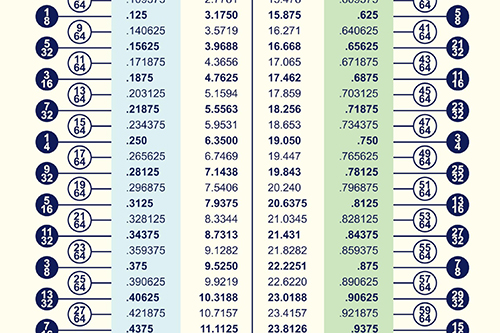
Fractions are fundamental in mathematics, representing parts of a whole. Converting fractions to decimals is a common task in various applications, from everyday calculations to advanced scientific computations. Understanding how to navigate a fractions conversion table can simplify this process significantly.
When Do You Need These Conversions?
In material sourcing and engineering, fractions show up more often than you might think:
- Material thicknesses are often specified in fractions of an inch—1/16", 1/8", 3/4" sheet metal and plate are common examples
- Alloy compositions may be given as percentages or fractions when describing constituent ratios
- Fastener dimensions like bolt diameters and thread pitches frequently use fractional inches
- Tubing and pipe walls are often specified in fractional dimensions, especially in US manufacturing
Having quick access to decimal and millimeter equivalents saves time and prevents mistakes when switching between drawings, specifications, and inventory.
Common Conversions for Material Specifications
The three tables below cover the most frequently needed conversions when working with materials:
- Fraction to Decimal: For calculations and digital inputs
- Fraction to Percentage: For alloy compositions and material blends
- Inches to mm: For switching between US and metric drawings
Example Fractions Conversion Table
Below is a sample fraction-to-decimal chart to illustrate the conversion process:
Fraction to Decimal Chart
|
Fraction |
Decimal |
|
1/1 |
1.0000 |
|
1/2 |
0.5000 |
|
1/3 |
0.3333 |
|
1/4 |
0.2500 |
|
1/5 |
0.2000 |
|
1/6 |
0.1667 |
|
1/8 |
0.1250 |
|
1/10 |
0.1000 |
|
1/12 |
0.0833 |
|
1/16 |
0.0625 |
|
1/20 |
0.0500 |
|
1/25 |
0.0400 |
|
1/50 |
0.0200 |
|
1/100 |
0.0100 |
|
3/4 |
0.7500 |
|
2/3 |
0.6667 |
|
3/5 |
0.6000 |
|
5/8 |
0.6250 |
Fraction to Percentage Conversion Table
|
Fraction |
Percentage |
|
1/1 |
100% |
|
1/2 |
50% |
|
1/3 |
33.33% |
|
1/4 |
25% |
|
1/5 |
20% |
|
1/6 |
16.67% |
|
1/8 |
12.5% |
|
1/10 |
10% |
|
1/12 |
8.33% |
|
1/16 |
6.25% |
|
1/20 |
5% |
|
1/25 |
4% |
|
1/50 |
2% |
|
1/100 |
1% |
|
3/4 |
75% |
|
2/3 |
66.67% |
|
3/5 |
60% |
|
5/8 |
62.5% |
Inches to Decimal Millimeters Conversion Table
When working with material dimensions, converting fractional inches to millimeters is a common task. To convert any fractional inch measurement to millimeters, multiply the decimal equivalent by 25.4. For example: 3/8" = 0.375 × 25.4 = 9.525 mm.
|
Inches |
Decimal Millimeters (mm) |
|
1/16 |
1.5875 |
|
1/8 |
3.1750 |
|
3/16 |
4.7625 |
|
1/4 |
6.3500 |
|
5/16 |
7.9375 |
|
3/8 |
9.5250 |
|
7/16 |
11.1125 |
|
1/2 |
12.7000 |
|
9/16 |
14.2875 |
|
5/8 |
15.8750 |
|
11/16 |
17.4625 |
|
3/4 |
19.0500 |
|
13/16 |
20.6375 |
|
7/8 |
22.2250 |
|
15/16 |
23.8125 |
|
1 |
25.4000 |
Materials Available from Stanford Advanced Materials
Stanford Advanced Materials (SAM) supplies metals, ceramics, and composites in a wide range of thicknesses and dimensions—whether you work in fractions, decimals, or metric. Common fractional thicknesses like 1/8", 1/4", and 1/2" are available in many materials, and we also offer metric dimensions to match your specifications.
[Browse our materials] or [contact us] for custom requirements.
Frequently Asked Questions
What is the simplest way to convert a fraction to a decimal?
Divide the numerator by the denominator using a long division or a calculator.
Why are fractions important in everyday life?
Fractions are used in cooking, measuring, budgeting, and many other daily activities requiring precise quantities.
Can all fractions be converted into terminating decimals?
No, some fractions result in repeating decimals, such as 1/3 = 0.333…
How can a fraction to decimal chart help students?
It provides a quick reference, aiding in understanding and memorizing decimal equivalents of common fractions.
Why do material thicknesses use fractions instead of decimals?
In US manufacturing, fractional inches are traditional for sheet metal, plate, and bar stock. 1/16" increments are standard for many materials, which is why quick reference charts are useful when working with both US and metric specifications.
Does SAM provide material thicknesses in fractions or decimals?
We can supply to either specification. Common thicknesses like 1/8", 1/4", and 1/2" are available in many materials, and we also offer metric dimensions. [Contact us] with your requirements.
 Chin Trento