
 Products
 Bars
Bars
 Beads & Spheres
 Bolts & Nuts
 Crucibles
 Discs
Discs
 Fibers & Fabrics
 Films
Films
 Flake
Flake
 Foams
Foams
 Foil
Foil
 Granules
 Honeycombs
 Ink
Ink
 Laminate
 Lumps
Lumps
 Meshes
 Metallised Film
 Plate
Plate
 Powders
 Rod
Rod
 Single Crystals
 Sputtering Target
 Tubes
Tubes
 Washer
 Wires
Wires
 Converters & Calculators
 Write for Us



Gold: Element Properties and Uses

Introduction to the Element
Gold over history has been desired for its scarcity, attractiveness, and durability as being at the focal point of art, money, and ritual items. Its intrinsic qualities, however, have also made it irreplaceable in contemporary industrial, technological, and medical uses, guaranteeing its continued utility over cultural and aesthetic significance.
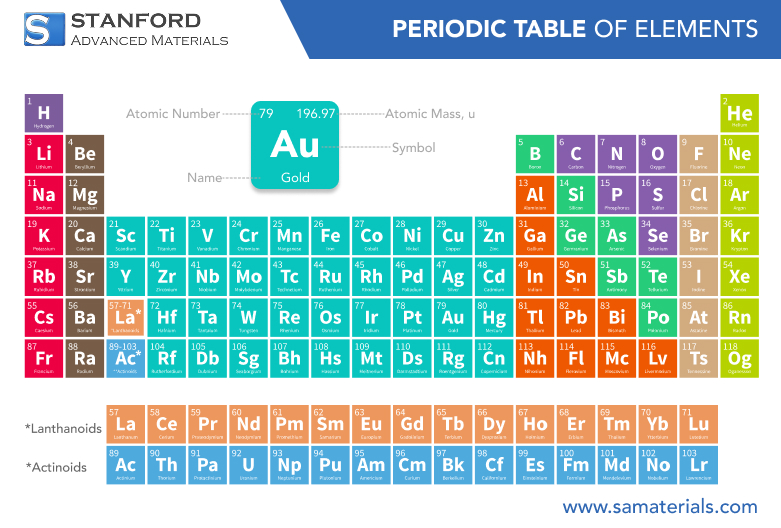
Physical Properties of Gold
Gold's physical attributes are no less astonishing and unusual:
• Density: Gold is 19.32 g/cm³ in density and is one of the densest metals. A very tiny nugget will weigh surprisingly more, showing its proportion of mass to volume.
• Malleability and Ductility: Gold is the most malleable and ductile metal known. It is possible to beat an ounce of it into a 300 square feet sheet or draw it into wire over 50 miles long. It is appropriate for applications where thin layers are ideal, like in gold leaf on artwork or reflective coatings on electronics.
• Luster: It possesses a rich metallic luster that is long-lasting as well as attractive to the eye, and it remains shining for centuries without corroding.
• Softness: 24-karat or pure gold is soft, and hence it is alloyed with copper, silver, or palladium for making jewelry and functional items.
• Conductivity: Gold is a good conductor of electricity and heat, and thus it is used in high-reliability electronic connectors and circuitry.
Chemical Properties of Gold
Chemical properties of gold are no less outstanding:
• Inertness: As a noble metal, gold does not oxidize and corrode, which is why ancient objects are discovered in ideal condition after millennia.
• Acid Resistance: Gold is more or less inert to the majority of acids but will dissolve in aqua regia (a combination of nitric and hydrochloric acids), which was used for centuries for purifying gold.
• Oxidation States: Gold occurs in +1 (aurous) and +3 (auric) oxidation states primarily, but -1, +2, and +5 in a few instances. All these are significant in catalysis, electroplating, and chemical synthesis.
Basic Material Characteristics
|
Property |
Value |
Unit |
|
Atomic Number |
79 |
- |
|
Atomic Weight |
196.97 |
g/mol |
|
Melting Point |
1064 |
°C |
|
Boiling Point |
2856 |
°C |
|
Density |
19.32 |
g/cm³ |
|
Electrical Conductivity |
Very High |
- |
For more information, please check Stanford Advanced Materials (SAM).
Common Uses of Gold
Gold's versatility stems from its unique combination of properties:
1. Jewelry and Decorative Arts
75% of all gold that is mined is used in jewelry. Its malleability allows intricate designs to be created, and its inertness prevents rings, necklaces, and other decorative items from tarnishing over the centuries. It is also used in the form of gold leaf in art and architectural decoration, e.g., gilded domes and religious icons.
2. Electronics
Gold's excellent conductivity and corrosion resistance put it at the center of high-reliability switches, circuit boards, and connectors. The gold-plating on smartphone connectors, for example, ensures long signal integrity despite repeated mechanical stress. An average modern smartphone contains 0.03 to 0.05 grams of gold, illustrating how a fraction of a quantity is highly effective.
3. Investment and Finance
Gold is a traditional store of value, having been used in coins, bullion, and central bank reserves. Its rarity and stability allow it to be used as a hedge against inflation, currency devaluation, and market fluctuations.
4. Dentistry
Gold alloys are commonly utilized in crowns, bridges, and fillings since they are hard and biocompatible. Gold does not corrode in the mouth, as do other metals, which allows for the formation of durable dental restorations.
5. Aerospace and High-Tech Applications
Spacecraft utilize gold thin films as thermal insulation to reflect sun radiation in temperature control. Astronauts' helmets have gold coatings to shield eyes from harmful UV radiation.
6. Medicine
Radioisotopes like Au-198 have found application in cancer treatment, while gold nanoparticles are being investigated for targeted drug delivery and diagnostic imaging. These exploit the inertness of gold and its functionalizability with biomolecules.

Frequently Asked Questions
What are the physically and chemically unique properties of gold?
Gold possesses a high density, malleability, ductility, conductivity, and chemical inertness in a combination sufficiently unique to allow both artistic and industrial use.
How is industrial gold refined?
Industrial gold is mined, crushed, chemically separated, and refined by cyanidation and electrorefining.
Why is gold utilized in electronics despite the cost?
Their reliability, resistance to corrosion, and conductivity justify the cost in life-critical systems where failure is not an option, i.e., aviation and medicine.
Can gold alloys improve performance?
In fact, gold alloying provides strength and hardness without sacrificing conductivity or corrosion resistance by adding gold to metals like copper, silver, or palladium.
In what ways do gold-containing products strengthen industries?
Electronics are made more robust and reliable, dental materials are guaranteed biocompatibility, and aerospace products are provided with thermal protection, demonstrating the versatility of gold across industries.
 Chin Trento