Products
 Bars
Bars
 Beads & Spheres
 Bolts & Nuts
 Crucibles
 Discs
Discs
 Fibers & Fabrics
 Films
Films
 Flake
Flake
 Foams
Foams
 Foil
Foil
 Granules
 Honeycombs
 Ink
Ink
 Laminate
 Lumps
Lumps
 Meshes
 Metallised Film
 Plate
Plate
 Powders
 Rod
Rod
 Single Crystals
 Sputtering Target
 Tubes
Tubes
 Washer
 Wires
Wires
 Converters & Calculators
 Write for Us



Electronegativity: Rules, Trends, and Periodic Table Insights

Introduction to Electronegativity
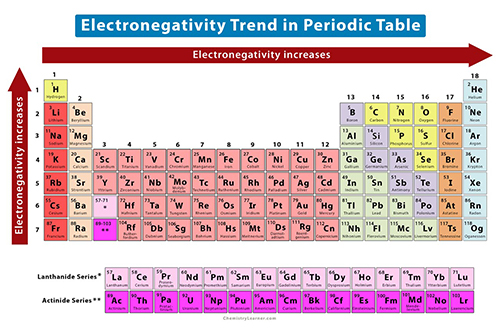
Electronegativity refers to the ability of an atom to attract electrons towards itself when it forms a chemical bond. This property plays a crucial role in determining the type of bond (ionic or covalent) between atoms.
Rules of Electronegativity:
1. Higher Electronegativity in Nonmetals: Nonmetals tend to have higher electronegativity compared to metals. For instance, fluorine (F) has the highest electronegativity, while elements like cesium (Cs) have very low electronegativity.
2. Electronegativity Increases Across a Period: As you move from left to right across a period (row) in the periodic table, electronegativity increases. This is due to the increasing nuclear charge, which attracts electrons more strongly.
3. Electronegativity Decreases Down a Group: As you move down a group (column), electronegativity decreases. This is because the atomic radius increases, and the valence electrons are farther from the nucleus, weakening the attraction for bonding electrons.
4. Pauling Scale: Electronegativity is often measured using the Pauling scale. Fluorine, with an electronegativity value of 3.98, is the most electronegative element.
Examples of Electronegativity:
|
Element |
Electronegativity (Pauling Scale) |
|
Fluorine (F) |
3.98 |
|
Oxygen (O) |
3.44 |
|
Nitrogen (N) |
3.04 |
|
Chlorine (Cl) |
3.16 |
|
Carbon (C) |
2.55 |
|
Hydrogen (H) |
2.20 |
|
Sulfur (S) |
2.58 |
|
Sodium (Na) |
0.93 |
|
Calcium (Ca) |
1.00 |
|
Francium (Fr) |
0.70 |
Periodic Table Insights
Fluorine is the most electronegative element due to its small size and high nuclear charge.
Cesium and Francium have the lowest electronegativity, making them highly electropositive.
Bond Type Prediction: The difference in electronegativity between two atoms helps predict the bond type:
Ionic bonds form when the difference is large (usually greater than 1.7).
Covalent bonds form when the difference is smaller (less than 1.7).
Electronegativity is essential in understanding molecular structure, reactivity, and the type of bonds that form between atoms. For more information, please check Stanford Advanced Materials (SAM).
Frequently Asked Questions
What is Electronegativity?
Electronegativity is the ability of an atom to attract electrons towards itself in a chemical bond. It influences the type of bond formed between atoms, whether ionic or covalent.
What are the trends in electronegativity on the periodic table?
Electronegativity increases across a period (from left to right) and decreases down a group (from top to bottom). This is due to the increasing nuclear charge and atomic size.
Which element has the highest electronegativity?
Fluorine has the highest electronegativity, with a value of 3.98 on the Pauling scale.
How does electronegativity affect bond polarity?
The difference in electronegativity between two atoms determines the polarity of the bond. A large difference leads to an ionic bond, while a small difference results in a polar covalent bond.
Why does electronegativity decrease as you move down a group?
Electronegativity decreases down a group because the atomic radius increases, and the outer electrons are farther from the nucleus, which weakens the attraction between the nucleus and the bonding electrons.




 Chin Trento